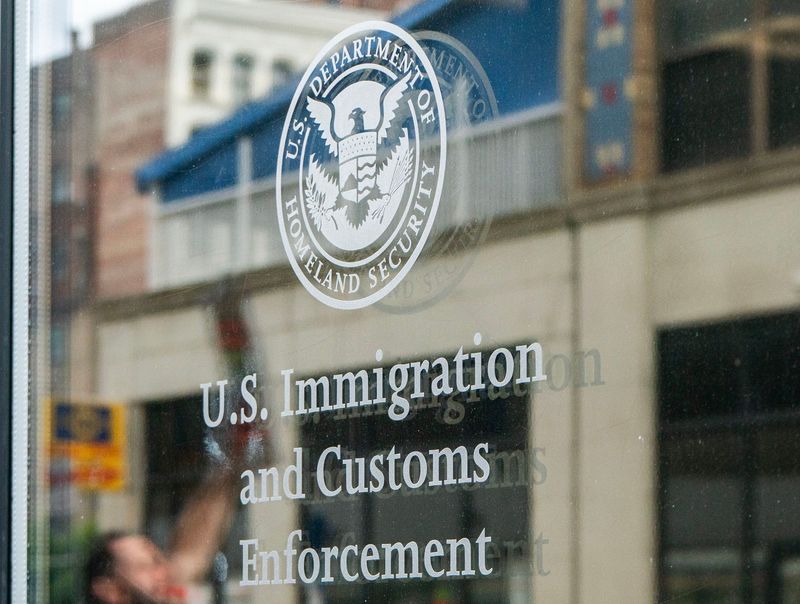
A recent change to Michigan court rules restricting civil arrests at courthouses — such as those tied to immigration status — is being hailed by rights advocates for adding protections amid President Donald Trump’s deportation campaign.
But opponents call the change a “false assurance” to immigrants that could put local law enforcement in legal jeopardy.

The Michigan Supreme Court ordered that as of May 1, subpoenaed witnesses, attorneys, jurors and those otherwise involved in legal proceedings cannot be arrested for a civil matter while on their way to, at, or leaving tasks at courthouses. That includes filing documents or going to mediations, custody evaluations or settlement conferences.
Most arrests in recent years by U.S. Immigration and Customs Enforcement’s Enforcement and Removal Operations were civil immigration arrests, according to several annual agency reports through fiscal year 2024. Such arrests can rely on civil or administrative warrants that are not signed by a judge, but don’t always require it.
Advocates say they face daily questions from immigrants, not just from those in the country without documentation, about whether it is safe for them to go to court, said Susan Reed, director of the Michigan Immigrant Rights Center, which called for the rule change. Those weighing whether to seek a personal protection order or anxious about testifying as a witness to a crime have had limited information on courthouse arrest policies.
“This is more information about the way that the highest court in the state of Michigan regards them as full and equal participants in the activities happening in the courts,” she said.
U.S. Immigration and Customs Enforcement, in an emailed statement attributed to an unnamed spokesperson, responded to the rule change, saying its “officers continue to risk their lives to apprehend dangerous criminals and uphold federal law.”
“Policies that limit cooperation with ICE may result in the release of individuals convicted of serious crimes back into the community, which can undermine public safety,” the statement from the Midwest branch of the department reads.
Less than 14% of nearly 400,000 immigrants arrested by ICE from Jan. 21, 2025, to Jan. 31, 2026, were charged with or convicted of violent offenses, according to a report from CBS News.
The ICE statement also mentioned the Supremacy Clause, which establishes that the Constitution and federal laws supersede state laws.
“While some local jurisdictions consider policies that restrict cooperation with federal immigration enforcement, ICE remains committed to its Congressionally mandated mission,” the ICE statement reads.
A Customs and Border Protection representative deferred comment to ICE.
Columbia Law School professor Jessica Bulman-Pozen told the Free Press that Congress must have clearly spoken on a topic in order for a state law to conflict, and did not do so on state courthouse arrests.
And a federal ruling in late 2025 against the Trump administration found a New York state law prohibiting such civil arrests in state or local courthouses was not unconstitutional.
Michigan justice calls immigration-related rule change ‘ill-advised’
Concurring with the 6-1 decision, Justice Noah Hood wrote the court rule change does not prevent criminal arrests, arrests based on warrants signed by judges, or detainers. (A detainer is when immigration agents can request another law enforcement agency delay release of an immigrant in their custody.) It also doesn’t prevent the state Legislature from weighing in.
“Put simply, our courts are service providers,” Hood wrote. “That service only works if the people seeking to use it can actually access it free from undue harassment or interference.”
To not act would be a failure of duty to “fairly and efficiently administer justice,” he said.
Dissenting, Justice Brian Zahra called the amendment “unnecessary and ill-advised.” He called it a “false assurance” that court-goers, like immigrants, wouldn’t be arrested by federal agents as they leave a courthouse, and said it was “at best a political statement framed as a solution in search of a problem.”
The rule change largely stems from a statute already on the books in Michigan but provides definitions of civil arrests and places people are required to attend.
The statute itself makes it a contempt of court to conduct any civil arrest on someone on their way to, from or at a place they are required to attend. It also makes such an arrest void.
“But state courts have no authority to void a federal arrest,” Zahra wrote.
What if ICE ignores Michigan court rule?
Zahra also wrote that the rule puts in legal jeopardy deputies providing courthouse security, should they have to contend with enforcing the rule against an ICE agent.
That’s a concern the Michigan Sheriffs’ Association raised before and after the rule’s adoption. Zahra wrote that there is no reason to believe the Department of Justice wouldn’t pursue an obstruction case against judges or law enforcement who sought to stop federal agents.
Reed, of the immigrant rights center, conceded there is a question of whether ICE ignores the rule.
“That’s a question that might have to be answered one day, but it’s not a reason for the court to fail to act to administer justice and promote participation,” Reed said.
The idea that federal agents would ignore the rule and push their way past court personnel to make a civil arrest would be a “fairly aggressive escalation,” said Harrison Stark, senior counsel at the State Democracy Research Initiative at the University of Wisconsin Law School. The initiative is a nonpartisan project focused on democracy, government institutions and constitutions at the state level.
The idea that a state might send law enforcement to arrest a federal agent for a violation would be, too.
State rules and policies like this are primarily meant to be a deterrence. Additionally, they could provide a basis for a lawsuit; though federal officers have many protections, they don’t have blanket immunity, said Stark.
That said, such policies alone would be unlikely to get an arrested person released from federal custody, Stark said.
The Michigan court rule change is in line with a wider trend of states and local governments responding to changes by immigration enforcement agencies, Stark said.
“These policies pose really thorny questions about the intersection of state and federal power,” Stark said. They also “play out in real time.”
Reporter Darcie Moran can be reached at dmoran@freepress.com.
This article originally appeared on Detroit Free Press: Can ICE make arrests at courthouses? Michigan’s top court weighs in
Reporting by Darcie Moran, Detroit Free Press / Detroit Free Press
USA TODAY Network via Reuters Connect