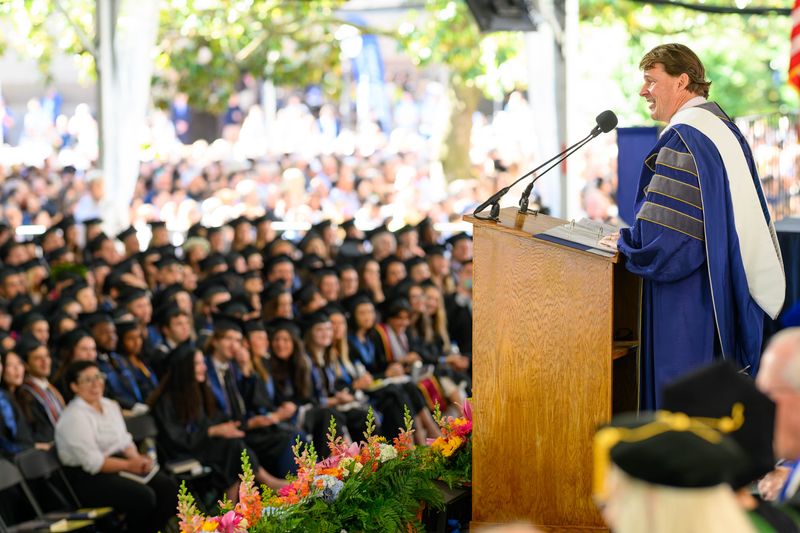
Ford Motor Co. CEO Jim Farley called himself a “problem-solving junkie,” citing it as one of the reasons he pursued a career in the auto industry — first joining Toyota in 1990, then Ford in 2007 in the midst of the Great Recession, because “I wanted to help solve big, hairy American problems.”
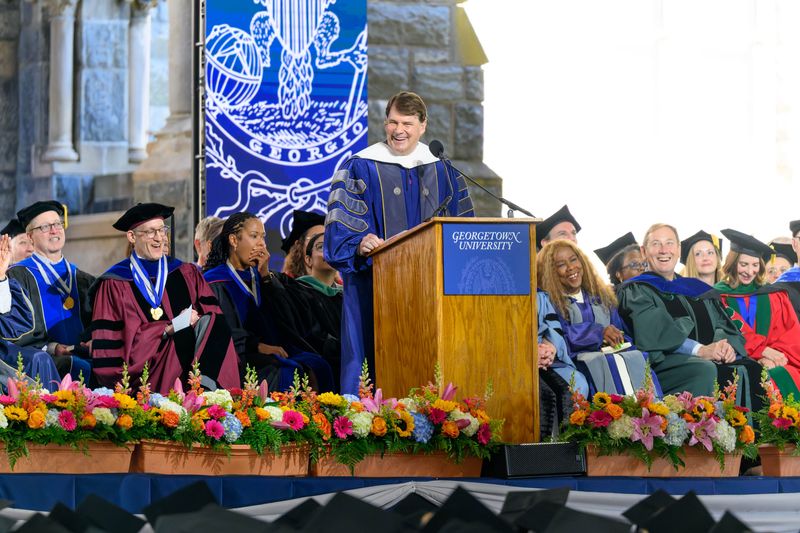
Farley made the comments to about 800 graduates May 16 at the 2026 College of Arts & Sciences Commencement ceremony at his alma mater, Georgetown University in Washington, D.C.

During the ceremony, the university gave Farley an honorary Doctorate of Human Letters degree.
Auto exec also shared personal stories from his time as a student at Georgetown, about the profound lessons he learned from noted professors there and by studying St. Ignatius of Loyola, the founder of the Jesuit order of the Catholic faith.
“What you have learned here is the first down payment on a framework of how to approach the world,” Farley said in the speech that Ford shared with the Detroit Free Press. “You will face hardship and thorny obstacles in your life, but these are opportunities and Georgetown (have) given you the tools to seize them.”
Farley said he relies on a problem-solving formula he learned at Georgetown to this day to run Ford.
He also said he considers the valuable lessons learned from Jan Karski, who taught Farley to embrace problems as an opportunity. Karski is a war hero who served in the underground Polish resistance against Nazi Germany during World War II. He taught international relations at Georgetown for more than 40 years and died in 2000. Karski was posthumously awarded the Presidential Medal of Freedom in 2012.
“I would never claim to have faced down the problems that Jan Karski did. But I learned a great deal from him about how to approach life,” Farley said in his speech. “It turns out that I have always loved problem solving — the nastier, tricker, the more complex the better. Maybe that’s why I have always loved the Jesuit order and Jan Karski. This is why I was so lucky to go to Georgetown.”
‘A strange freshman’
Farley told the Detroit Free Press on May 17 that he is grateful for his time at Georgetown because his ties to the school go deep — both his father and sister are alumni as well.
“My studies were a catalyst for the rest of my life, including meeting friends with common values,” Farley said in an email to the Free Press. “It wasn’t long ago I was in the audience wondering what life would be like, how I would make my way. So, it was so energizing to see bright and motivated young people embracing their faith and the liberal arts.”
Farley’s father, James D. Farley, earned a degree from the School of Foreign Service there in 1950. Farley, who graduated in 1985 with a degree in economics, met his wife, Cornelia “Lia” Connor-Farley at Georgetown. Farley’s father and Lia’s father, Joe Connor Jr., both served on the Board of Georgetown together, Farley said.
Farley said he keeps in touch with his friends from Georgetown, which he referred to as “my crew,” to this day, noting they celebrated their 40th reunion together in 2025.
“While we traded Old Milwaukee and Tab for wine and flavored water, we were still dancing to Madonna and the Clash like we did at the old pub,” Farley told the crowd.
But his crew knew how to get under Farley’s skin. He told a humorous story about how they almost got him in trouble back in the day and the usual way he solved the problem.
“I had taken four years of intense Latin in high school. So when I was a freshman, I convinced my Latin professor to let me skip the classes and just come back for the midterm and final,” Farley said. “He gave me a spot test, nodded, and told me, ‘Don’t worry about attending class everyday.’ “
But a couple months later, Farley said he received a concerning letter from what appeared to be the Provost’s Office demanding he come for an academic hearing to consider his expulsion from Georgetown for not attending class regularly.
“I wrote a lengthy letter to the professor challenging his personal integrity and I slipped it under his office door,” Farley said.
Soon, however, he learned the hearing was a prank by his friends. He was relieved that the threat was not real, until he remembered the letter he wrote that was awaiting the professor.
“As much as I tried and tried, I could not fish that stupid letter out from under his office door with a bent hanger!” Farley said. “When he came to his office on Monday morning, there I was, leaned up against his door, sleeping. I quickly snatched it from his office floor and scurried off. He must have thought I was a very strange freshman!”
A formula for problem solving
In his junior year, Farley studied under Karski, who Farley said “embodied the long inheritance of courage and problem solving that is at the heart of Georgetown.”
“And this is my advice to you: Learn to love solving problems,” Farley said. “Seize the opportunity to fall in love with it. The fulfillment it will give you and how it will enable you to serve the people around you.”
He then cited St. Ignatius’ framework for solving problems, which said he’s leaned on many times in his life:
As an example, Farley said his father was a banker. So for one summer, Farley worked at a finance firm in mergers and acquisitions, following in his father’s footsteps.
“I was miserable,” Farley said. “The work was tedious and had little meaning for me. As I approached graduation, I knew something needed to change.”
He relied on the St. Ignatius formula. First, he identified the problem, which was he was “bored out of my mind.” Next, he prayed for guidance to find work that was challenging and meaningful to him. Finally, he made a decision.
“I decided to join Toyota — a much smaller company in those years. Why Toyota? I thought the problem-solving at Toyota would be more rewarding,” Farley said. “My job was to help start a little brand called Lexus — a totally new company — which was a rare opportunity back then.”
Solving an American problem
Farley said even during a long, successful career at Toyota, he kept thinking about St. Ignatius and asking himself, “Are there bigger, harder problems to solve?”
He considered his grandfather, Emmet Tracy, who started work at Ford’s Highland Park Plant in 1913 as employee No. 389. Farley keeps his grandfather’s picture and badge on his desk. So in 2007, when Ford’s then-CEO Alan Mulally tapped him to head up Ford’s marketing, Farley said yes.
“I joined Ford because I am an American, and because I wanted to help solve big, hairy American problems,” Farley said. “Let me tell you, there is nothing that will put your problem solving skills to the test like a full-blown crisis and nothing that will provide a greater opportunity to serve others if you rise to the occasion.”
The economy was in shambles back then, Ford had crippling debt and new vehicles were not selling.
“Our stock was down to a dollar and change,” Farley said. “Millions of Americans were depending on us.”
Farley credited Executive Chair Bill Ford for helping the automaker avoid bankruptcy, a fate General Motors and then Daimler-Chrysler could not escape. He noted how the Ford family even put up the Ford Blue Oval logo as collateral to borrow money.
“Imagine a family doing that after 110 years!” Farley said.
Ford made it through the recession by cutting billions in costs, working with the unions and work to improve quality — an effort that continues today as Ford once again leads the industry in recalls.
“I relied on God, St. Ignatius, and especially Lia as my rock. It all came back to problem solving,” Farley said. “The older I’ve gotten, the more I want to solve the big problems facing our country. Right now I want to revitalize the skilled trades — the plumbers and electricians and workers who make our lives possible but don’t get the respect, attention, or training they need or deserve.”
Helping autos and homeless people
For his work in the auto industry and his work to help people experiencing homelessness, the university gave Farley an honorary Doctorate of Human Letters degree.
As the Detroit Free Press reported in December, Farley has volunteered with the Pope Francis Center — both the day center on St. Antoine Street in downtown Detroit where hot meals are served and the Bridge Housing Center also in Detroit — for decades.
“Today, Georgetown University honors a man whose life and work embody the hopes we hold for our graduates on this commencement morning,” said Sherry Linkon, a professor in the Department of English during the ceremony. “He lives with purpose, turning a love for cars into a vocation. He embraces lifelong learning to engage globally and adapt to a changing world.”
Farley’s parting words for graduates was that they will face a lot of problems in life, but to view those problems as opportunities, not obstacles.
“If you love solving problems, the bigger and nastier they are, the more fulfilled you will be. That’s why a lot of us are at Ford — we feel like our work makes society stronger, and makes America stronger,” Farley said. “God bless all of you, Georgetown, the Jesuits and St Ignatius, my freshman Latin teacher, and Jan Karski. God Bless America!”
Jamie L. LaReau is the senior autos writer who covers Ford Motor Co. for the Detroit Free Press. Contact Jamie at jlareau@freepress.com. Follow her on Twitter @jlareauan. To sign up for our autos newsletter. Become a subscriber.
This article originally appeared on Detroit Free Press: In Georgetown address, Ford’s Jim Farley shares campus stories, advice
Reporting by Jamie L. LaReau, Detroit Free Press / Detroit Free Press
USA TODAY Network via Reuters Connect