This year, it’s all about defending our right to vote, by any means necessary. Period. All other issues begin at a distant second place, then fade in importance from there.
The recent decision by the U.S. Supreme Court to finish off the Voting Rights Act stands as a flaming exclamation point to that message. The court ruled 6-3 to significantly narrow a key provision of the 1965 law, that will likely have the effect of eliminating many, if not all, Black representatives from majority Black districts in southern states.

It’s very hard to swim upstream against a waterfall.
And when it comes to the Democrats, we need to stay laser-focused on the goal of putting the brakes on Trump and Trumpism. We can’t just vote, we need to vote accordingly, and in overwhelming numbers.
For Democrats in 2026 (and again in 2028, assuming we make it that far), that means no matter how difficult and nearly impossible it may seem, we need to put our divisions aside and maximize all our efforts behind protecting the vote. And once – if – we’re successful doing that, we need to recognize where the real threat lies, and then use our votes accordingly. Because otherwise we will all be on the same side whether we want to be or not: the losing side.
Again.
Democrats can’t afford another protest-vote mistake
Some of you may remember two years ago when then-Vice President Kamala Harris was running as the Democratic candidate for president against Trump.
This was after then-President Joe Biden was strongly urged to step aside from his candidacy, because too many Democrats were fretful he couldn’t beat Trump because he was too old, too infirm, too whatever.
So Biden handed the baton to Harris, who – once again – not enough Democrats thought was the perfect candidate for the job. Too Black, not Black enough, too female, laughed too funny. Whatever.
But here in Michigan, especially in Wayne County, perhaps the biggest mark against her came from many voters in the Arab community who were highly upset that she wasn’t considered pro-Palestinian enough in regards to the horrific conflict taking place in Gaza.
Many believed – and still believe ‒ that what Israel was doing to the Palestinian people was an atrocity. For the record, I agreed with them then, and I still agree, because I don’t see how it can be characterized any other way.
But where I part ways with certain members of the pro-Palestinian group is with those who openly promoted and advocated for the position that no one should vote for Kamala because she wasn’t pro-Palestinian enough.
So I’ll be as careful here as I can, because I know I’m probably tap dancing on eggshells. Withholding votes from Kamala Harris was the equivalent of voting for Trump, and where we are with Trump today is exactly where not just Harris but many others predicted we would be, with plenty of evidence to back up that prediction.
Not only was Trump never a supporter of the Palestinians in any way shape or form, but he was openly supportive of Israel’s Prime Minister Benjamin Netanyahu’s anti-Palestinian stance, and opposed to any form of immigration that would allow Palestinians or any other brown-skinned people the ability to immigrate to America.
In fact, Trump made it clear that he wanted to get those brown-skinned Muslim types (or brown-skinned and non-Muslim) out of this country just as quickly as possible – legally or not.
I want to be clear that I can’t possibly know or understand what it’s like to have family members in a war zone, being forced to endure unimaginable amounts of trauma, like what’s happening in Gaza.
I can understand the compulsion to be radically vocal about the need to bring attention to that situation and to bring it to a halt. But I think where we all find ourselves today – all of us – which is with a president who is gleefully tearing down this country with all deliberate speed, suggests that maybe the 2024 presidential election wasn’t the best time to stay home.
That was a tragic miscalculation made not just by some members of the Arab community, but by too many other voters as well, including African Americans (particularly males). We came out, but not in the numbers we needed to, with more than double the number of Black people inexplicably supporting Trump in 2024 at 15% vs. 8% in 2020. As for white women, statistics show that the majority of them voted for Trump for the second time at 51%, although that was several percentage points less than previously.
Michigan’s Senate race exposes a dangerous Democratic rift
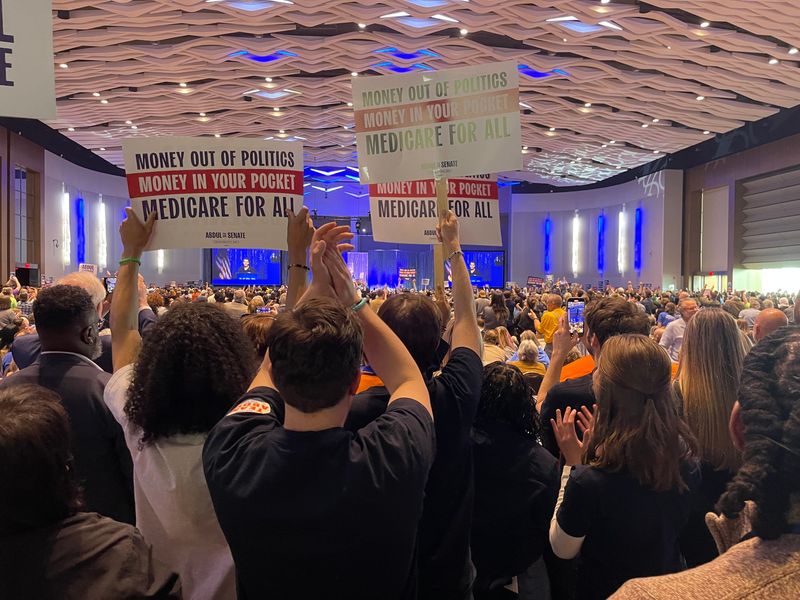
In mid-April, when the Michigan Democratic Convention came to town, another fracture became apparent: the widening rift between the progressives and what some refer to as more establishment (or corporate) Democrats.
That rift was laid bare when Rep. Haley Stevens, one of three candidates for the U.S. Senate seat currently occupied by retiring U.S. Sen. Gary Peters, was booed when she attempted to speak.
Many of those who booed were, reportedly, supporters of Senate candidate Abdul El-Sayed, who has made a point of not only refusing any support from AIPAC, but has openly challenged their pro-Israel stance concerning the situation in Gaza.
Stevens has been backed by AIPAC. State Sen. Mallory McMorrow, the third Democratic Senate candidate, has also refused AIPAC support, calling them a “far right, pro-Netanyahu organization.” She was not booed, but still did not receive the strong level of applause enjoyed by El-Sayed.
Soon thereafter, this rift was criticized less as being between progressives and not-so progressives, but between those who were antisemitic and those who were better-behaved, more acceptable Democrats.
Without question, antisemitism cannot be tolerated anywhere for any reason. It’s not complicated, and I haven’t seen any evidence that’s the kind of support El-Sayed wants or encourages. Similarly, El-Sayed’s supporters should not be labeled as antisemitic just because they oppose AIPAC.
But Democrats have to get past these divisions. Because protecting our votes and our democracy is too important to get hung up on our differences, even when they seem vast.
Voting rights are the fight that decides every other fight
In a nutshell, that was the message I got from this year’s NAACP Freedom Fund Dinner, which featured House Minority Leader Rep. Hakeem Jeffries as keynote speaker and New York Attorney General Letitia “Tish” James as the Ida B. Wells Freedom and Justice Awardee. Detroit Branch NAACP President Wendell Anthony referred to James as “a bad sister,” and for good reason. If you know, you know. If you don’t, you owe it to yourself to find out.
In her brief but powerful remarks, James, who received a loud and enthusiastic round of applause from attendees, made a point of praising Michigan Attorney General Dana Nessel several times for her refusal to comply with the Trump Department of Justice’s outrageous demand for Wayne County to turn over voter ballots from the 2024 election, risking effectively – and illegally – handing the voting process over to him.
From Nessel’s website:
“Michigan Attorney General Dana Nessel has joined a coalition of 23 attorneys general, along with the Governor of Pennsylvania, in filing a motion for summary judgment (PDF) in their ongoing challenge to President Trump’s executive order that unlawfully attempts to interfere with States’ constitutional authority to administer elections by restricting voter eligibility and mail voting to lists of voters pre-authorized by the federal government. The power to regulate elections belongs primarily to the States.
“The President has no constitutional authority to make or alter laws governing federal elections. Earlier this month, Attorney General Nessel joined the same coalition in bringing a lawsuit against the administration, arguing that Executive Order No. 14399, entitled Ensuring Citizenship Verification and Integrity in Federal Elections, is unconstitutional and beyond the authority of the President and other federal officials.”
Urging everyone in listening range not simply to pay attention but to engage and take action, both James and Jeffries made it clear that now is not the time to be silent or to play observer on the sidelines while someone else takes up the fight on your behalf. If you vote, then you have skin in this game, and if you are eligible to vote but choose not to vote then you need to make better choices.
Use it or lose it. But if you don’t fight for it, then you won’t even have anything to lose.
Free Press contributing columnist Keith A. Owens is a local writer and co-founder of Detroit Stories Quarterly and the We Are Speaking Substack newsletter and podcast. Submit a letter to the editor at freep.com/letters, and we may publish it online and in print.
This article originally appeared on Detroit Free Press: As SCOTUS guts voting rights, Democrats can’t afford division | Opinion
Reporting by Keith A. Owens, Contributing columnist / Detroit Free Press
USA TODAY Network via Reuters Connect