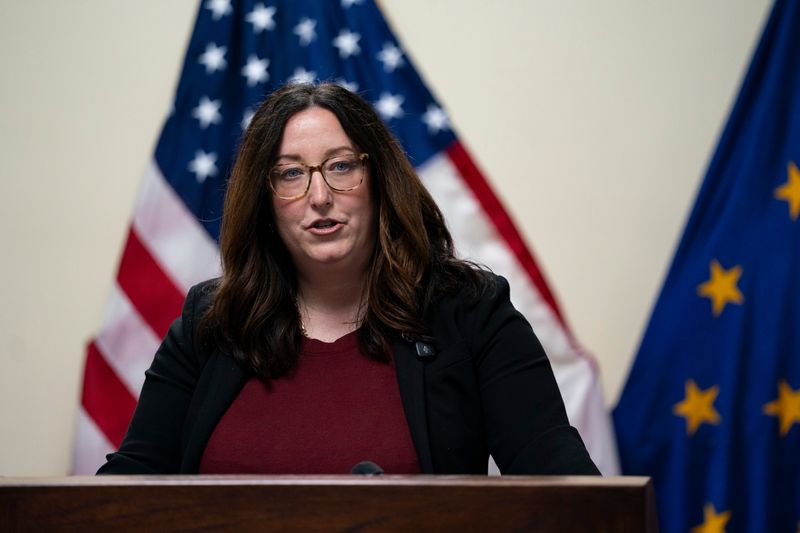
EVANSVILLE — Vanderburgh County Prosecutor Diana Moers this month offered a fuller picture of how her office plans to confront a rise in domestic violence cases, outlining details of a new unit dedicated to prosecuting the repeat offenders and complex cases that have increasingly strained a staff that, until now, amounted to a single dedicated prosecutor and one victim advocate.
The plans make use of a $500,000 federal grant awarded to the office in April through the U.S. Department of Justice’s Office on Violence Against Women. Speaking at a news conference, Moers said $35,000 of that funding will go toward training for prosecutors and law enforcement partners, while the remainder will fund the hiring of a new deputy prosecutor and a victim advocate assigned exclusively to domestic violence, sexual assault, dating violence and stalking cases.

For the investigators, prosecutors and advocates victims turn to for justice, the boost in resources couldn’t come soon enough.
Between 2023 and 2024, the number of domestic violence cases in the county rose from 1,294 to 1,401. Continuing a worrying trend, prosecutors handled approximately 1,500 such cases last year.
Sexual assault cases, including sexual battery and rape, climbed sharply in recent years from 31 cases in 2023 to 41 in 2024 and 54 in 2025. Stalking cases rose 60% during the same time period.
“The total volume of cases involving domestic violence, sex assault and stalking is increasing drastically,” Moers said. “At the same time, however, the number of personnel at the Vanderburgh County Prosecutor’s Office who are dedicated specifically toward these cases remain static due to limited funding.”
A deluge of cases but not enough resources
Aside from Moers and her chief deputy, Vanderburgh County employs 22 prosecutors to try cases ranging from misdemeanors to homicides. Under the existing framework, a single dedicated prosecutor — herself funded by a separate federal Violence Against Women Act grant — handled roughly 300 domestic violence cases annually. The rest fell to prosecutors also juggling other types of cases.
Moers said the new unit will house a second dedicated prosecutor, effectively doubling the hours her office can exclusively devote to domestic violence, sexual assault and stalking cases, which can often necessitate resource-intensive, complex jury trials. The unit will prioritize strangulation cases and others requiring specialized expertise, Moers said, in part because they demand additional jury education, but also to intervene effectively in domestic violence cases before they escalate — potentially with deadly consequences.
“Strangulation cases involve specialized expertise, they are an indicator of lethality,” Moers said. “If someone strangles you, in particular, that’s an indication that they are trying to kill you.”
That there is a renewed need for such a focus reflects what advocates say is a troubling trend. Kristin Cordts, the executive director of Holly’s House — an Evansville child and victim advocacy center — said the potential for violent escalation is real and too often goes ignored.
“There’s a lot more violence, there’s a lot more strangulation in the cases that we’re seeing,” Cordts said in an interview Friday. “And so that should be disturbing for every member of the community.”
Chief Deputy Prosecutor Winston Lin said Vanderburgh County recorded 245 strangulation cases in 2025 alone. Moers pointed to data from the Indiana Domestic Violence Fatality Review Team showing that domestic violence-related deaths in Indiana increased 180% in the first year of the COVID-19 pandemic compared to the five-year average prior to 2020, with 72% of those fatalities involving firearms.
In 2024, the most recent year for which the Indiana Coalition Against Domestic Violence has published data, the state recorded 83 fatalities linked to domestic violence across 22 counties, including Vanderburgh.
Addressing domestic violence will take multifaceted approach, advocates say
The potential for escalation is only part of the challenge prosecutors face. The sheer volume of cases has long outmatched the local resources devoted to addressing domestic and sexual violence, Cordts said, a gap that has real consequences for getting defendants before a judge or jury.
“These are not easy cases to work with,” Cordts said. “In order to pursue a criminal case, we in every level of the justice system have to provide additional support to [victims].”
By the time abuse results in attention from law enforcement, victims have often spent years isolated from family and friends, stripped of financial independence and wholly dependent on the person who hurt them. That dynamic, Cordts said, makes participation in the legal process — and particularly providing witness testimony — deeply difficult.
“The victims are in an incredibly vulnerable state,” she said. “It’s very hard for them to participate in the court system.”
Because juries typically want to hear directly from victims, that vulnerability has a direct bearing on whether prosecutors can secure convictions. A victim who lacks stable housing, income or psychological support may be unable or unwilling to take the stand — and without that testimony, Cordts said, cases that should result in accountability often do not.
“If we cannot pursue justice because the victim is not able or healthy enough,” she said, “then we really haven’t done any justice for the community either.”
Moers said the grant will address that problem by pairing the new prosecutor with a victim advocate trained to shepherd victims through the process from the earliest stages of a case through trial.
The office also plans to direct the unit toward trying repeat offenders, utilizing Indiana’s sentencing enhancements for habitual criminals and for defendants who use firearms. A 2017 study by the Indiana Criminal Justice Institute found that nearly 60% of domestic violence offenders in Indiana reoffended after conviction, and that the average offender had approximately five prior arrests.
“Holding offenders accountable through prosecution is essential to ending the cycle of violence,” Moers said Friday.
Added resources come amid financial strain elsewhere
The announcement arrives as the federal funding infrastructure underpinning victim services nationwide faces significant strain. The federal Victims of Crime Act (VOCA), a program that redistributes dollars from fines and penalties to states to fund victim services, has seen its national funding decline an estimated 50% to 70% since 2018 even as advocates call on Congress to shore up the program’s finances.
According to Cordts, Indiana organizations have been told to expect cuts of at least 40% in VOCA funds as soon as October. Congress has passed stabilization legislation in the House, but the Senate has not yet acted.
And VOCA’s funding instability comes at a time when the Trump administration is downsizing Department of Justice grants and programs, including victim support services.
In April 2025, the DOJ slashed more than $500 million in grants to hundreds of organizations, including $72 million initially allocated to programs supporting survivors of crime, according to a tally by the Brennan Center for Justice.
The Trump administration restored a fraction of the funds after public outcry, but advocates argued the cuts damaged an important safety net for victims at a time when VOCA funding was already in decline.
Data collected by the National Network to End Domestic Violence illustrates the on-the-ground impact federal and state-funded programs can have when victims seek help — and the pitfalls of a cash-strapped system: On a single day in September 2024, Indiana domestic violence programs served 1,848 people but still turned away 123 requests for help due to a lack of resources.
Cordts said the addition of even one or two prosecutors and victim advocates in a place like Vanderburgh County can make a real difference.
“This is the way that we need to move,” she said. “We’re only going to be able to protect the city in a better way.”
If you or someone you know may be in need of assistance, you can contact Holly’s House at hollyshouse.org, the national RAINN hotline at 1-800-656-4673, or the Indiana Coalition Against Domestic Violence’s 24-hour hotline at 1-800-332-7385.
Houston may be contacted at houston.harwood@courierpress.com
This article originally appeared on Evansville Courier & Press: Vanderburgh prosecutors vow to take on rise in domestic violence
Reporting by Houston Harwood, Evansville Courier & Press / Evansville Courier & Press
USA TODAY Network via Reuters Connect