At the top of the 62 recommendations list in the South Bend Reparatory Justice Commission’s report is seemingly the simplest of actions.

An apology.
Specifically, the commission’s recommendation says the the city “should formally acknowledge and apologize for a long history of racial discrimination.”
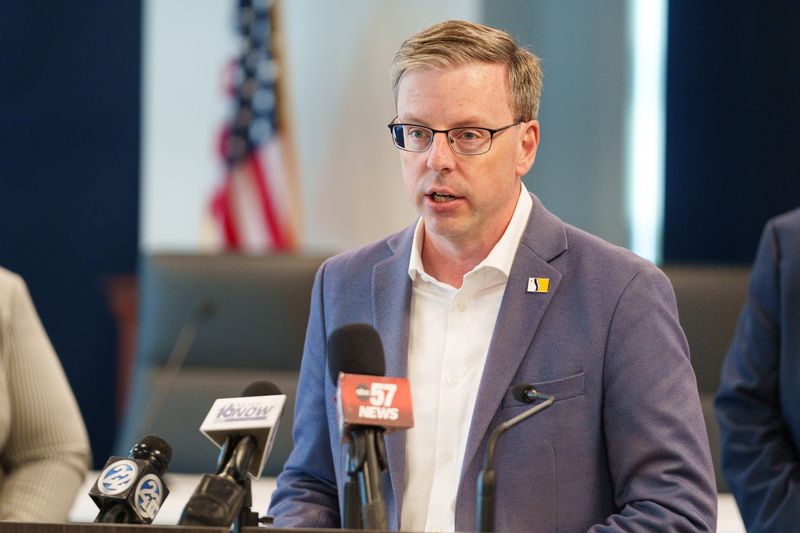
It’s understandable that some may approach the apology issued earlier this month by Mayor James Mueller ― for “a history of racial discrimination in South Bend in housing, in employment, in education, in health [and] in the basic fairness of services” ― with a healthy degree of skepticism.
After all, LaSalle Park residents have experienced decades of neglect and empty promises from city officials. In the face of all of that, how much do words matter?
Not at all, if those words aren’t backed up with action.
But if the apology is part of a sincere commitment to righting wrongs, it’s an important start.
The commission’s report lists an apology at the beginning of its recommendations for a reason. And we suspect that’s because an apology represents a long overdue public acknowledgment and a taking of accountability for the harms inflicted on the historically African American community. These harms were no secret. Indeed, as we noted in an earlier comment, for longtime South Bend residents, the commission’s report was confirming, not shocking.
For that reason, we see the apology as a positive, necessary step in the journey toward addressing wrongs and making the needs of this neighborhood a priority.
South Bend is hardly the first city to apologize for racial discrimination. For example, in 2023, Cincinnati city leaders apologized for the dismantling of one of Cincinnati’s historically Black neighborhoods for the sake of a highway, calling it racist and acknowledging that it created long-term damage to the Black community that endures today.
Helping to spur the apology was a documentary, “America’s Truth: Cincinnati,” produced by George Washington University Assistant Professor Wendy Ellis. Ellis was invited to Cincinnati’s apology proclamation and has said that she wouldn’t have been there if she felt the apology was a one-time performance.
“The apology is certainly monumental, but it’s what comes next,” she said.
She’s right. And so we ― along with other residents of this community ― will be paying extremely close attention to what comes next.
Editorials represent the opinion of the Tribune Editorial Board. Its members are Audience Engagement Editor Alesia I. Redding, Enterprise Editor Cory Havens and Executive Editor Ismail Turay Jr.
This article originally appeared on South Bend Tribune: An apology is a good start. But it’s only a start | Editorial
Reporting by South Bend Tribune / South Bend Tribune
USA TODAY Network via Reuters Connect
By South Bend Tribune | USA TODAY Network