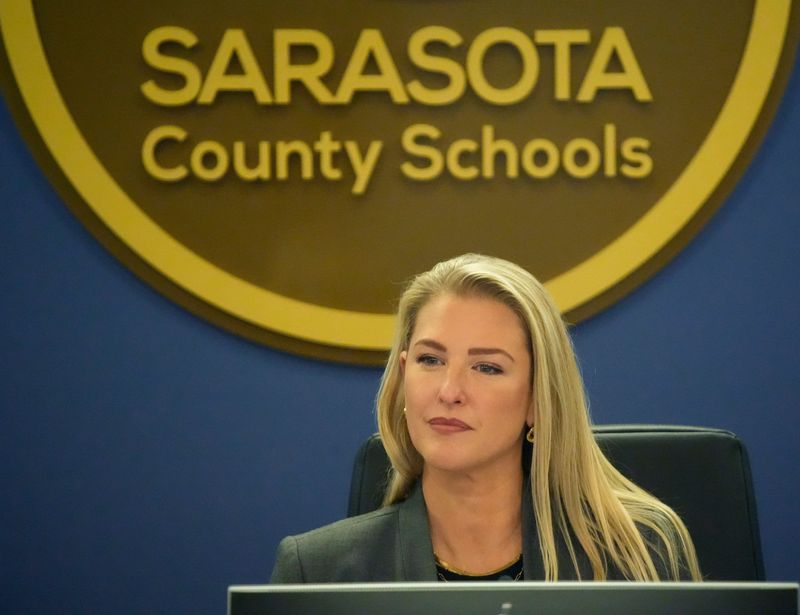
A school board resolution about federal immigration agents might seem like a bureaucratic footnote — a dry exercise in local governance. But when Sarasota School Board Chair Bridget Ziegler introduced a resolution pledging “full cooperation” with U.S. Immigration and Customs Enforcement (ICE), the Sarasota Herald-Tribune recognized it for what it truly was: a lightning rod for the soul of our community.
The resolution, which passed in a narrow 3-2 vote earlier this month does not actually change a single district policy. By the school system’s own admission, administrators were already legally required to comply with lawful warrants. It was, in every technical sense, “symbolic.” So why did the Herald-Tribune devote such significant coverage to it? Why should you, the reader, care about a move that changes nothing on paper?

The answer lies in the power of symbols to shape reality. In a community as diverse and rapidly growing as Sarasota, a “symbolic” move by the school board is never just a gesture; it is a declaration of values.
The Herald-Tribune’s reporting illuminated a fundamental shift in how our local institutions interact with the national political stage. Ziegler proposed the resolution in response to fellow board member Tom Edwards’ participation in a protest following the fatal shooting of Renee Good in Minneapolis. By bringing a national flashpoint into a local boardroom, the resolution transformed a body meant to focus on literacy and bus routes into a proxy for the country’s most polarized debates. When a newspaper covers such an event, it isn’t just reporting on a vote; it is documenting the “nationalization” of our local life.
Beyond the political theater, there is the human cost of the rhetoric — a cost the Herald-Tribune had a duty to expose. For many of our neighbors, the word “ICE” isn’t an abstract political acronym; it is a source of visceral, daily anxiety. Educators and community leaders warned that even if the resolution didn’t change the law, it changed the feeling of the classroom. Fear has a “chilling effect” on enrollment and attendance. When families are afraid to drop their children off at the schoolhouse gates, the educational mission of the district is compromised. Reporting on this ensures that the board’s “symbolic” victory is weighed against the very real atmosphere of fear it creates for students who have nothing to do with federal policy.
Furthermore, the resolution contained a sharp edge: a provision threatening employees, volunteers, and board members with termination or criminal referral if they “interfere” with law enforcement actions. While framed as a reaffirmation of the law, the Herald-Tribune’s coverage highlighted how this language acts as a muzzle. It sends a message to every teacher and staff member: watch your step, watch your words, and remember who is in charge. When the newspaper analyzes the text of a symbolic resolution, it helps the public see the difference between “clarifying the law” and “enforcing conformity.”
Public education is one of the few remaining spaces where we are all supposed to be on the same team. The seven-hour meeting that preceded this vote, featuring hundreds of potential speakers, proved that the community is anything but unified. The Herald-Tribune’s reporting captured that exhaustion and that passion. It reminded us that the school board is the most immediate form of democracy we have.
We live in an era where “symbolic” moves are often used as “political playbooks” to excite a base or distract from local scandals. By giving this resolution the front-page treatment, the Herald-Tribune held a mirror up to Sarasota. It asked us: Is this what we want our schools to be? Are we comfortable with our elected officials using the district to “set the record straight” on national controversies while our classrooms face teacher shortages and enrollment dips?
The resolution may have been symbolic, but the debate it sparked was as real as it gets. The Herald-Tribune wrote about it because symbols matter. They tell us who belongs, who is welcome, and what our priorities are. In Sarasota, we are currently learning that a piece of paper that “changes nothing” can still change everything about how we see one another.
That is a story worth writing, and it is a story worth reading.
Mark J. Rochester
Executive Editor
Sarasota Herald-Tribunemrochester@gannett.com
Mark J. Rochester previously was managing editor of inewsource, a nonprofit investigative newsroom in San Diego. He was twice elected to the national board of directors of Investigative Reporters & Editors Inc. – an international association of journalists dedicated to improving investigative journalism – and served as its vice president.
This article originally appeared on Sarasota Herald-Tribune: Why ‘symbolic’ ICE resolution in Sarasota matters more than you think
Reporting by Mark J. Rochester, Sarasota Herald-Tribune / Sarasota Herald-Tribune
USA TODAY Network via Reuters Connect