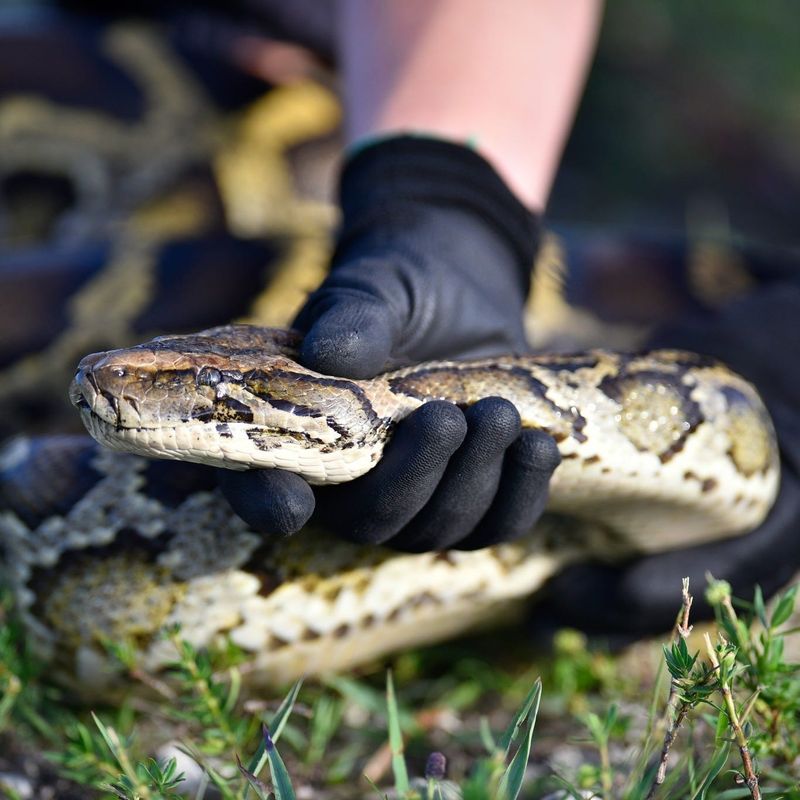
Florida is known nationwide for boasting a myriad of eclectic residents, diverse environments and sometimes intimidating wildlife. But gators aren’t the only massive reptile to look out for in the Sunshine State.
Burmese pythons are one of the Sunshine State’s most invasive species and have been an established predator in the Everglades for decades. The enormous snakes have reduced the Everglades population of raccoons by 99%, opossums by 98% and bobcats by 88%.

But how far north can they be found in Florida? There have been sightings as far north as Nassau County on Florida’s East Coast.
Here’s what to know about Burmese pythons in Florida and a map of sighting numbers by county.
What is the habitat of a python?
Pythons typically live in rainforests near streams, although they have been known to survive in a variety of habitats, such as grasslands, swamps and rocky foothills.
The FWC notes that in Florida, Burmese pythons are often found near or in water due to them being semi-aquatic snakes.
Pythons are more common in South Florida (primarily in and near the Everglades) than anywhere else in the state, but there have been sightings as far north as Nassau and Duval counties.
How far north in Florida have pythons been spotted? See county-by-county map
According to the FWC, Burmese pythons are established from just south of Lake Okeechobee to Key Largo and from western Broward County west to Collier County, including:
According to experts, the number of observed pythons in urban areas is expected to increase over the next five to 10 years. However, residents should not be alarmed, since most snakes will remain in natural areas.
What is the farthest north a python has been located?
On Nov. 9, 2012, a Burmese python was removed on the outskirts of Florida’s northern border, just outside of the Okefenokee National Wildlife Refuge in southeast Georgia.
How far north can pythons survive?
Colder weather limits the range of Burmese pythons.
In their native habitats in India, lower China, the Malay Peninsula and some islands of the East Indies, they need a warm, tropical climate. In their native habitats, pythons are used to temperatures of around 88 degrees in the sun, similar to the climate of South Florida.
But, according to a USGS report on Burmese pythons in Florida, “there is evidence that evolutionary change has already altered parts of the genome responsible for cold tolerance, and there is the potential for behavioral plasticity to enhance cold tolerance.”
“This evidence suggests we may at least expect that pythons can tolerate climatic conditions farther north than where the population is currently established south of Lake Okeechobee,” the report says.
How did pythons come to Florida?
According to past reports, Burmese pythons were introduced to the Sunshine State in the 1970s and 1980s when they were imported for sale as exotic pets.
However, some owners were unable to handle the giant snakes and could not find them new homes, so they illegally released them into the wild.
See photos of the biggest pythons caught in the Florida Python Hunt
When is the 2026 Florida Python Challenge?
The dates have not yet been announced for the 2026 Florida Python Challenge, but it will likely fall in early July. Although it was held in August for years, the 2025 Florida Python Challenge began on July 11 and ended on July 20.
The Florida Python Challenge website posts updates and registration details as they are announced.
How does the Florida Python Challenge work?
The Florida Python Challenge is one of the many efforts the FWC has in place to keep the python population in the state as low as possible. It offers a cash prize to the python hunter who removes the most pythons over a 10-day period.
Although the event is usually held in August, it was held in July in 2025 and included a broader range of hunting grounds to include Everglades National Park as one of eight official competition locations. Last year, the challenge began on Friday, July 11 at 12:01 a.m. and lasted through Sunday, July 20 at 5 p.m.
“The event, hosted by the Florida Fish and Wildlife Conservation Commission (FWC) and the South Florida Water Management District, features an Ultimate Grand Prize of $10,000 for the registered participant who removes the most pythons,” the FWC’s website says.
Throughout the yearly python challenges, more than 1,400 of the invasive snakes have been removed.
More than 900 people from 30 different states and even some from Canada participated in the 2025 Florida Python Challenge last year, removing a record-breaking 294 invasive Burmese Pythons in just 10 days.
Are possums helping track Florida pythons?
Yes. Opossums have been used to help track and eliminate pythons for the last few years. Possums are a key food source for the invasive Burmese pythons, which have reduced the Everglades population of raccoons by 99%, opossums by 98% and bobcats by 88%.
According to a 2023 report from LiveScience, in 2022, researchers discovered a new technique for studying pythons while examining the behaviors of small mammals. After putting GPS collars on possums and raccoons in South Florida, they discovered they could also track the invasive snakes after they swallowed the tagged animals whole.
The effort of tagging these small critters that pythons love to eat was then expanded to help track and euthanize the gigantic snakes.
“We’re not putting these animals out there and in harm’s way,” Crocodile Lake National Wildlife Refuge manager Jeremy Dixon told the South Florida Sun Sentinel on April 19. “Harm’s way is there. We’re just documenting what’s happening.”
What should you do if you see a Burmese python?
The Florida FWC advises that if you have a non-native species, do not release it. If you come across one, report it to the Invasive Species Hotline immediately at 888-Ive-Got1 (888-483-4681), providing an exact location and photos.
Pythons must be humanely killed onsite at the time of capture. Live transport of pythons is not allowed.
The FWC says you can humanely kill Burmese pythons on private land at any time with landowner permission. You don’t need a permit to kill the invasive species.
Here are the basic guidelines from the Fish and Wildlife Commission:
Contributing: Mark H. Bickel, Fort Myers News-Press and Jennifer Borresen, USA TODAY
Lianna Norman and Samantha Neely are trending reporters for the USA TODAY NETWORK-Florida, covering pop culture, lotteries, rocket launches, Florida wildlife, breaking news and more. You can get all of Florida’s best content directly in your inbox each weekday by signing up for the free newsletter, Florida TODAY, at https://floridatoday.com/newsletters.
This article originally appeared on The Daytona Beach News-Journal: Where are Burmese pythons in Florida? They’re moving north
Reporting by Lianna Norman, Samantha Neely and Kim Luciani, USA TODAY NETWORK – Florida / The Daytona Beach News-Journal
USA TODAY Network via Reuters Connect