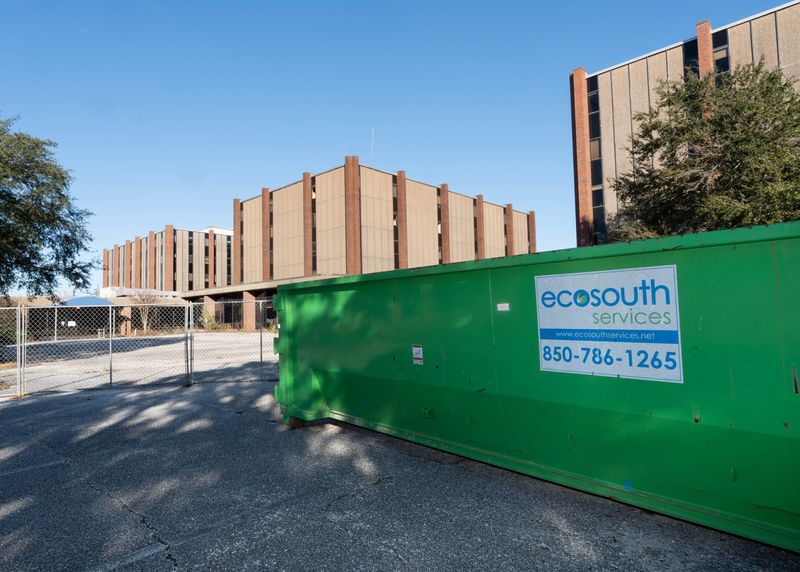
Demolition is underway at the old Baptist Hospital and many of the buildings that were built in the 1950s and 1970s contain hazardous material.
Much of the $16.4 million cost of the demolition is dedicated to meeting environmental regulations to safely tear down the old buildings.

NorthStar Contracting Group won the bid to tear down the hospital for $13.9 million. Included in that bid is environmental consultant Intertek PSI to ensure all environmental regulations are met on the project.
Pensacola also hired Jacobs Solutions as the city’s owner representatives under a $1 million contract that is part of the total $16.4 million cost.
Joshua Wallace, senior project manager for Jacobs, is essentially acting as the city’s eyes and ears on the demolition work.
“So sometimes they hate to see me coming, but hey, that’s what we’re here for,” Wallace told the News Journal in January. “But it’s good. It’s necessary, right? I think with a job like this and with the concerns that we’ve seen in the community, everybody wants to make sure it gets done right.”
Some residents who live near the former hospital property have voiced concern over the impact of the demolition, especially with the high amounts of asbestos in the original building.
Asbestos is the biggest hazardous material concern during demolition. Asbestos fibers cause lung cancer, and the material was widely used in construction in the first half of the 20th century because it is fireproof.
There are two types of asbestos materials, friable and non-friable. Friable asbestos, like ceiling tiles or insulation, can easily be broken apart, releasing the fibers into the air. While non-friable asbestos is usually part of a tougher material, like floor tiles, it would take a tool to break apart, and fewer fibers would be released. Both types have to be removed before demolition can begin.
Wallace said Northstar had to obtain permits from the Florida Department of Environmental Protection to conduct the work and has to follow specific procedures to ensure the asbestos is removed safely.
“We’ll have to clear the buildings before any brick comes down or any demolition starts,” Wallace said.
Wallace said only the main hospital building from 1951 has friable asbestos, while the other towers built in the 1970s have non-friable asbestos.
“We want to make sure it doesn’t get outside the building,” Wallace said. “And so we’ll put the necessary checks in place, make the containment zones, remove the materials from the project, and make sure it goes to a proper landfill where it will be recorded.”
Wallace said crews put up containment zones inside the building with sections of the building sealed off inside a negative air pressure environment so no dust can escape. The air pumps used to create the negative air pressure also have multiple filters to ensure that no hazardous materials leave the containment area through the pumps.
Going into the containment zone in each building will require workers to wear Hazmat suits inside and decontamination showers when exiting. There will also be extensive air monitoring around the hospital while work goes on.
“We’ll be making sure that occurs, so nobody exposes themselves to something they shouldn’t be,” Jacobs said.
Where will the hazardous material be taken?
All of the materials will be taken off the building and sealed in bags before they are removed from the containment zone and transported to the Perdido Landfill, which is permitted to take asbestos, or the Timberlands Landfill in Brewton, Alabama, according to the Northstar’s original bid proposal to Pensacola.
Other hazardous materials and chemicals identified during the demolition process will be transported to Emelle Hazardous Waste Facility in Emelle, Alabama. Northstar’s plan also has a hazardous waste landfill in Bellview, Michigan, identified as a backup if the Alabama landfill is unavailable.
Some hazardous items have material that can be recycled, like batteries or the estimated 44,072 fluorescent light bulbs in the buildings. Northstar will have those transported to a recycling and processing facility in Fort Worth, Texas.
The asbestos will be removed in the northern towers first, before crews go into the original hospital tower on the south end. The northern towers will start to be taken apart while the final asbestos remediation wraps up in the original tower.
How will the building be taken down?
Wallace said there will not be any implosions or wrecking balls to take down the buildings; crews will work from top down, removing the structure piece by piece.
The project has its own website, FormerBaptistDemolition.com, for the public to stay informed and submit questions to the team.
In February, Northstar Contracting Group applied to cut down 33 crape myrtles to essentially create a new road to allow for heavy equipment to be brought in during demolition and trucks to come and go with building debris.
Cliff Collins, associate city administrator for Pensacola, told the News Journal in January that the city wants to keep the community informed about the project as it progresses, including sending out postcards to neighborhoods and face-to-face meetings.
“Our objective is to make sure that we communicate, so hold us accountable to that. That’s our goal, is to make sure we do communicate,” Collins said.
The city held its first town hall on the demolition this month and is planning another one in April when exterior pieces of the hospital will start coming down.
This article originally appeared on Pensacola News Journal: What is Pensacola doing to remove asbestos from old Baptist Hospital?
Reporting by Jim Little, Pensacola News Journal / Pensacola News Journal
USA TODAY Network via Reuters Connect