Three generations of the Hannong family gathered on a West Palm Beach property hidden by a decaying 12-foot fence and a crush of foliage to hear a man talk about a cabin that fell through time in a place once called Mangonia.
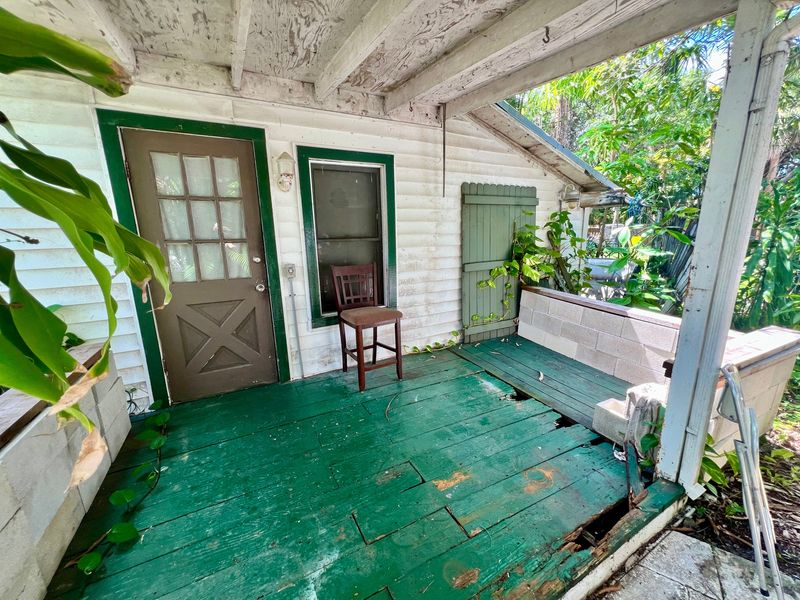
Down a shade-embraced path of moldy pavers, the small home is believed by some in the Northwood Shores community to date to the early pioneer days of the area, possibly as far back as 1893, when Lucretia and Henry Hannong arrived by schooner to the western shore of the Lake Worth Lagoon and established a homestead.

The 2023 death of a previous property owner and subsequent sales left the cabin open to inspection by neighborhood historian and trained city planner Carl Flick. He fears the recent discovery could be lost again, this time forever, as properties near the waterfront are gobbled up by investors keen on profiting from the city’s post-pandemic renaissance.
“It’s hard to get people excited by something so diminutive,” Flick said about the cabin. “But this is a connection to another century.”
Its rickety pine needle green porch is splintered, its west wall is soft with rot and modifications over the decades conceal its true history.
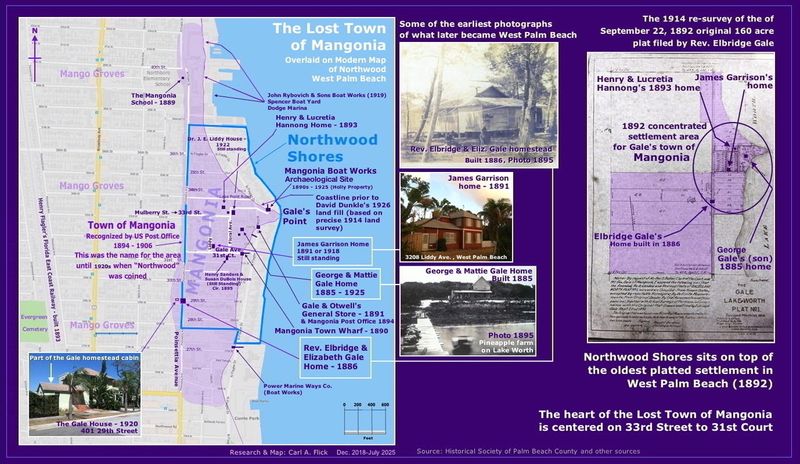
But there are clues to its senescence — uneven crudely cut boards were found under drywall and there are no roofing trusses as seen in more modern construction. The home is angled to catch cool breezes off the Intracoastal Waterway, which was a must before air conditioning. It was built on one of the first lots platted in 1892 by Elbridge Gale, a minister who planted the mango trees that lent the town of Mangonia its name.
“In the past week we were able to ascertain that this was the cabin of your great-great-grandmother when we exposed the floors and walls,” Flick said to members of the Hannong family who came together on a steamy July morning to see the flagging artifact. “Everything we have found supports that.”
Flick, a coil of energy and passionate history buff, had been trying to reach someone from the Hannong family since 2018, when he first saw the home on a 1920 Sanborn Co. map.
His urgency increased after the longtime owner of 233 33rd Street died and the property, which includes the cabin and another house that county records date to 1928, was sold for $1.5 million in September 2024.
As of July 22, the property was listed for sale for $2.1 million on Realtor.com. It was marked “pending,” meaning a sale was imminent or recently closed. No deed had been filed in official county records.
Flick had tried to make Northwood Shores a historic district in 2023. It’s a designation that would offer better protection to the handful of century-old homes in the community. But neighbors voted it down, leaving the aging structures vulnerable to demolition.
The 0.36-acre lot where the cabin sits is one block west of popular North Flagler Drive. A newly built home on the same block is on the market for $6.5 million. A waterfront home across the street on North Flagler is listed for a notable $37.5 million. A home two blocks south is for sale at $4.3 million.
Flick would like to see the cabin moved and used to display the history of Mangonia, which begins to disappear from newspaper stories as a standalone town in the 1920s.
He acknowledges that skepticism about the cabin’s true identity is founded.
But some facts, a little faith, and the intriguing tale of a castaway town may be enough to make a case for saving it, said Rick Gonzalez, a West Palm Beach Architect who visited the cabin and specializes in historic preservation.
“Sometimes you don’t have everything you need to tell a story, so you use what you have to tell it,” Gonzalez said. “It is well worth saving.”
‘We came to a wilderness’: West Palm area’s first settlers
The city of West Palm Beach was founded in 1894 as the first incorporated municipality in what was then Dade County. It evolved beside railroad tycoon Henry Flagler’s crafting of Palm Beach into a bastion of winter leisure and wealth.
But a decade before West Palm Beach was established, Elbridge Gale took a boat south from the St. Johns River to the sparsely populated shores of Lake Worth where Mangonia grew.
The Hannongs, who bought Lot 30 of Plat 1 of the Gale subdivision, helped build Henry Flagler’s Royal Poinciana Hotel in Palm Beach. Henry Hannong was the first custodian at the Palm Beach County Courthouse.
Henry and Lucretia’s son, Robert Hannong, was deputy sheriff of Palm Beach County at one time but drowned near Lantana Beach in 1920. Henry followed six years later, dying at the age of 74.
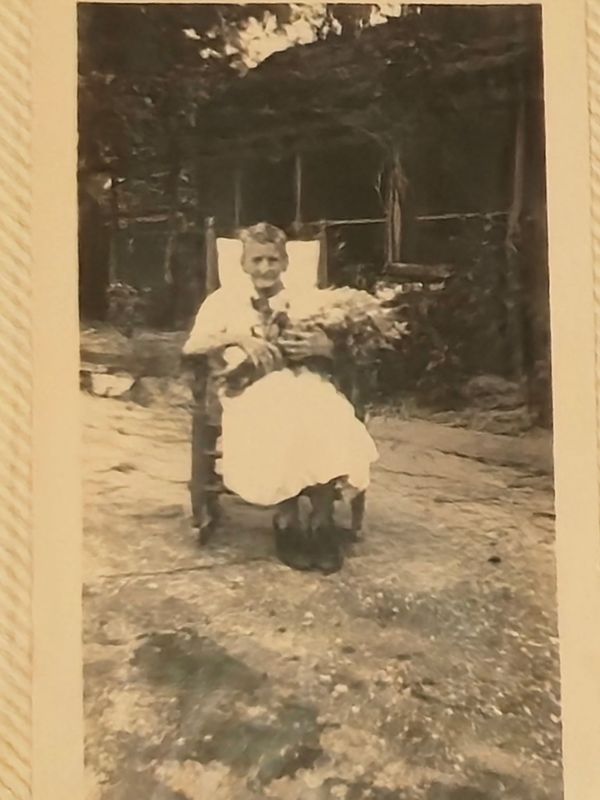
It’s believed Lucretia Hannong was 110 years old when she died in 1951. She was often interviewed for Palm Beach Post stories about the area’s past.
“We came to a wilderness in 1893,” Lucretia Hannong said in a 1945 Palm Beach Post article. “(It was) a wild new land that was inhabited mostly by deer, turkeys, quail, fish and occasionally Seminole Indians on hunting trips.”
The area of Mangonia, which is just north of downtown West Palm Beach, evolved to include the Mangonia school, a general store and the Mangonia Boat Works at Gales Point — a knuckle of land that stuck out into the lagoon until the shoreline was filled in for development.
The cabin that Flick believes is that of Lucretia and Henry Hannong is directly one block west of the boat works site.
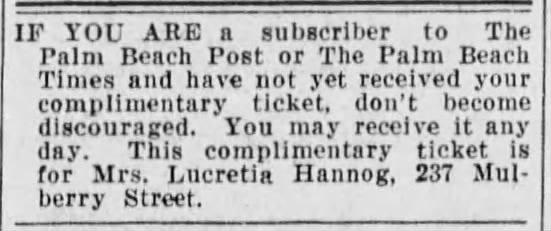
The Hannong’s address was 237 Mulberry St., which is confirmed in a 1936 Palm Beach Post classified listing that announced a complimentary ticket had been won by “Mrs. Lucretia Hannong, 237 Mulberry Street.” The ad does not say what the complimentary ticket was for. At some point Mulberry Street became 33rd Court.
“In 1951 when Lucretia died at 110, her lot was acquired and erased so 237 Mulberry Street went into the history books,” Flick said. “Her living so long, her longevity, probably helped preserve the house.”
Losing West Palm Beach history one home at a time
West Palm Beach has 18 historic districts. They mostly date to the 1920s land boom, which was followed by a second post-World War II population surge in the 1950s. Homes must be at least 50 years old to be considered historic, and 50%, but preferably 80%, of homes in a community must be historic to be considered for historic district status.
Some communities without historic protections have experienced waves of knockdowns and new builds since the pandemic migration bolstered city wealth. That’s happened in the popular community south of Southern Boulevard, nicknamed SoSo, where 1920s-era homes of wood and stucco mix with mid-century concrete block ranch-style houses.
From 2020 through 2024, 106 new homes were built in SoSo east of Dixie Highway, according to Palm Beach County Property Appraiser records. With limited vacant lots, most were likely built on properties where older homes were demolished.
A 1927 Spanish-style home on Murray Road with a stately tower and pecky-cypress ceilings in SoSo was demolished in 2021 after it was bought for $2.2 million by a limited liability company. The West Palm Beach historic preservation planner saw the demolition permit and offered to move the home, but was unsuccessful.
A new 4,300-square-foot house with a pool and a total market value of $8.6 million now sits on the lot.
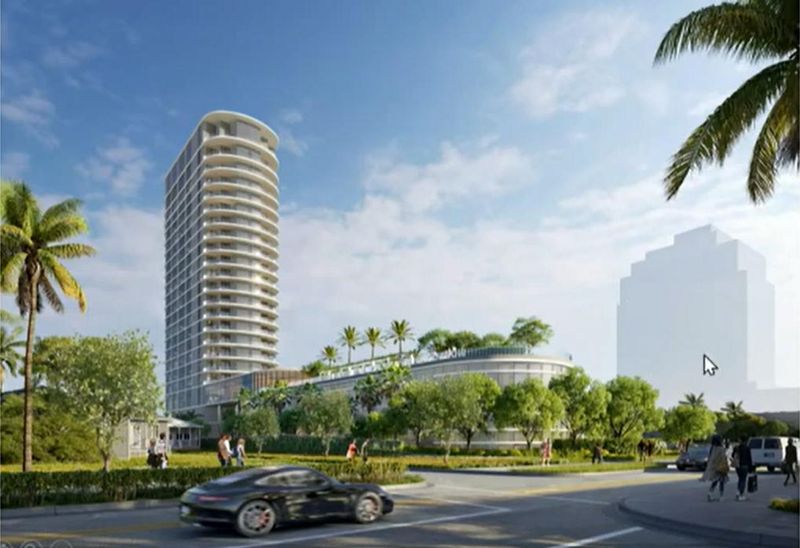
In April, West Palm Beach city commissioners approved the construction of a 21-story condominium on North Flagler Drive called Apogee that will mean the demolition of a 1949 Mediterranean-style estate formerly owned by gadabout Wolfgang Von Falkenburg.
The neighborhood of Sunshine Park, which is north of Belvedere Road and west of Dixie Highway, was so tired of seeing its land boom-era homes replaced with modern boxy houses that it lobbied for and won historic district status in 2022.
“This whole city, the whole state, is open for business and to hell with historic renovation and thoughtful building,” said Gonzalez, whose firm renovated the 1926 Harriet Himmel Theater in CityPlace and has been critical of a recent remodel.
The remodel was completed, in part, so an Eataly Italian marketplace could go into the bottom floor of the old theater. It is set to open this fall. Gonzalez called the remodel an “unsympathetic, major, non-historic renovation to the interiors and exterior of the historic and cultural landmark.”
Preserving Mangonia: What West Palm, private citizens can do from here
A few clapboard pioneer homes from the Mangonia days still exist in Northwood Shores, but the dates of some of their construction are muddled. Flick says a house on 31st Street was built between 1895 and 1898. The Palm Beach County Property Appraiser lists its construction as 1925, but Flick said a fire destroyed the early property records and that he has tax maps that reflect the earlier construction date.
The Mangonia Boarding House, originally believed to be a hospital, was built in a Dutch gambrel style between 1895 and 1905, Flick said. It still sits at 239 31st Court. Near it is the 1924 former Pillar of Fire Church, now a single-family home.
The Hannong family, first skeptical of Flick’s advances, now hopes he is successful in saving the cabin.
“We all talk to each other, and when he contacted us seven years ago we were like, ‘What’s he up to and why?’ ” said Bill Hannong, 78, who drove from Fort Myers to see the cabin. “We knew about our great-great-grandmother but growing up, grandaddy and his brothers didn’t really talk about it.”
Assistant City Administrator Armando Fana and City Commissioner Cathleen Ward also visited the cabin at Flick’s invitation. They said there is little the city can do to preserve it because it was never historically designated and there’s no indisputable evidence that it was built in 1893.
“Carl is our local historian, and I really appreciate him documenting and sharing the history of this area,” Ward said in an email. “Unfortunately, the city isn’t always in a position to intervene, but I do hope the new owners realize the history they stumbled upon and try to do their best to save some of it.”
There is some doubt about the cabin’s origin. Ginger Pedersen, also a local historian and author, said she’s dubious the structure dates to 1893. Termites, the 1928 hurricane and repeat floods in the area all work against the idea that it is 132 years old, she said.
“It’s possible,” Pedersen said. “But who knows of the structure that’s there whether the Hannong family was actually in it.”
The oldest home in West Palm Beach is on Plymouth Road and reliably dates to 1895, Pedersen said.
Flick believes there is enough evidence that the cabin is the Hannong homestead to pursue its relocation, or have it rebuilt at the vacant boat works site in the style of the 1890s.
“The house has fallen through the cracks,” Flick said. “We live in this incredible spot with a history that no one knows about.”
Kimberly Miller is a journalist for The Palm Beach Post, part of the USA Today Network of Florida. She covers real estate, weather, and the environment. Subscribe to The Dirt for a weekly real estate roundup. If you have news tips, please send them to kmiller@pbpost.com. Help support our local journalism: Subscribe today.
This article originally appeared on Palm Beach Post: West Palm Beach cabin believed to be from original pioneers faces uncertain future
Reporting by Kimberly Miller, Palm Beach Post / Palm Beach Post
USA TODAY Network via Reuters Connect