

Park City, Utah ― For CEO RJ Scaringe, the time has come to kick Rivian into high gear.
Telsa Inc.’s success with its premium, electric, 2013 Model S sedan inspired a new generation of startup automakers not seen in a century. New brands like Bollinger, Canoo, Faraday, Fisker, Lordstown, Lucid and Scaringe’s Rivian Automotive Inc. launched in the last two decades with high hopes of leading an EV revolution.

But after introducing intriguing, halo models gobbled up by first adopters, these companies have faced the reality of sustaining capital investment and entering mainstream segments where America’s middle class shops. Tesla was first to make the transition with its wildly popular 2017 Model 3 sedan and 2019 Model Y SUV, which have sold in comparable numbers to top gas models from legacy-makers Toyota Motor Corp. and Honda Motor Co.
Now it’s Rivian’s opportunity with the R2.
After the success of the halo, $75,000 R1T pickup and $80K R1S SUV, the $45K R2 marks the Irvine, California-based brand’s entry into the mainstream market ― making Rivian only the second (after Tesla) of its startup peers to make it this far. The R2 has debuted to rave media reviews even as Scaringe faces a changed U.S. landscape with no federal sales subsidies, consumer skepticism and looming competition from new models by Slate and Chinese automakers.
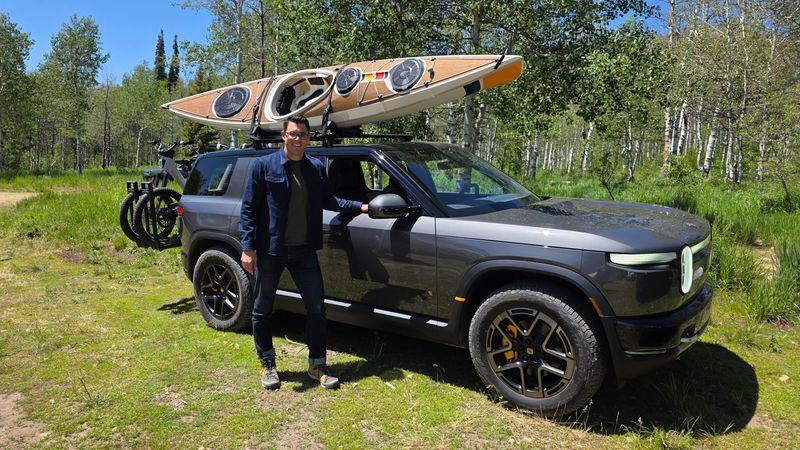
“Tesla products are highly compelling, but if you want an SUV form factor (to go off-road) like what you guys just did, the Model Y obviously can’t do that,” Scaringe told media after a test-drive aboard the rugged R2 deep in the Wasatch Mountains. “(That customer) is stuck. They have to make a big trade-off on capability.”
Indeed, Scaringe sees the R2 as a product that transcends the EV market niche ― just as the Model Y has sold 350,000-400,000 units a year, on par with gas-fired compact SUV peers like the Toyota RAV4 and Honda CR-V.
“We look at the bigger opportunity, which isn’t focusing just on Tesla. It’s the fact that EV adoption in the United States is actually quite low,” said Scaringe of electrics’ 6% market penetration in 2026. “More than half of the total EV market share is Tesla across two products. It reflects a market that has far too little choice.”
Continued Scaringe: “So when we designed R2, we thought of it as (being) cross-shopped with RAV4 and Subarus and BMW X3. We hope the way people interpret R2 is: yes, it’s electric ― but first (it’s) an incredible vehicle to drive on road. It’s the best car in that price range, and by virtue of that, it’ll draw new, non-EV customers.”
Sam Abuelsamid, vice president of market research for Telemetry, said Rivian has an uphill climb in the saturated SUV market.
“The midsize utility segment is getting increasingly crowded, so it’s remains to be seen if … R2 is actually going to be able to grow that much,” he said. “To a large degree, they’re going to have to steal market share from other manufacturers. I don’t see it growing that much to accommodate another 300,000 units from Rivian.”
Seeking volume production
Selling in such volumes would also put Rivian on a sounder financial footing. To date, the company has had to rely on B2B commercial ventures like its 100,000-vehicle contract with Amazon for delivery vans, which account for more than 50% of its revenue.
The latest U.S. EV startup, Troy-based Slate, also seems intent on getting traction by selling to businesses, local service providers, and municipal fleets that need to meet internal or government sustainability goals.
Backed in part by Amazon.com Inc. founder Jeff Bezos, Slate will not have the benefit of government subsidies that Rivian enjoyed upon startup ― including selling hundreds of millions of dollars in EV credits to legacy manufacturers and enticing customers with the $7,500 federal EV tax credit that expired last fall.
“I think it’s great,” said Scaringe of the bare-bones, $25K Slate pickup, though he said Rivian had no plans to produce a cheap EV pickup. “I deeply believe we need more choice, and more choice will lead to better understanding of what it’s like to have an EV. Because of (products like Slate), you’ll have more investment in things like charging infrastructure.”
What’s coming next
For its next act after the R2, Rivian plans the R3 ― a subcompact version of the R2 aimed at competitors like the Volvo EX30 and Chevy Bolt.
“We think of the next thing beyond R2 that will unlock the most market force is R3. Subsequent to R3, we’ve shown what you can extend in terms of performance variant, which is R3X,” said Scaringe, referring to a possible “hot hatch” from the brand’s RAD performance division.
Scaringe said Rivian is prepared for increased volume. Its nonunion Normal, Illinois, assembly plant ― which has three assembly lines for the R1 models, R2 and commercial vans ― will soon get a sister.
“We launch at Normal with around 160,000 units of capacity for R2,” said the CEO, who founded the company in 2015. “We’re building another plant in Georgia, and this is going to be built across two phases. The first is a 300,000-unit phase that’ll build R2. It’ll also build R3 and some other things that we haven’t shown yet.”
Rivian’s billions in funding from investors as diverse as Saudi Arabia’s Abdul Latif Jameel, Amazon and Volkswagen has created the foundation for this long-awaited moment of capacity expansion.
“We have quite a bit of confidence in the blind potential of what R2 can do,” Scaringe said. “All the work we’ve built into Rivian ― vertical-integrating a wide spectrum of technology from electronics to software sensors to silicon to our full self-driving platform … plus our go-to market, service, parts distribution, vehicle distribution and sales locations — we didn’t do all that because we want to sell 50,000 cars a year. We’ve been spending a lot of money … over the last few years preparing to become a very large company.”
Analyst Abuelsamid said Rivian’s experience over two generations of R1 models should pay dividends: “I think they learned a lot about design and manufacturing over the last five or six years, and hopefully incorporated that into the R2 to make it cheaper for them to build.”
Tesla struggled in 2017 with a flood of demand of 250,000-plus orders for its Model 3. CEO Elon Musk called the resulting manufacturing complexity “production Hell.” So, too, Rivian.
“We launched the R1T and R1S, with all available trims — and a commercial van — all within the same three-month period, and it … was impossibly hard,” Scaringe said. “With R2, we’ve said let’s keep it simple for operational ramp-up.”
Handicapping China’s challenges
Rivian does not sell globally like Tesla, and its home U.S. market has aggressively moved against Chinese imports that have savaged European manufacturers across the pond. Chinese-owned Polestar, for example, was banned this week from U.S. sales starting in 2027.
“Rivian is probably the primary competitor to Model Y” among startup makers, said Abuelsamid. “It’s a different customer that’s going to be looking at R2 versus Model Y. Their challenge is going up against the likes of Jeep Wrangler and Ford Bronco … where there is still very much unproven demand for electric off-road vehicles.”
CEO Scaringe is mindful of the challenges ahead from Chinese automakers.
“If you’re building a car company today, regardless of what market you operate in, it would be shortsighted to ignore the Chinese,” he said.
Scaringe said Chinese automakers enjoy a fundamental cost advantage against global competitors — not just on labor but in capital investment from Chinese governments that compound across the supply chain.
“There’s nothing magic (about Chinese vehicles),” the Rivian CEO said. “They’re using the same technologies, the same approaches that leading folks are doing here. So it’s a very interesting policy question where countries have to decide if having a domestic manufacturing industry ― where the cost structures are fundamentally different ― is important.”
He continued: “It’s not possible to compete (when) your cost of labor is 1/7th or 1/8th what it is in the United States, and where cost of capital is a tiny fraction of what it is in the United States.”
He said countries without a manufacturing base will be big market opportunities for low-cost Chinese models.
“For (western) companies competing in countries outside of China ― where there’s no trade barriers ― those companies will need to leverage Chinese supply to get access to that cost structure. The best example of this is playing out already in Europe. Almost every European (electric) car from European manufacturers sold in Europe is using a Chinese battery. So we’ve seen (Chinese) companies like CATL and BYD grow significantly.”
By contrast, the United States has placed high costs on both vehicle sales and content from China, Scaringe said: “As a result, you don’t see any Chinese vehicles penetrating the market, and the companies operating in the United States are not leveraging a lot of Chinese content.”
That is a question for future policymakers, he added. For now, he has an R2 he’d like to sell you.
Henry Payne is auto critic for The Detroit News. Find him at hpayne@detroitnews.com or @HenryEPayne.
This article originally appeared on The Detroit News: Rivian CEO RJ Scaringe is charged up about the volume R2 EV
Reporting by Henry Payne, The Detroit News / The Detroit News
USA TODAY Network via Reuters Connect

By Henry Payne, The Detroit News | USA TODAY Network
