They dug Luna.
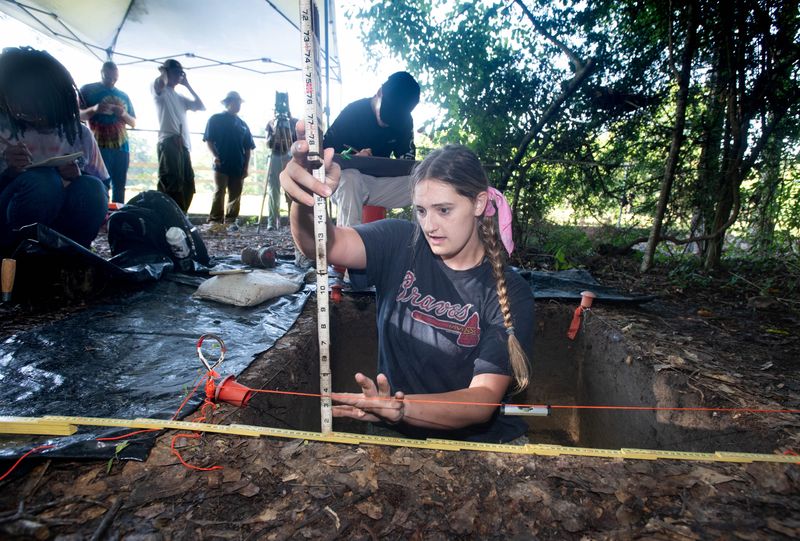
Now, University of West Florida archaeology students are digging, very carefully, and investigating the nearly 300-year-old remnants of San Joseph de Escambe, a mission constructed in 1741 in present-day Molino near the Escambia River.

The mission was built by the members of the Apalachee − indigenous people who inhabited parts of Northwest Florida and the Southeast. Ten years after its construction, Spanish cavalry soldiers and infantry, along with Spanish friars, joined the Apalachee at the mission and remained until spring1761 when it was burned during a raid by Creek Indians.
UWF archaeology students, both undergraduate and graduate students, have spent nearly three-weeks excavating the heavily wooded site located on private land − UWF has the landowner’s permission − not far from the Escambia River.
The excavations and research are part of the UWF Archaeology summer field school, where students first spent three weeks excavating the De Luna settlement discovered in and around present-day East Pensacola Heights, just off shore of the two Emmanuel Point shipwrecks discovered in 1992 and 2006 that are linked to the settlement − the first European settlement in North America, predating both the Spanish settlement of St. Augustine and the European settlement at Jamestown.
Pensacola’s storied history, much longer than that of most North American cities, makes it a great location for archaeology and archaeology students, and is why UWF’s archaeology programs, both maritime and terrestrial, have received numerous awards and distinctions through the years.
“Pensacola is uniquely endowed with not just a rich record of prehistoric Native American occupation sites that tell us a lot about their lifestyles and how they changed over time and how they utilized the bay and the estuary, but also because we have some of the earliest European settlements,” said John Worth, a UWF anthropology professor specializing in archaeology and ethnohistory. “We had this competition between the Spanish, French and the British and we have presidio sites and ports and so on, and they were interacting with Native Americans. It’s one of the richest areas for archaeology in the whole southeast. It’s an amazing area.”
Amazing, but not without its challenges. You’ve seen the Indiana Jones movies. There are always challenges. Even danger sometimes. Or at least a little pain.
Worth was watching over as students delicately scraped thin slices of dirt and sand from a site in Molino where he and others thought a post or two might be located. (Thin slices for sure. Think of a cook removing an omelet from the skillet.)
Suddenly, UWF archaeology student John Merts, one of the students with shovels, gasped and did a little dance step with the shovel as he shimmied in pain. A horsefly the size (and width) of a thumb had bitten through his tie-dye shirt into his skin.
“That’s a big horsefly,” Worth said.
There are other critters too. Students had made two fire pits to shoo the many mosquitoes away from the site of the mission, which is located in a field of sweet gum and water oak trees. He said the Apalachee probably did the same.
“We’ve found these smudge pits where they would dig a hole in the ground, and they are stuffed with corn cobs,” he said. “It was just the cobs, and they would let them smolder. Part of that was probably for mosquito control, but another reason is that they were buying deer skins, or you know, trading deer skins with the Creeks and they would dress them and tanning them would involve smoking them.”
Throughout the site, about a hectare, Worth said − that’s 100 by 100 meters − students have dug up post sites, and small pits of pottery. Students with wheelbarrows would take the excavated dirt and sand to a water screen station near the dirt road that leads the mission, which Worth said at its height probably had about 30 occupants.
While looking over one wheelbarrow’s remains as it went through water, UWF student Jack Jacobson spotted something interesting. A little speck of a piece of, well, something.
“I think it might be a piece of pottery,” Jacobson said to Worth.
“I think you’re right,” Worth said. The fragment was bagged, tagged and will make its way back to UWF’s archaeology laboratory.
“It’s exciting to see something and you think you know what it might be and find out you are right,” Jacobson said, before going back to search for more pieces.
UWF instructors and students have been excavating and researching at the San Joseph de Escambe mission since 2009. Students and UWF archaeologists have also been working at the de Luna settlement near downtown Pensacola during the summers since its discovery in 2015.
On the recent three-week research stint at the Pensacola site, students found a few interesting pieces. But what they didn’t find was interesting as well, Worth said.
“We found a few bits of Spanish material, but most of what we found was native pottery,” he said. “But we were digging close to the bluff so it could be from the Luna period because the Spaniards brought back materials from food gathering expeditions, because the Native Americans also camped right in the same area just along the bluff. We found a piece of brigandine armor, a small blue glass bead and a couple of pieces of Spanish table wear. But we did not find a single Spanish nail, and they are usually all over, so they probably weren’t building anything that close to the bluff.”
Student Max Stevens took a break from slicing thin layers of soil away from an excavation site and said “he has always been interested in history and I’ve always wanted to learn more about it.”
That’s what prompted the Panama City native from entering UWF’s archaeology program.
“I wanted to see it with my own eyes,” he said. “Not just read about it.”
For more information on UWF anthropology and archaeology, go to www.uwf.edu. For more information on the research at both the Molino and Pensacola research sites, go to the Pensacola Colonial Frontiers Facebook page
This article originally appeared on Pensacola News Journal: UWF archaeology uncover secrets of Molino and Luna settlement site
Reporting by Troy Moon, Pensacola News Journal / Pensacola News Journal
USA TODAY Network via Reuters Connect