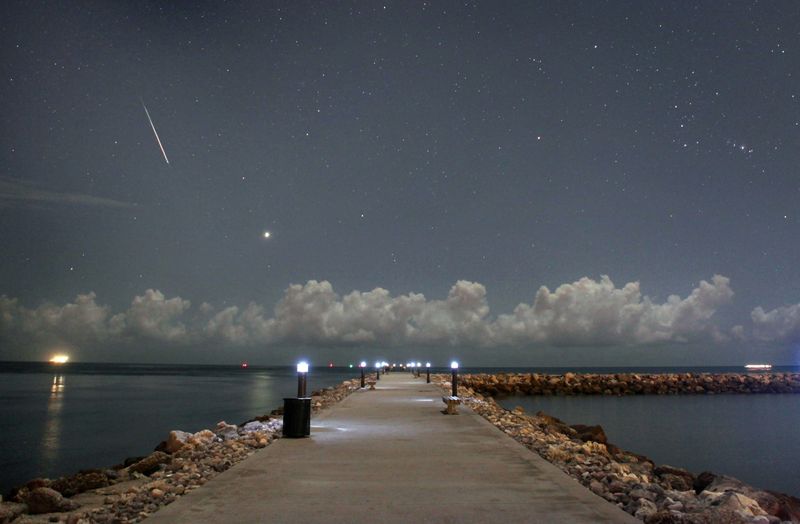
For stargazers, the Perseid meteor shower may just be the highlight of the summer.
With its whizzing bright meteors that leave long wakes of light and color behind, there’s a reason the Perseids are considered the best of the year.

The Geminids in December may be one of the strongest and most consistent meteor showers, but the Perseid meteor shower has a couple things going for it: Not only is it one of the “most plentiful” showers, according to NASA – with anywhere from 50 to 100 meteors potentially visible per hour – but it peaks in the summertime, rather than the colder months like the Leonids and Geminids.
What’s more, many of the Perseid meteors are explosive fireballs that can persist even longer than an average meteor streak.
But this year, a nearly full moon could spoil most of the meteor-watching fun when the Perseid shower hits its two-night peak in activity.
Here’s everything to know about the Perseid meteor shower and how spectators can attempt to see it in August.
Perseid meteor shower 2025: Here’s when activity peaks
This year, the Perseids are expected to peak Tuesday, Aug. 12, and Wednesday, Aug. 13.
Could the moon interfere with Perseids? Weather forecast for Florida
Unfortunately, the Perseid meteor shower is peaking three days after a full moon in 2025. For that reason, a bright waning gibbous moon could outshine the fainter of the streaking meteors and make them more difficult to spot.
In fact, the moon will still be 84% full on peak nights, according to NASA.
“A few bright meteors may still be seen in the pre-dawn hours, but viewing conditions are not ideal this year,” NASA wrote in an August skywatching guide.
Of course, cloud cover also determines just how easily spectators can see whizzing meteors.
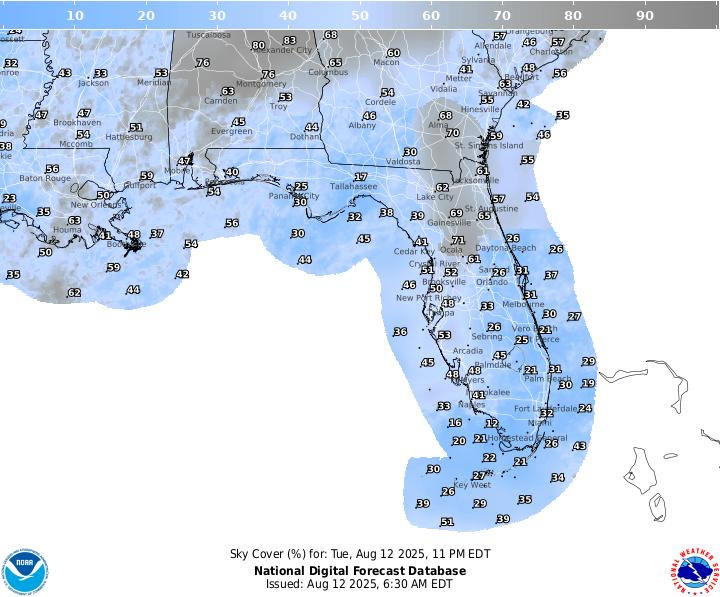
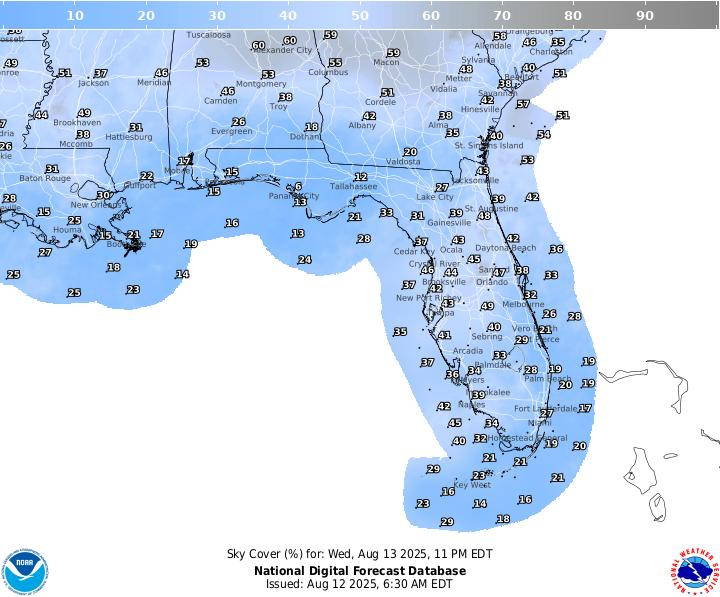
In Florida, conditions look to be relatively clear both nights, with some clouds forecast late at night Tuesday, Aug. 12, in northern parts of the state, including Gainesville, Jacksonville and St. Augustine.
The National Weather Service shared graphics showing the cloud forecast for both dates overnight in Florida.
Perseid meteor shower underway: Where, when to look up
But spectators don’t need to limit themselves to the Perseids’ peak days to see the meteor shower.
In 2025, the Perseid meteor shower became active July 17, and will remain so until Saturday, Aug. 23, according to the American Meteor Society.
The Perseids are best viewed in the Northern Hemisphere.
Once the sun sets and the moon is below the horizon, spectators should only have to contend with local light pollution and clouds that could interfere with the number of meteors they can see.
Like all meteor showers, the Perseids are best viewed during the dark hours between midnight and dawn. However, it is possible under the right conditions to view Perseid meteors as early as 10 p.m. ET, according to NASA.
Tips for seeing streaking meteors
For those determined to catch a few Perseid meteors, NASA has these viewing tips to increase your odds:
The website TimeandDate also provides detailed information about where and when to see the phenomenon.
What causes the Perseids? Are meteor showers ‘shooting stars?’
Originating from the constellation Perseus, the Perseids are made up of leftover particles from comet 109P/Swift-Tuttle.
Every year, Earth passes through the comet’s debris trail, resulting in the Perseid meteor shower when the broken bits of Swift-Tuttle disintegrates in our atmosphere at high speed – creating fiery and colorful streaks in the sky known colloquially as “shooting stars,” according to NASA.
Swift-Tuttle, which takes 133 Earth years just to orbit the sun a single time, was discovered to be the source of the Perseids in 1865 by Italian astronomer Giovanni Schiaparelli. Discovered in 1862, Swift-Tuttle is absolutely gargantuan – twice the size of the asteroid theorized to have wiped out the dinosaurs 66 million years ago.
Eric Lagatta is the Space Connect reporter for the USA TODAY Network. Reach him at elagatta@gannett.com
This article originally appeared on Florida Today: The Perseid meteor shower is about to peak. Will a nearly full moon spoil the show?
Reporting by Eric Lagatta, USA TODAY NETWORK – Florida / Florida Today
USA TODAY Network via Reuters Connect