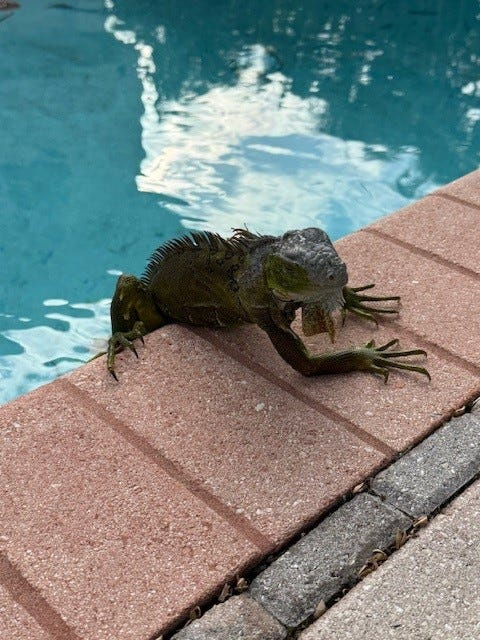
As expected, green iguanas living in Southwest Florida froze and fell to the ground in many places early Sunday morning (Feb. 1).
Temperatures plummeted into the low 30’s as far south as Naples and for the invasive green iguanas, which have adverse impacts on Florida’s environment and economy, it made them not only vulnerable to the conditions but to the Florida Fish and Wildlife Conservation Commission (FWC).

On Friday (Jan. 30) the FWC announced an executive order ahead of the freezing temperatures. The message: if you find frozen iguanas today (Feb. 1) or Monday (Feb. 2), bring them to a designated location and the FWC would humanely kill or, in some cases, transfer the critters to permittees for live animal sales.
For Southwest Florida that location was the FWC’s office on Edwards Drive in downtown Fort Myers. Four members of the FWC’s staff, including a conservation officer, were in the building’s lobby where they processed the frozen iguanas as they were dropped off.
As of 10:45 a.m. on Sunday, very few iguanas had been taken in. The FWC staff would not provide data or share any comments. The Fort Myers office was one of five FWC location open on Sunday accepting frozen iguanas and the only one in Southwest Florida.
One man, Marlin Smith, entered the parking lot in his pick-up truck and walked to the entrance clutching a cardboard box underneath his arm that had a frozen iguana in it.
Smith, a field technician and fleet manager for Florida Gulf Coast University’s Water School, said he found the frozen iguana at the university’s Vester Field Station in Bonita Springs. He made the one-hour journey up to Fort Myers to deliver the iguana.
“I had seen the news about the live iguana collections and I wanted to participate,” said Smith, who is also a graduate of FGCU and from Cape Coral. “I was doing my rounds at the field station and noticed there was a frozen iguana by the pool.”
He said the field station is known for iguanas being on the property and he was surprised to only find the one frozen iguana. Smith said he will look again on Monday (Feb. 2) morning and if he finds any iguanas he will bring them back to Fort Myers.
What happens to iguanas when the weather is cold in Florida?
When temperatures drop and sustain to near-freezing or below, reptiles and amphibians, including green iguanas, can go into a state of “torpor”, where they temporarily lose muscle control and appear “frozen” − sometimes even falling out of trees.
What is the FWC’s Executive Order 26-03?
According to a press release from the FWC, Executive Order 26-03 provides a unique opportunity for members of the public to remove green iguanas from their property during this unusual cold-weather event and bring them to the FWC, no permit required, to be humanely killed or, in some cases, transferred to permittees for live animal sales.
Green iguanas are a prohibited species in Florida, and other than during the dates listed within this executive order, may not be possessed without a permit − including temporarily, such as during transport.
The executive order allows people without a permit to be in temporary possession of prohibited green iguanas so they may collect and transport cold-stunned iguanas to the FWC.
The executive order stipulates the following:
Did you know? Invasive species in Florida
The FWC reports more than 600 nonnative fish and wildlife species have been reported in Florida. Eighty percent of these have been introduced via the live animal trade, with 139 species established in Florida, meaning they are reproducing in the wild.
Invasive species management is a high priority for the FWC because these animals negatively impact native fish and wildlife, cause damage that is costly to repair, and can pose a threat to human health and safety.
What about cold weather and Burmese pythons in Florida?
“In their native range Burmese pythons are subtropical reptiles and are cold sensitive animals,” Conservancy of Southwest Florida Environmental Science Coordinator Ian Bartoszek told The News-Press.
“Freezing temperatures can be lethal to pythons. Conservancy biologists have observed pythons using gopher tortoise and armadillo burrows to seek refuge from cold events.”
But, according to a USGS report on Burmese pythons in Florida, “there is evidence that evolutionary change has already altered parts of the genome responsible for cold tolerance, and there is the potential for behavioral plasticity to enhance cold tolerance.”
“This evidence suggests we may at least expect that pythons can tolerate climatic conditions farther north than where the population is currently established south of Lake Okeechobee,” the report says.
This article originally appeared on Naples Daily News: The FWC’s campaign to collect frozen iguanas underway in SW Florida
Reporting by Mark H. Bickel, Fort Myers News-Press & Naples Daily News / Naples Daily News
USA TODAY Network via Reuters Connect