LAKELAND — U.S. Secretary of Health and Human Services Robert F. Kennedy Jr. came to Lakeland to announce a seemingly obscure bureaucratic change with major implications for Florida’s citrus industry.
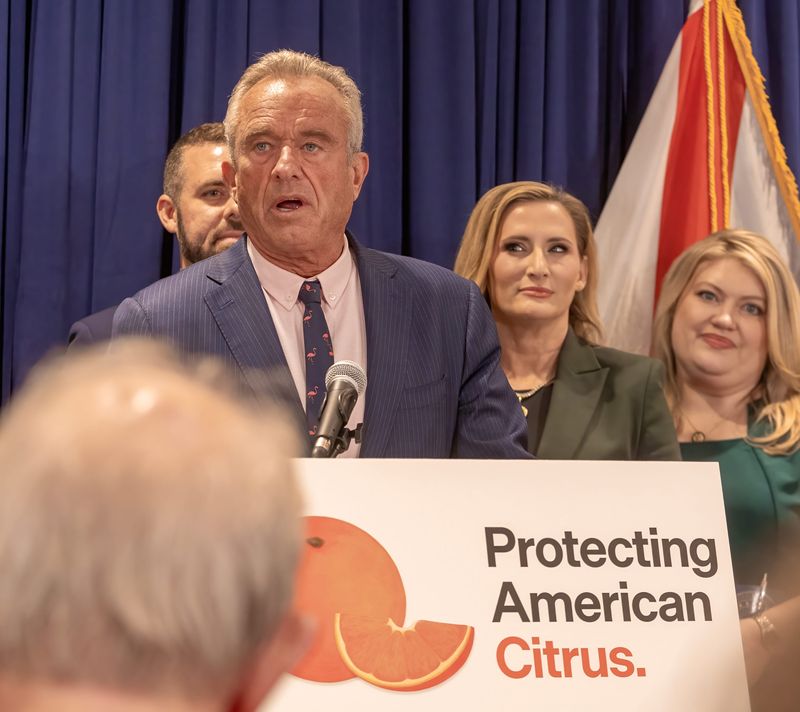
Kennedy, joined by members of Congress, held a news conference at Bonnet Springs Park to celebrate the revision of a federal standard on the required level of natural sugar content in orange juice. The Food and Drug Administration’s rule change means that Florida growers will no longer need to blend in imported juice to meet standards for sweetness.

The rule change took effect the morning of July 16, Kennedy said. Under the revision, orange juice need only have a sugar content of 10 degrees Brix, a standard for natural sweetness. A rule in place since the 1960s had required juice to contain 10.5 degrees Brix.
Kennedy said the change was based on “gold-standard science.”
“This long overdue reform will reduce our dependence on foreign imports, unleash American agriculture and save the industry more than $6 million every year,” Kennedy said. “It strengthens American supply chains and levels the playing field for American citrus growers and maintains the safety and quality and taste of this American product.”
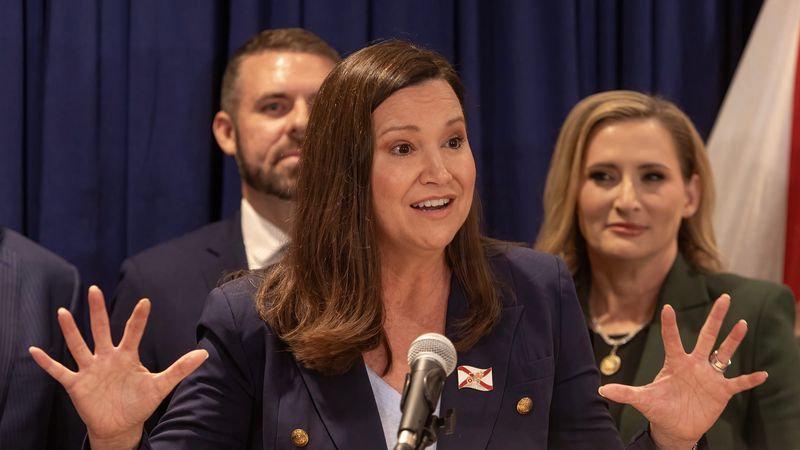
U.S. Sen. Ashley Moody, a Republican from Plant City, said she introduced a bill that would have forced a revision of the rule. Rep. Scott Franklin, R-Lakeland, introduced a companion bill in the U.S. House.
But Moody said she decided that rather than waiting for the Congress to adopt the bills, she realized that the FDA could simply change the rule on its own. She said she lobbied the Trump Administration to make the revision.
“When I heard an outdated FDA rule was threatening the survival of Florida’s great citrus growers, I immediately went to work, filing the Defending Domestic Orange Juice Production Act and meeting with the White House to expedite a solution,” Moody said. “Today is proof that the juice was worth the squeeze. Florida’s citrus farmers are an integral part of Florida’s culture, and I will always fight to ensure they have the support they need to continue growing and making a living.”
Citrus greening affects levels
Kennedy said that Secretary of Agriculture Brooke Rollins, who was unable to attend, played a crucial role in making President Donald Trump aware of the issue at Moody’s request.
“And President Trump said, ‘Let’s get this done,’ and we have gotten it done,’ ” Kennedy said.
Kennedy and others said that citrus greening, a bacterial disease spread by the Asian citrus psyllid, causes a decline in Brix level, based on the percentage of soluble solids in juice. Florida’s citrus industry has been devastated by greening, first detected in 2005.
Annual orange production in Florida has declined from 242 million boxes in 2004 to 12 million in 2025, according to the Farm Bureau.
When the FDA first set quality standards for orange juice in the 1960s, Florida oranges averaged about 11.8 degrees Brix, the Farm Bureau reported.
The FDA proposed the change in 2025 and invited public comments. The agency reviewed those comments and then issued a final rule, which took effect July 16.
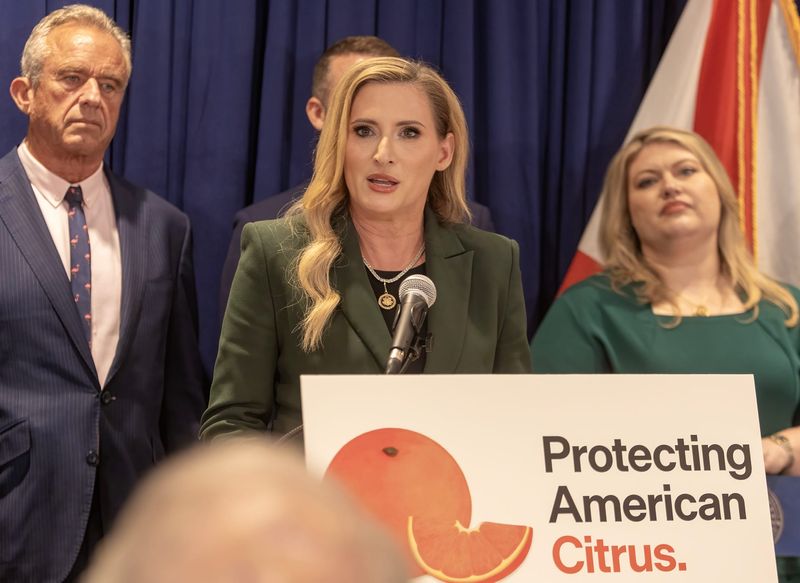
Franklin was unable to join the news conference, hosted by Rep. Laurel Lee, R-Tampa. Franklin’s wife, Amy, attended and sat in the front row.
“This final rule is a critical victory for Florida citrus and the growers working tirelessly to keep this iconic industry alive,” Franklin said in a news release. “For years, our producers have battled citrus greening, hurricanes, freezes and rising production costs while operating under a federal regulation written for a different era.”
Effect will be ‘immediate’
Bonnet Springs Park lies within Lee’s district, which covers the western section of Lakeland and parts of Polk, Hillsborough and Pasco counties.
“Agriculture is constantly evolving as science advances and farming practices adapt,” Lee said. “Good policy should evolve as well. That’s how innovation works, and good government should never stand in its way. Consumers will continue to enjoy the same wholesome, nutritious, high-quality Florida orange juice they’ve always known, while more Florida-grown fruit will qualify as juice.”
Asked why the Trump Administration did not seek to change the standard during the president’s first term from 2017 to 2021, Kennedy said the president only became aware of the issue after Moody brought it to his attention.
Matt Joyner, CEO of Florida Citrus Mutual, said that his agency, along with the Florida Department of Citrus, filed a citizens’ petition about four years ago to “modernize” the standard for pasteurized orange juice. The effect of the change will be felt right away, Joyner said.
“It will be immediate because we’ll be able to bring more fruit to the processors, irrespective of an arbitrary sugar content that’s been dictated by a federal regulation that’s been in place since the ’60s,” he said. “So that impact is going to be immediate, and it will help the growers this upcoming season. So we’re very excited about it.”
Kyle Diamantas, the acting commissioner of the Food and Drug Administration, also spoke at the news conference, as did U.S. Rep. Kam Cammack, R-Gainesville; Florida Secretary of Agriculture Wilton Simpson; and Jeb Smith, president of the Florida Farm Bureau. Josh Henderson, CEO of Bonnet Springs Park, introduced the event.
At the outset of the news conference, Kennedy said that he has a personal connection to the citrus industry, through his wife, the actor Cheryl Hines. She “grew up in an orange grove in Frostproof,” in Polk County, and later became an “Orange Blossom Queen” in Tallahassee, he said.
Gary White can be reached at gary.white@theledger.com or 863-802-7518. Follow on X @garywhite13.
This article originally appeared on The Ledger: RFK Jr. promotes rule change to boost Florida’s citrus industry
Reporting by Gary White, Lakeland Ledger / The Ledger
USA TODAY Network via Reuters Connect
By Gary White, Lakeland Ledger | USA TODAY Network