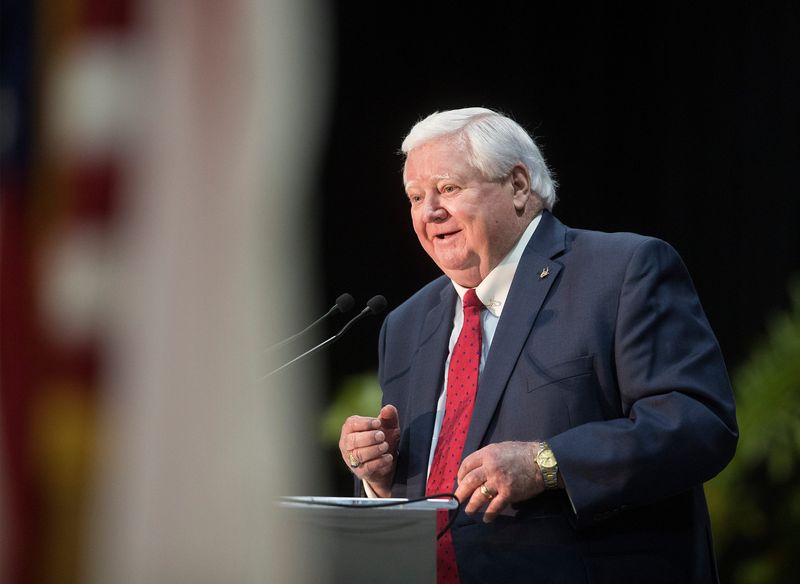
R. Fred Lewis, one of the last liberal-leaning justices on the Florida Supreme Court, died on May 26, a court spokesman said. Lewis was 78.
Lewis, a champion of civic education who created a Justice Teaching initiative, retired at the same time in 2019 as Justices Barbara Pariente and Peggy A. Quince.

They often formed a cohesive voting bloc, and their departure kickstarted an ideological remaking of the court by Gov. Ron DeSantis into a solidly conservative panel. Years before, the trio survived a Republican-organized campaign to get them defeated in the 2012 merit retention election for what GOP opponents called their “judicial activism.”
Lewis, a 1998 appointee of Democratic Gov. Lawton Chiles, also served as chief justice in 2006-08 during his two decades on the court, which included hearing the 2000 presidential election challenge and recount.
The West Virginia native generally supported strengthening jury involvement in death penalty sentencing, and resisted attempts to limiting access to courts and juries in civil cases. He backed strong enforcement of judicial ethics and good government-style reforms of the court system.
Lewis “had a strong work ethic and sense of justice,” Pariente said through a spokesperson. “Our philosophies aligned in that we both cherished individual rights and liberties. (He) did so much for civic education, including the Justice Teaching institute.
“He continued his commitment to civic education and the teaching about the important role of the judiciary after his retirement.”
After his retirement, Lewis joined his undergraduate alma mater, Florida Southern College in Lakeland, as its first “Eminent Professor of Law and Letters.”
Teaching was a passion for Lewis
According to background provided by court spokesman Paul Flemming, Lewis was an “accomplished” high school athlete, recruited to play basketball at Florida Southern. There, he excelled in the classroom and athletics and met his wife Judy. They married in 1969.
Lewis later attended the University of Miami School of Law, graduating third in his 1972 class. After military service, Lewis began practicing law in Miami.
His Justice Teaching initiative allowed “thousands of volunteer judges and lawyers” to go to Florida middle and high schools to bolster civic and law-related education.
“I started going out on my own to the schools to teach the kids,” Lewis once said, referring to the “woeful status of civic education … providing good, correct information, to me, was of critical value.” His work led to a Sandra Day O’Connor Award for the Advancement of Civics Education, from the National Center for State Courts.
Moreover, as chief justice, Lewis directed an audit of all state courts to identify and remove barriers to justice for people with disabilities, Flemming explained. His daughter Lindsay, who died in 2012 at age 26, had a “rare mitochondrial disorder that left her deaf, legally blind, and unable to walk,” her obituary said.
In his 1998 application to the court, he said he had “learned to transform the suffocating stares and ridiculing comments due to my daughter’s abnormal behavior into an understanding by others of her human condition,” adding that “her human spirit has taught me more about life than I ever thought possible.”
In that application, he also explained his ability to “understand … human difficulties.”
He wrote, “My lessons of life came from being born into generations of coal miners in the mountains of West Virginia and the sense of community and human interaction necessary for survival at that time.”
Service information
Jim Rosica is a member of the USA TODAY Network – Florida Capital Bureau. Reach him at jrosica@tallahassee.com and follow him on X.com: @JimRosicaFL.
This article originally appeared on Tallahassee Democrat: Retired Florida Supreme Court Justice R. Fred Lewis dies at 78
Reporting by Jim Rosica, USA TODAY NETWORK – Florida / Tallahassee Democrat
USA TODAY Network via Reuters Connect