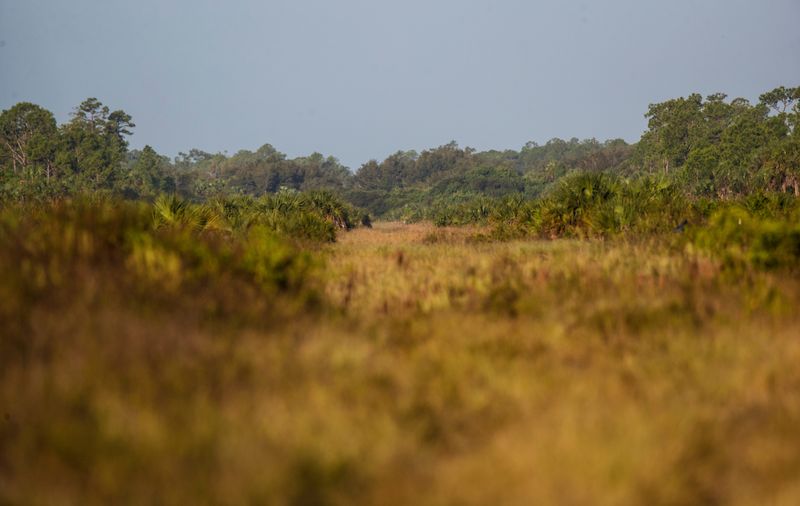
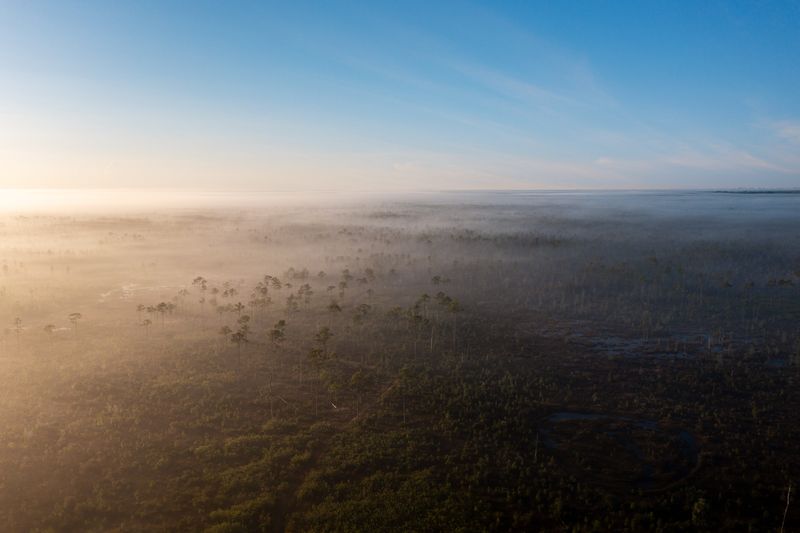
On a cold, sunny morning in late January, hope emerged for a damaged and drained landscape in the western Everglades.
The Picayune Strand Restoration Project (PSRP), part of the Comprehensive Everglades Restoration Plan (CERP), is now complete. How did 55,000 acres in Collier County become the site of the largest restoration effort of its kind — and why should people across Southwest Florida care? The answer lies in the land’s history, a dramatic reversal of fortunes for this critical part of the western Everglades and the troubling ways earlier chapters of that history are unfolding again.

The Picayune Strand, once a refuge for the Seminole and Miccosukee Tribes, was heavily logged for cypress in the 1940s and 50s. After the timber was exhausted, the land was sold in what became one of the largest real-estate scams in U.S. history.
The Golden Gate Estates was slated to become the largest residential subdivision in the world, with a north and south section. Thousands of buyers purchased a supposed “piece of paradise,” unaware that Golden Gate Estates South was largely wetlands submerged for much of the year.
Developers drained the land and built hundreds of miles of roads and canals, disrupting natural water flow and threatening Rookery Bay and surrounding watersheds that protect Southwest Florida from flooding and filtering recreational and drinking water. When the corporation collapsed in 1975, the state was left with thousands of fragmented wetland lots, failed infrastructure, and severely altered hydrology.
In 1986, the Miami Herald reported, “the Conservancy won tentative approval… of its request to add nearly 55,000 acres of low-lying land to south Golden Gate Estates to the Save our Rivers list.” The Save Our Rivers program, created under the Florida Resources Rivers Act of 1981, provided funding for land acquisition.
However, the effort to buy out 17,000 landowners moved at a crawl in Tallahassee, slowed by limited staffing at the Department of Environmental Protection (DEP) and the difficulty of locating owners scattered around the world. Upon learning of this obstacle, the Conservancy stepped forward and volunteered to facilitate the tedious work of contacting property owners since the land deeds were located in Collier County, and this was before computers. Although the state estimated the process would take more than a decade, the Conservancy completed it in under three years with a small team that began with an intern, a volunteer, one staff member, and an IBM typewriter.
After the land was transferred to the state, the Conservancy again answered the call to help. Under contract with the South Florida Water Management District, our Science Department conducted more than a dozen pre-restoration baseline studies to measure the success of future restoration. Our Policy Department continued to join partners in advocating for funding for CERP projects to ensure completion.
Our Science team also remained on the ground tracking and removing invasive Burmese pythons during restoration. Since 2020, the Conservancy has removed 189 snakes, 10,547 pounds of pythons, and more than 5,000 eggs from the Picayune Strand alone.
Today, we can see the results of that collective effort.
Water is moving across the landscape. Natural sheet flow is being restored. Habitats are being reconnected. This project is already improving conditions for wildlife and strengthening the resilience of the Everglades ecosystem.
The Picayune Strand Restoration Project shows what can happen when science leads, public investment stays the course, and partners commit for the long term. The Conservancy of Southwest Florida applauds the work of the U.S. Army Corps of Engineers, which led efforts to plug canals and eliminate roads that disrupted water flow. We also recognize the State of Florida’s commitment across many administrations to complete this work, and in particular, the efforts of the South Florida Water Management District, whose partnership and future operation will deliver lasting benefits through improved water quality, reduced fire risk, and improved habitat for native wildlife.
It’s important that several components still be completed to ensure the project delivers its full benefits. A water quality treatment feature is still needed to address nutrient-rich discharge from the new canal within the levee system. In addition, Picayune is home to the last remaining subpopulation of threatened red-cockaded woodpeckers in Collier County. The Conservancy will continue working with partner agencies to help complete these final elements and secure a healthy future for this landscape.
What we see in Picayune Strand today is a restored environment. It is long-overdue for a landscape with a troubled past, but a renewed future. However, after decades of effort and billions in investment, continued eastern sprawl in Lee and Collier counties risks repeating similar mistakes this restoration was meant to correct, undoing hard-won progress if we let it.
We look forward to sharing this conservation story through a new exhibit at the John & Carol Walter Nature Experience opening in 2028 at the Conservancy of Southwest Florida, and online at www.conservancy.org/picayunestrand.
Rob Moher is president & CEO, Conservancy of Southwest Florida.
This article originally appeared on Fort Myers News-Press: Redemption for the Picayune Strand: A conservation success | Opinion
Reporting by Rob Moher / Fort Myers News-Press
USA TODAY Network via Reuters Connect