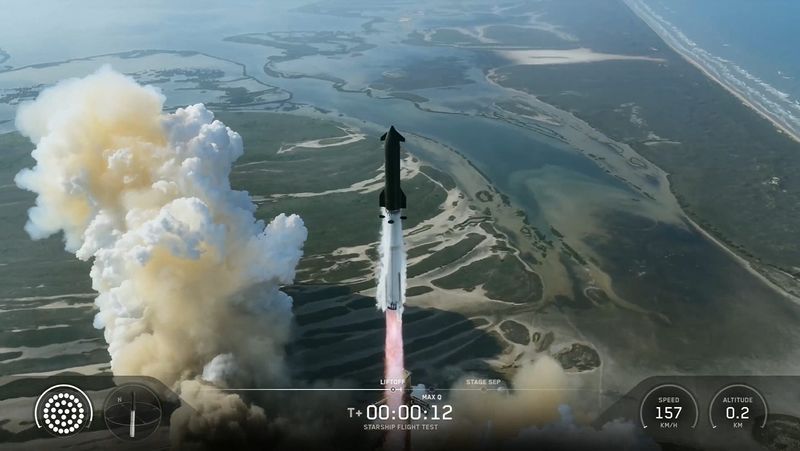
SpaceX’s maiden liftoff of the reengineered, third-generation Starship and Super Heavy booster kicked off a successful test flight leading from the Texas launch pad around the globe to the Indian Ocean on Friday, May 22.
The colossal Starship rocket system — which topped off at a whopping 407 feet tall — rumbled from SpaceX’s remote Starbase at 6:30 p.m. EDT in Boca Chica, Texas.

After ascending to about 115 miles above Earth under power of five of its six engines, the Starship’s mechanical payload “PEZ dispenser” deployed 20 simulated Starlink satellites and a pair of modified Starlink satellites. The latter were engineered to scan Starship’s heat shield and transmit imagery, collecting data for future missions.
“Congratulations @SpaceX team on an epic first Starship V3 launch & landing! You scored a goal for humanity,” SpaceX CEO and founder Elon Musk said in a tweet.
Earlier during the hour-plus test flight, the Super Heavy booster experienced engine-lighting issues and struck the Gulf of America at high speed, rather than descending during a controlled burn.
The Federal Aviation Administration is assessing the anomaly, and there were no reports of injury or damage to public property.
“The FAA activated a Debris Response Area and determined the booster debris fell inside the hazard area. During the event there were six departure delays, five airborne holding events, and no aircraft diversions,” an FAA statement said.
Meanwhile in Florida, preparations are underway ahead of the massive Starship system’s first Space Coast flight. Three weeks ago, Col. Brian Chatman, who commands Space Launch Delta 45, told FLORIDA TODAY SpaceX is “driving hard” to finish building Starship infrastructure at pad 39A at NASA’s Kennedy Space Center — and the first Starship may lift off there by year’s end.
Chatman has said Starship’s arrival would mark 2026 as “the year of the giants” at Cape Canaveral. Super Heavy boosters could begin arriving on SpaceX’s drone barge You’ll Thank Me Later in the coming months. And at NASA’s Kennedy Space Center, Gigabay — an enormous Starship maintenance facility — is rising beam-by-beam off Roberts Road.
In tandem, construction crews are reconstructing Launch Complex 37 to host future Starship launches at adjacent Cape Canaveral Space Force Station.
Looking ahead, Starship must meet many criteria before the rocket can serve as a crewed lander for NASA’s Artemis moon program. The upper stage must not just reach orbit, but also refuel in orbit in order to transport astronauts to the moon.
First, NASA plans to conduct a docking test in Earth orbit with SpaceX’s Starship lander and/or Blue Origin’s Mark II lander during next year’s Artemis III mission.
“Congrats @SpaceX team and @elonmusk on a hell of a V3 Starship launch. One step closer to the Moon…one step closer to Mars,” NASA Administrator Jared Isaacman said in a tweet.
For the latest news from Cape Canaveral Space Force Station and NASA’s Kennedy Space Center, visit floridatoday.com/space. Another easy way: Click here to sign up for our weekly 321 Launch space newsletter.
Rick Neale is a Space Reporter at FLORIDA TODAY, where he has covered news since 2004. Contact Neale at Rneale@floridatoday.com. Twitter/X: @RickNeale1
Space is important to us, and that’s why we’re working to bring you top coverage of the industry and Florida launches. Journalism like this takes time and resources. Please support it with a subscription here.
This article originally appeared on Florida Today: SpaceX’s next-generation Starship V3 rocket makes maiden flight from Texas
Reporting by Rick Neale and Brooke Edwards, Florida Today / Florida Today
USA TODAY Network via Reuters Connect