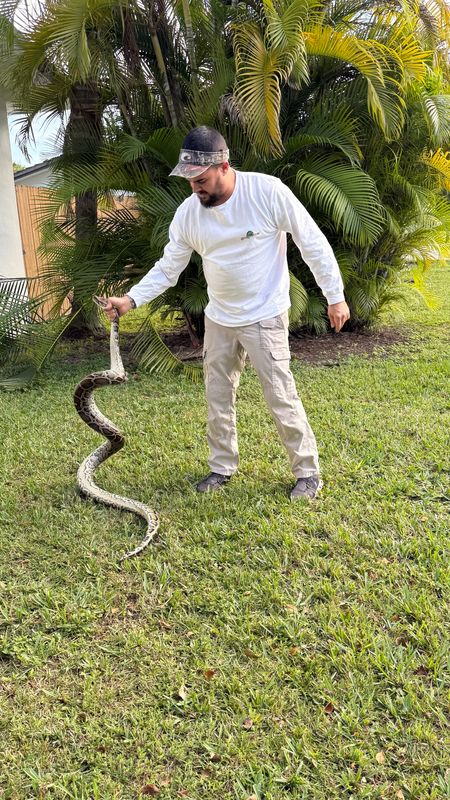
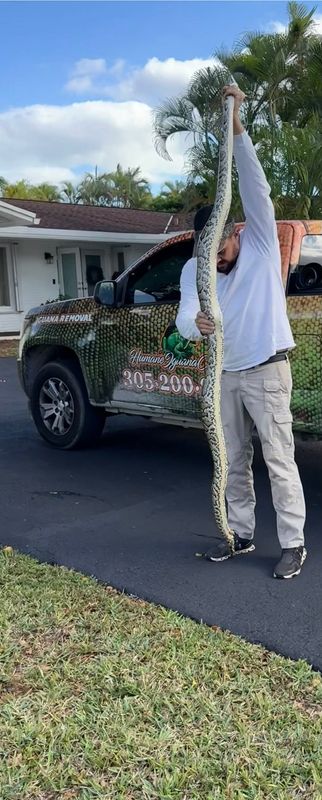
Ten days before Christmas, a distraught South Florida homeowner called Michael Ronquillo about a snake in her neighbor’s yard.
Ronquillo, owner of Humane Iguana Control, assumed it was a harmless black racer. The common snake is sometimes seen sunbathing on lawns or basking on sidewalks. They’re native, not venomous and scare easily.

But it wasn’t a black racer.
Even with the proliferation of invasive Burmese pythons in the Everglades, Ronquillo was a little surprised that what he found wrapped around the stems of an areca palm in a densely populated urban community was a 6.5-foot Burmese python.
“In my opinion, we’re going to see more and more of this,” Ronquillo said about the invasive reptile finding its way into the urban landscape. “All these waterways connect to the Everglades and it’s just a highway for the pythons.”
The snake Ronquillo trapped in the neighborhood southeast of Miami was the second urban python he’d been called about in 2025.
The woman who called him Dec. 15 was taking a walk in the neighborhood, which abuts a canal, when she saw the python.
And it’s not unique. A handful of videos posted on social media by python hunters and first responders show situations where the voracious invasive snakes have migrated out of the swamp and into more cosmopolitan settings.
“We are seeing more pythons in more places,” said University of Florida wildlife professor Frank Mazzotti, who leads the school’s Croc Docs research team. “Like any wildlife population, once they reach the carrying capacity of the area, it’s disperse or die, so we are seeing animals dispersing.”
Mazzotti doesn’t think urban sightings will “skyrocket,” but he does expect it to become more common.
Python hunter Taylor Stanberry, who won the $10,000 grand prize last year in Florida’s Python Challenge, said she fished a python out of a pile of decorative landscape boulders in a Naples backyard and recently found one alongside a neighborhood road when she was driving home from work.
“Obviously, pythons are doing great in Florida,” Stanberry said. “But people are also coming down here and tearing up the woods to build houses, so snakes are losing that habitat.”
Stanberry also operates a venomous snake relocation program with her husband Rhett Stanberry. She said people can get pythons and native rattlesnakes confused with deadly consequences for what may be a Florida native.
“We don’t need anymore native snakes or animals being killed,” she said. “People can send me photos and I’ll do snake identification.”
Pythons, which are not venomous, may also be more visible this time of year because they come out during the day to bask in the sun when there are cooler overnight temperatures. In the warmer summer months, snakes move mostly at night, Stanberry said.
In August 2025, Miami-Dade Fire Rescue posted a video on social media of one of its first responders pulling a Burmese python out of a backyard shed of a home in Homestead.
“You’d be shocked at the places you will find a python,” said Stanberry, who has tracked them down on her own more rural property in Naples. “Pythons are great swimmers and it’s less dangerous for them to swim so you have a higher chance at getting one in your yard near a canal.”
The Burmese python invasion started with releases — intentional or not — that allowed them to gain a foothold in Everglades National Park by the mid-1980s, according to a 2021 Florida Python Control plan.
By 2000, multiple generations of pythons were living in the park, which is noted in a more than 100-page 2023 report that summarized decades of python research.
Pythons have migrated north from the park, with some evidence suggesting they may be able to survive as far north as Georgia if temperatures continue to warm and more pythons learn to burrow during cold snaps.
Since the year 2000, more than 23,000 wild Burmese pythons have been removed from Florida, according to an August press release from the Florida Fish and Wildlife Conservation Commission.
Ronquillo said urban pythons don’t pose an overwhelming threat to humans.
“If someone goes to trim a palm tree or something and doesn’t know it’s there, they could get bitten,” said Ronquillo. “But these snakes can also eat a cat or small dog.”
Or a medium sized dog. Deer, alligators and most small to middle-size furry mammals are on the menu for pythons.
Mazzotti recommends calling FWC’s invasive species hotline, 1-888-483-4681 (888-Ive-Got1), or a paid invasive species expert.
“Even a 3- to 4-foot python, if it starts coiling up on you, it is very difficult to straighten out because of its strength,” Mazzotti said. “Most people don’t give credit to how strong a snake is.”
Kimberly Miller is a journalist for the USA TODAY NETWORK FLORIDA. She covers weather, the environment and critters as the Embracing Florida reporter. If you have news tips, please send them to kmiller@pbpost.com. You can get all of Florida’s best content directly in your inbox each weekday by signing up for the free newsletter, Florida TODAY, at https://palmbeachpost.com/newsletters.
This article originally appeared on Palm Beach Post: Python in Florida woman’s backyard a sign of their movement to urban areas
Reporting by Kimberly Miller, Palm Beach Post / Palm Beach Post
USA TODAY Network via Reuters Connect