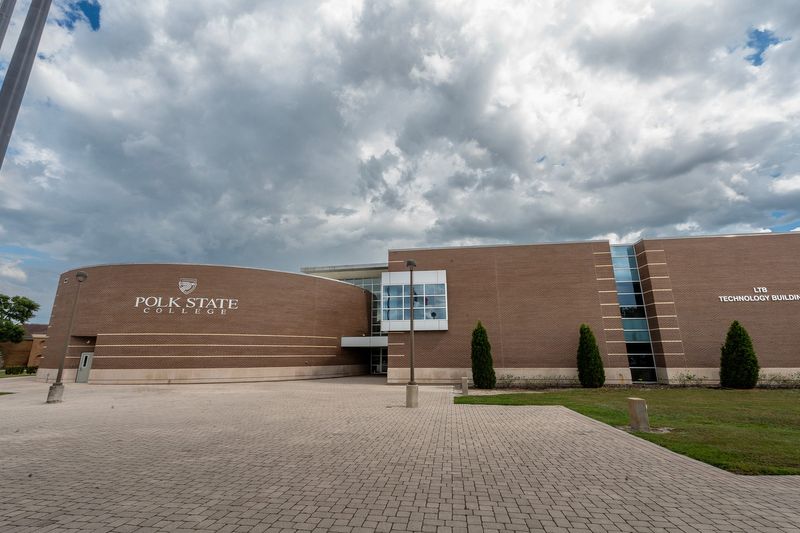
LAKELAND — As Polk State College prepares to hire its sixth president, the District Board of Trustees is changing details of the presidential search process.
At its meeting Feb. 23, trustees approved on first reading proposed revisions to two rules, one of which covers the appointment of a president.

The proposed revisions partly reflect laws passed by the Florida Legislature since Polk State last hired a president that shield much of the search process for state university and college presidents from public view.
Polk State is seeking a new president because Angela Garcia Falconetti, the college’s leader since 2017, departed to become interim president at the University of North Florida in Jacksonville, pending approval from the State University System’s Board of Governors.
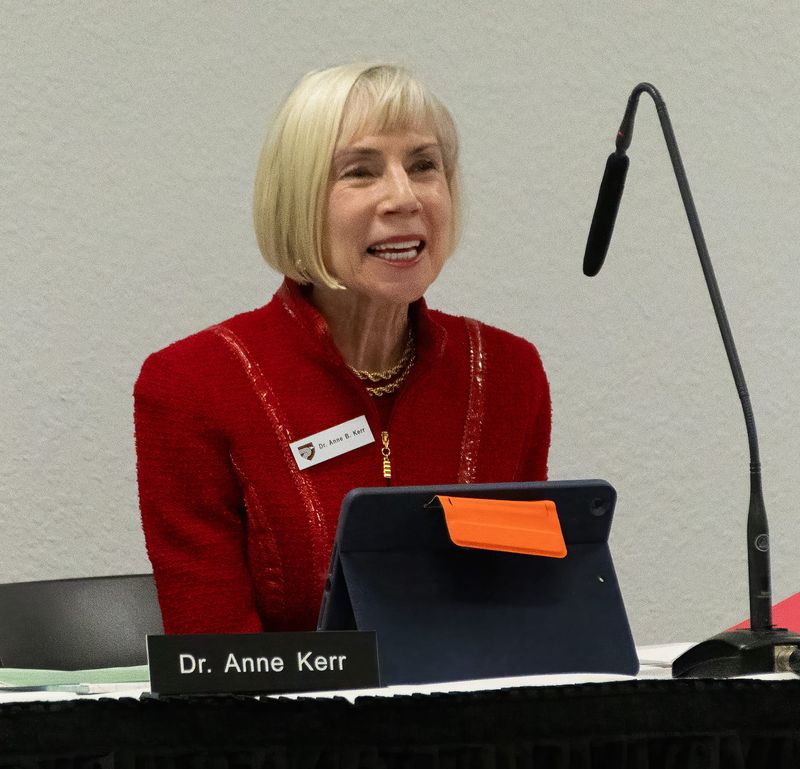
Polk State trustees appointed Anne B. Kerr as interim president at a special meeting on Feb. 5. Kerr is the retired president of Florida Southern College in Lakeland.
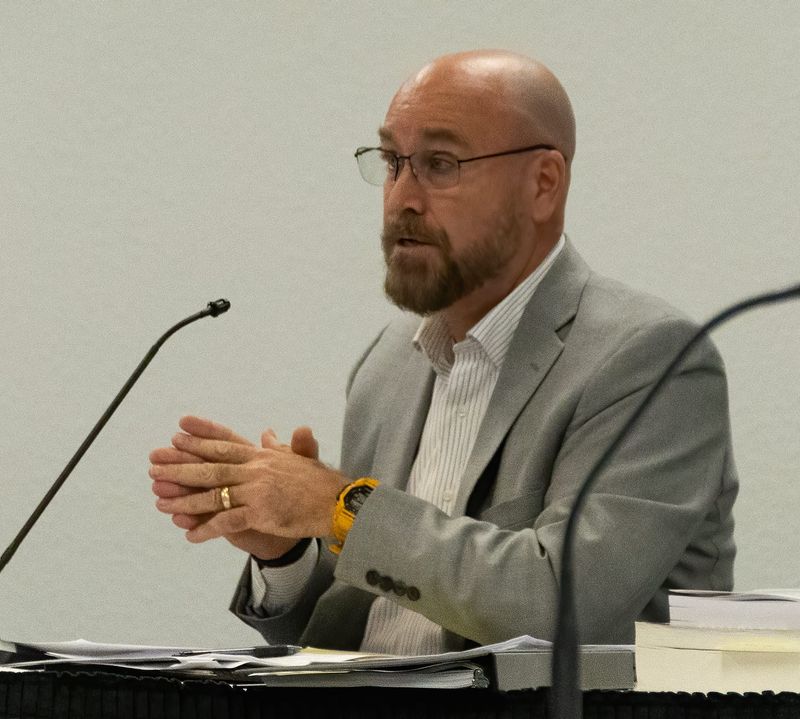
Addressing trustees at the Feb. 23 meeting, Polk State’s new general counsel, David Carmichael, said that the process defined in the college’s current rules would violate state law and a state attorney general’s opinion.
The Florida Legislature enacted a law in 2022 that conceals the names of state college and university president applicants until finalists have been chosen. Carmichael referred to the process as operating “in the shade,” as opposed to in the sunshine, meaning that all records are available to the public.
“The existing rule wanted us to set up a screening committee and have some details about who’s on that committee and how that committee operates,” Carmichael said at the meeting.
He said he agreed with David Fugett, Polk State’s executive vice president for human resources and legal affairs, that “We don’t need that kind of detail in this rule.”
Not requiring a doctorate
Carmichael suggested eliminating a paragraph in the current rule that discusses the creation of a screening committee, whose actions, he said, “would be outside the sunshine, potentially, but not in the shade.”
“And so, once we put together a search committee and we properly notice the shade meeting and follow all the necessary prerequisites to do so, we can do all that search,” Carmichael said. “But if you use a screening committee, potentially, that means, according to the attorney general, somebody other than this group is making the final decision, or at least an initial decision on candidates, and that would have to be done in the sunshine.”
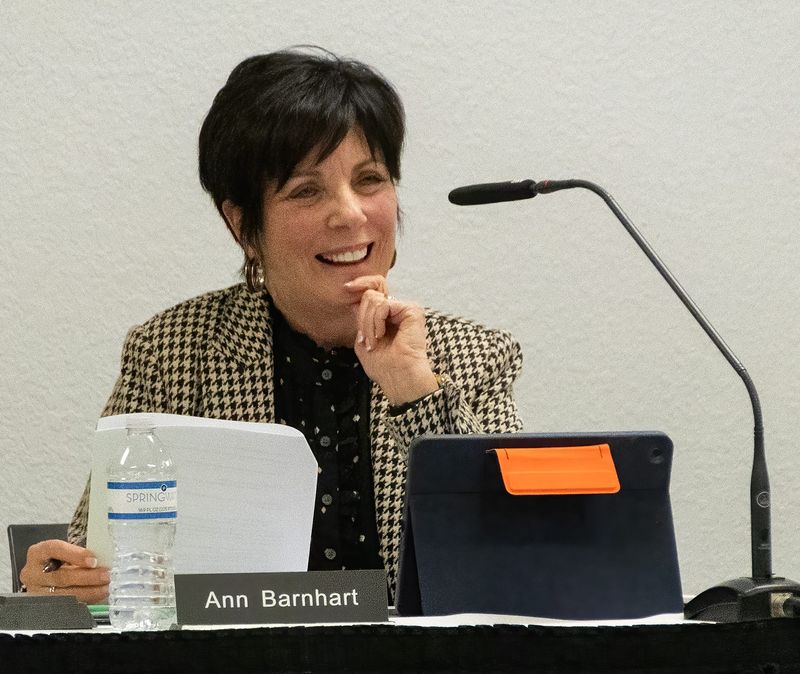
Carmichael suggested revising the rule to say that the chair of the District Board of Trustees — currently Ann Barnhart — would appoint the members of the search committee.
The Florida law has allowed at least one institution to hide details of its search process and the names of all applicants except for a single finalist. The University of Florida revealed Nebraska Sen. Ben Sasse as the lone finalist in 2023 before he was hired.
UF’s presidential search committee followed the same approach in 2025, proposing just one finalist, University of Michigan President Santa Ono, as Sasse’s successor. The state’s Board of Governors later rejected Ono, with Ashley Bell Barnett — a member of Polk State’s Board of Trustees — casting one of the “no” votes.
Carmichael also proposed eliminating a provision in college rules that requires any presidential candidate to have earned a doctorate “from a regionally-accredited graduate university.”
“A doctorate means many things today that it might not have meant in 1962,” Carmichael said, referring to the year that predecessor Polk Junior College was founded. “I think that when you set out to set the criteria and the job description of the next president, you can be specific and include that, but it’s not applicable in a general rule.”
All of Polk State’s recent presidents, including Falconetti, have been PhD holders.
Removing the requirement for an academic doctorate would open the position up to politicians, in keeping with a recent trend in Florida. Fred Hawkins, then a Republican state representative from St. Cloud, was appointed in 2023 as president of South Florida State College in Avon Park. Hawkins held only a bachelor’s degree.
Trustees will hold a second and binding vote on the two rule changes at their March meeting.
The college cannot begin the search process, including the posting of the position, until after the rule changes are approved, Carmichael said.
A collaborative process?
In seeking to alter its rules regarding presidential searches, it is not clear whether Polk State has followed its own guidelines. Procedure 6073 describes the process for revising rules or procedures and says that the changes will be accomplished through “an inclusive, collegial, and collaborative process.”
The procedure specifies that an assigned committee or work group will submit the proposed rule or procedure to the president’s staff member responsible for its development. That staff member then initiates the review process through the Faculty Senate and District Campus Group.
The Ledger asked Polk State’s communciation office about the process of changing rules.
“The authority to conduct a search for a new College President rests entirely with the Board of Trustees and the Board will act in the best interest of Polk State College,” spokesperson Madison Fantozzi said by email.
The selection of Kerr as interim president created tension among the District Board of Trustees at the Feb. 5 meeting. Trustee Ashley Troutman asked pointed questions of Barnhart, the chair, on how Kerr was selected.
Barnhart replied that she had identified candidates in coordination with the Florida Department of Education. Troutman asked what criteria were used, and Barnhart replied, “You have documentation before you. You need only to read her resume, sir.”
Troutman suggested reviewing the college’s procedures on choosing an interim president. After the meeting, Troutman indicated that he only learned that Kerr was being considered after Polk State issued a news release.
Troutman cast the lone vote against Kerr’s appointment, emphasizing that he did so only because of concerns about the process.
Following the retirement of President Eilleen Holden in 2017, Polk State created a 22-member presidential screening committee. The college also hired a search consultant, Jeff Hockaday, who narrowed a list of 61 applicants to 23 candidates.
The screening committee then whittled the list to nine finalists, including the ultimate choice, Falconetti. Under Florida law at the time, the names of all applicants were available as public records.
Mark Turner, vice chairman of the Board of Trustees, chaired the screening committee. The panel included six faculty members, three staff members, two students/alumni, one member of the college foundation board, five representatives of community organizations and four representatives of partner agencies, The Ledger reported at the time.
Kerr attended her first meeting Feb. 23 as interim president. When she appeared at a Feb. 5 meeting before her appointment, Kerr said that she had a “hard stop” of the summer for the duration of her interim role.
The Ledger requested a copy of Kerr’s contract the morning of Feb. 24 and has not yet received it.
Gary White can be reached at gary.white@theledger.com or 863-802-7518. Follow on X @garywhite13.
This article originally appeared on The Ledger: Polk State trustees consider changes to presidential search process
Reporting by Gary White, Lakeland Ledger / The Ledger
USA TODAY Network via Reuters Connect