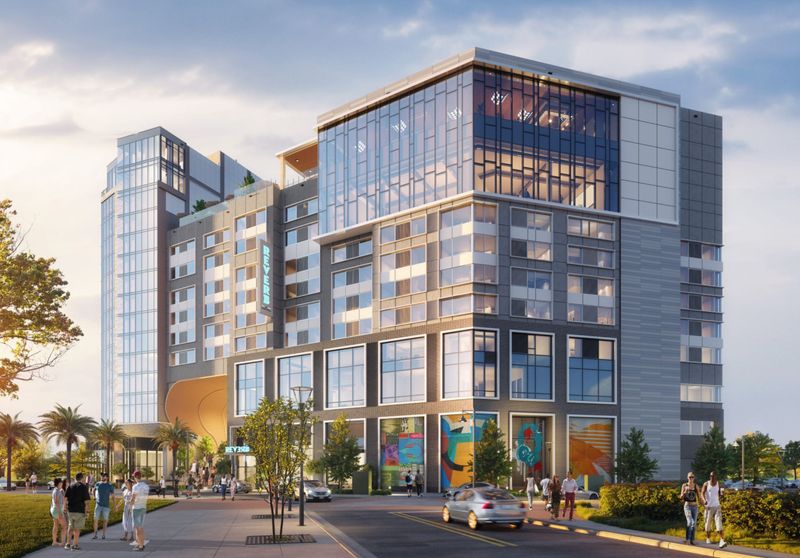
Construction of the $250 million Reverb by Hard Rock Hotel and Rhythm Lofts apartments at Community Maritime Park is supposed to begin later this year, but developers are now asking Pensacola for a 20-year tax rebate to finance the project.
Inspired Communities of Florida, also known as The Dawson Company, and Corporate Contractors Inc. (CCI) have applied for a 20-year tax rebate that would have the city’s Community Redevelopment Agency rebate approximately $2.9 million a year for 20 years once the project is complete.

Without the rebate, the developers say in the application, only a mid-rise single-use hotel building can be built at the site and would require a redesign just months before construction is set to begin.
“If we don’t get the tax abatement, we’ll basically have to go back to the drawing board and try to figure out what our plan B is right now,” Dawson Company President and Chief Operating Officer Tamara Bowens told the News Journal. “But we’re really hoping that the tax abatement does happen, because we really believe it’s a win-win for everyone, for us, for the city of Pensacola, as well as the citizens of Pensacola.”
Even with the tax rebate, the city will still net $1.74 million a year in property taxes off the project.
Pensacola Mayor D.C. Reeves told the News Journal that the city will have a third party conduct an evaluation of the rebate proposal, and right now, he doesn’t have an opinion on the proposal.
It’s the first tax rebate application the CRA has received since Reeves took office in 2022, and he said he believes the city should “do the same math” a developer does to see if the rebate is a good deal for the taxpayer.
“It is not mutually exclusive that we encourage and welcome investment, but that we remain smart and that we protect the taxpayer dollar intelligently,” Reeves said. “And that’s what they should expect from me. So the bottom line is, we’re in an analysis mode.”
When the City Council approved the lease for the project in 2024, one of the selling points was that the project wouldn’t require a CRA tax rebate like the previous proposal at Maritime Park. Reeves also pointed out several times in the years since the project is happening without tax rebates.
“When I walked in to this office, the conversation we were having about (Lot No. 5 where the Reverb Hard Rock will be built) was abating 75% of the taxes for 10 years and 25% of the taxes for the next 10 years,” Reeves said during an October press conference. “We abated zero taxes on (Lot No. 5) — zero. So all of that tax revenue for is going back to the citizens.”
The Hard Rock developers are now asking for a 100% rebate over the full 20 years. They contend the arrangement is still a net positive for the city as 49 condo units on the site would generate $1.74 million in property taxes.
Bowens acknowledged that the discussion of tax rebates was new, but the changing economic conditions have made it necessary.
The application is dated Feb. 26, but Bowens said the first discussions with the mayor and city officials about the rebate only began in the previous week.
She said the building site at Maritime Park is already more costly than a typical project just to deal with storm surge and flooding during hurricanes, and on top of that, the site is also a brownfield site, and additional regulations to safely build on the site add even more costs.
“And then you look at what’s happening in the world, it’s gotten even more expensive with the tariffs and all the other things,” Bowens said. “So where we started out at is not where we are today in terms of our economic environment. It has definitely shifted, and because of that, it made the economics of the deal look very different.”
Reeves said it would be unrealistic not to expect broader changes in the economy to cause projects that take years to develop to change, but at the same time, Pensacola isn’t the same as it was 10 years ago, when it was “searching high and low” for outside investment.
“We would be naive to act as if discussions over years of time don’t change factors,” Reeves said. “Nonetheless, that doesn’t change how we expect to do math on behalf of the taxpayer, which is tell us what it’s going to cost us, and tell us what we’re getting for those dollars.”
The city is conducting a review of the application under the CRA policy. Ultimately, it will be the City Council members, meeting as the CRA board, who will decide whether to grant the tax rebate.
What is being built as part of the project?
The Dawson Company and CCI are co-developing the project with Emmitt Smith’s E Smith Advisors at Lot No. 5 at Community Maritime Park.
The $250 million project will be to build a 12-story, 147-room hotel branded as a Reverb by Hard Rock Hotel, and a 16-story, 247-unit apartment tower at Community Maritime Park.
Developers say the construction project will generate 2,500-3,000 construction jobs over the 34-month build period. The completed project creates 300 direct permanent jobs through the operations of the hotel, spa and fitness club, restaurant, rooftop bar and residential office operations.
Developers say in the application, even with the personal guarantee of Wisconsin billionaire Diane Hendricks, who owns CCI, four separate underwriters require the city’s approval of the tax rebate to approve a $200 million construction loan, according to the rebate application.
”Without ARA abatement, the most viable development for Lot 5 is a single-use, mid-rise hotel … at $300-350K per key,” developers wrote in the application. “That project generates an estimated $1.0-$1.25M annually in property taxes, but delivers none of the middle-income housing, public plaza, structured parking, cultural programming, or talent pipeline that the CRA has called for on this site.”
What is the tax rebate the developers are applying for?
The tax rebate developers are seeking was created in 2021 by the Pensacola CRA as part of finding the first developer for the West Main Master Plan to incentivize development at Maritime Park and the former downtown sewer plant property.
The policy spelling out the conditions to grant the rebate, officially known as an Area Reinvestment Agreement Policy for the West Main District, requires any project to meet a combination of criteria aimed at creating a public benefit to the community, eliminating blight, strengthening the economic base of the West Main District and creating or retaining jobs.
The policy requires the developer to still pay property taxes, but once the project is complete and taxes are being paid, the CRA can refund the approved amount of between 50% to 100% of the increased property tax revenue from the project to the developer each year for a maximum of 20 years.
Bowens said they believe the project not only meets some of the criteria as required but also all of the criteria in the policy.
The policy also requires the city to get a third-party evaluation of any proposal.
Since the program’s adoption, only one project has applied for the rebate, the ill-fated Silver Hills proposal to build 375 and 450 apartments, 10,000 square feet of retail space and a 1,050-car parking garage on part of the same property now leased by the Hard Rock Reverb development team.
Silver Hills asked for a 75% rebate for the first 10 years and a 50% rebate for the second 10 years.
Developers are also applying for certification of the project under the Live Local Act, which would grant an estimated $952,900 in local property tax abatement for the project because of 99 deed-restricted rental units that will have to offer rents at rates the state of Florida deems affordable for “middle-income” households that make 80% to 120% of the area median income.
What is the public benefit taxpayers will get in exchange?
Beyond the 300 permanent jobs and 2,500-3,000 construction job, developers say the project will still provide tax revenue on a piece of property currently generating no tax revenue, waterfront activation that will add 42,500 square feet of event and hospitality space, 99 deed-restricted middle income affordable units, a 325-space parking garage that will boost walkability by including a 21,000-square-foot public plaza on its top that will have outdoor bar and sound stage, and five pop-up retail bays.
All of these elements were part of the original concept approved by the City Council and planning officials before the tax rebate discussion began.
The new addition to the project is the fact that 49 of the residential units in the apartment tower will be “for-sale” condo units rather than rental units. Those units will not be subject to the city tax rebate or state Live Local Act tax abatement, which is largely the reason why the project would still generate a net positive tax revenue to the city during the 20-year period.
Bowens said a third of the project is dedicated to public space, where they could’ve have added more density to the project to make it more financially viable.
“We made the tough decision to actually make this (plaza) space for the public,” Bowens said. “So that space is totally dedicated to the citizens and the tourists that come to Pensacola, so that they can come and enjoy the same things that anyone staying at the Hard Rock or anyone living at Rhythm Lofts can enjoy as well.”
In a letter accompanying the rebate application signed by Harold Dawson with The Dawson Company and Homer Auge with CCI, the developers said they will also look to partner with institutions like the University of West Florida and Northwest Florida State College to “establish an incubator-style talent pipeline providing students and emerging creatives with paid real-world training, mentorship, and access to industry-standard facilities.”
The application says the program would provide students with training and real-world experience in the fields of culinary, hospitality, and music at the hotel and restaurant.
“This is how Pensacola retains talent and competes nationally as a destination for cultural excellence and culinary innovation,” Dawson and Auge wrote.
This article originally appeared on Pensacola News Journal: Pensacola Reverb Hard Rock Hotel developers want a 20-year tax break
Reporting by Jim Little, Pensacola News Journal / Pensacola News Journal
USA TODAY Network via Reuters Connect