A part of Pensacola’s old Confederate monument is being moved to historic St. John’s Cemetery.
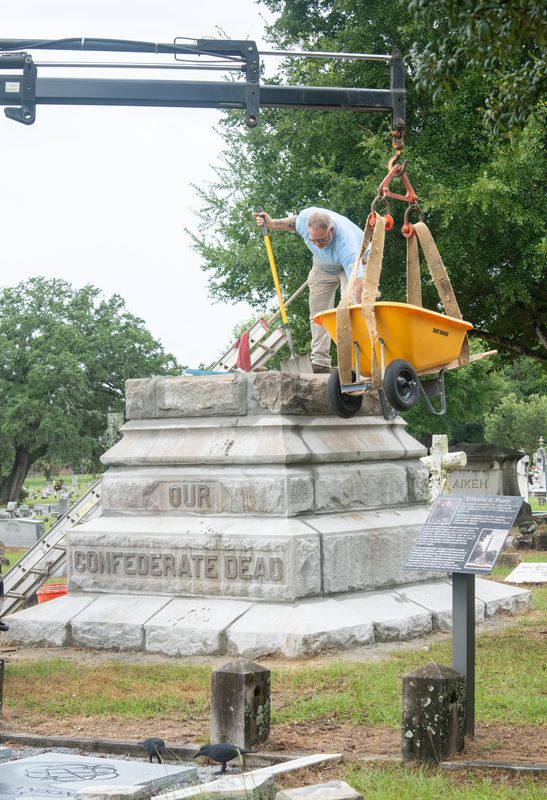
Workers were on site Monday installing the base of the old monument and had already placed the portion of the base that had the inscription “Our Confederate Dead.”

The full lower part of the monument, known as a cenotaph which are designed as memorials that are empty tombs, has four inscriptions dedicating the monument: Jefferson Davis, the president of the Confederacy; Stephen Mallory, the Confederacy’s secretary of the Navy who lived in Pensacola; Edward Perry, a Confederate general who went on to be the 14th governor of Florida; and an inscription to “The Uncrowned Heroes of the Southern Confederacy.”
City spokesperson Shannon Nickinson confirmed to the News Journal that St. John’s Cemetery Inc. took possession of the cenotaph portion of the monument in the spring of this year, and there had been discussions about donating the upper portion, including the 9-foot-tall statue of the Confederate soldier, to the University of West Florida Historic Trust.
Wesley Odom, a board member of a non-profit that owns and manages St. John’s Cemetery, told the News Journal that the cemetery is installing the cenotaph next to the grave of Perry.
St. John’s Cemetery had previously offered to take the Confederate monument and install it in the center of the cemetery’s roundabout, once in 2017 when former Mayor Ashton Hayward said the monument should be removed, and again in 2020 when the City Council voted to remove it.
Odom said the cemetery ultimately decided that accepting the full monument would be too much of a Confederate war memorial, but the cenotaph portion of the monument was more appropriate for the cemetery.
Odom said the monument’s location next to Perry was the most fitting place in the cemetery, as he was largely responsible for its creation.
Perry was a Pensacola attorney who enlisted in the Confederate army and rose through the ranks to become a brigadier general. He came back to Pensacola after the war and was elected governor in 1885. While governor, he pushed for the creation of a state Confederate monument; in his hometown, he stripped Pensacola’s city charter, which removed all of the elected city officials, including African Americans. Salvador Pons was removed from his position as city clerk. Pons was the only Black man ever elected mayor of Pensacola.
Perry also oversaw the rewriting of the state constitution that cleared the way for the legal regime in Florida that would become known as Jim Crow to suppress Black participation in civic life.
Perry died of a stroke in 1889. The monument he had advocated and raised funds for was placed in Pensacola rather than Tallahassee after his wife took over the fundraising effort, and his name was included on the monument that was dedicated in 1891.
Odom said St. John’s Cemetery isn’t trying to resurrect “The Lost Cause,” but only to honor the memories of those buried there.
“What we do in the cemetery is we honor the dead, whatever beliefs they had,” Odom said.
St. John’s Cemetery was founded in 1876 and has about 80 Confederate soldiers buried on its grounds, including three generals, one of which is Perry.
Rob Overton, director of the UWF Historic Trust, confirmed there were talks with the city earlier this year, but they have been put on hold because the statue was too large and the cost of relocating it was too high. Overton said the Trust was interested in including it in an exhibit that would show the monument’s full history and how it came down.
The Pensacola City Council voted to remove the controversial monument from its place overlooking downtown Pensacola on Palafox Street in 2020, and changed the name of the small park where it stood from Lee Square back to its original name, Florida Square.
The city faced a lengthy legal fight challenging the monument’s removal from Save Southern Heritage Inc. and the Florida Chapter and Ladies Memorial Association, and an Escambia County Circuit Court judge dismissed the case in January 2024, ruling the city had the right to remove the monument and the monument’s removal didn’t violate any rights of the parties that were seeking to challenge it.
The group appealed that ruling, but the Florida First District Court of Appeal upheld the ruling in November 2025.
This article originally appeared on Pensacola News Journal: Part of Pensacola’s Confederate Monument moving to St. John’s Cemetery
Reporting by Jim Little, Pensacola News Journal / Pensacola News Journal
USA TODAY Network via Reuters Connect
By Jim Little, Pensacola News Journal | USA TODAY Network