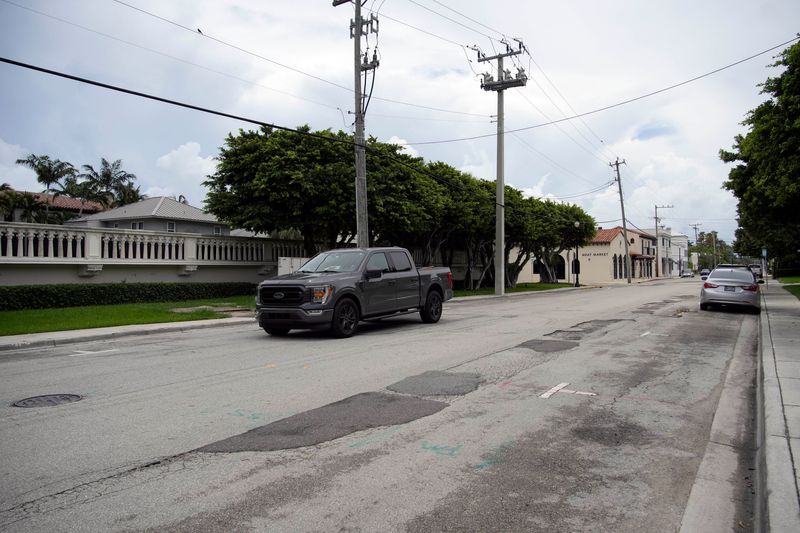
Many of the Palm Beach’s aging roads need repair — and it won’t come cheap, a new study shows.
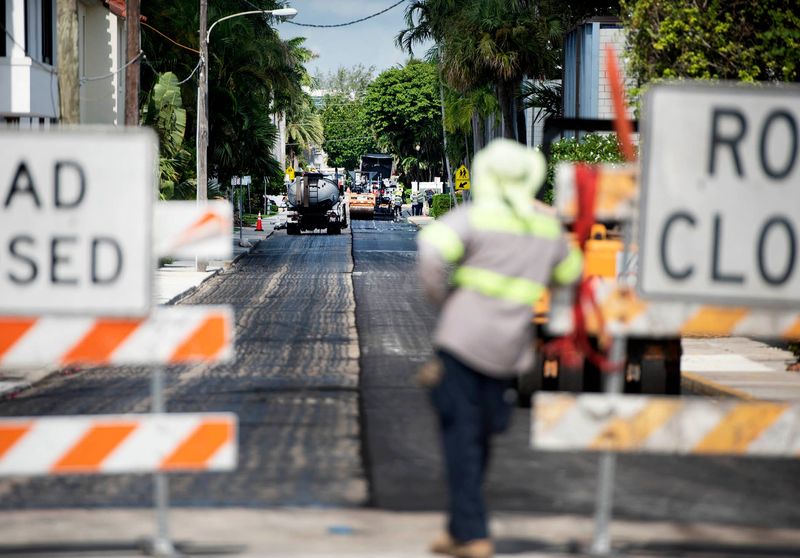
Palm Beach could spend about $5 million a year on road maintenance and reconstruction as part of a five-year plan recommended in a new pavement management study presented to the Town Council.

Council members recently reviewed the results of the study assessing the condition of the town’s 49 miles of roads and outlining a long-term plan for maintaining and rebuilding them.
The study, presented to the council by Brent Whitfield of West Palm Beach-based civil engineering firm Chen Moore and Associates, recommends budgeting about $2 million annually for milling and resurfacing roads. An additional $3 million annually for five years would address roads with the most significant structural issues beneath the pavement.
After the five-year reconstruction effort, the town would continue budgeting about $2 million annually for roadway maintenance, according to the study’s recommendations.
The study examined which streets could be maintained through routine resurfacing and which have underlying structural problems requiring reconstruction.
To assess the condition of the town’s roads, engineers reviewed pavement inspections, core samples, pothole and repair records, and information collected during the town’s undergrounding program.
The engineers also used the Pavement Condition Index, an industry-standard system that rates roads on a scale of zero to 100, to estimate how the town’s roads would deteriorate and how much funding would be needed to maintain them.
Whitfield said the town’s milling and resurfacing program has helped extend the life of its roads, but some have structural problems beneath the pavement that resurfacing alone can’t address.
“The mill and overlay that is planned is important to kind of clean up what’s out there, but it’s not going to give you that 10-year maintenance cycle,” he told council members during their July 14 meeting at Town Hall. “It’s going to make things better for a shorter time. But without that structure underneath it, the new pavement will deflect and settle.”
Whitfield said visible cracking alone does not necessarily mean a road has failed structurally. More serious signs of underlying problems include potholes, rutting and pavement depressions caused by failures beneath the asphalt.
Mayor Danielle Moore said she was surprised to learn the key differences between resurfacing and reconstruction.
“I didn’t realize that this milling and resurfacing wasn’t enough,” Moore said.
The study found that about seven miles of roads have 2 inches or less of lime rock base beneath the asphalt, compared with the town’s current standard of 8 inches for new roadway construction. Another three miles have 2 to 4 inches of base, while six miles have 4 to 6 inches.
Whitfield recommended prioritizing roads with less than 4 inches of base for full-depth reconstruction. The cost to rebuild those roads was estimated at about $14.5 million, based on recent paving contractor bids of about $68 per square yard.
Bradley Place was cited as an example of a road with significant structural problems. Two pavement cores taken there found about 2 inches of asphalt over what Whitfield described as essentially sand, with no lime rock base beneath it.
The town has budgeted to resurface Bradley Place this year, but Public Works staff said a full reconstruction would have to wait until ongoing work to bury utility lines in the area is complete.
Council member Lew Crampton said the study’s findings will help guide the town’s budget decisions and determine which roads should be prioritized for work.
“It gives us some data on which we can make some of these budget decisions,” Crampton said. “When we’re putting the budget together, and we’re following an overall master plan, that is really very, very helpful to us.”
Crampton asked that the town’s final report include a ranking of roads in need of reconstruction. Whitfield said roads with the thinnest underlying base should be prioritized.
“You want to start with roads that have the least base, so we would do Bradley and other maybe side streets that don’t have base and then anything that’s an inch, that’s 2 inches,” Whitfield said.
Council member Bridget Moran questioned whether delaying reconstruction could increase the estimated cost of the work.
Whitfield said the $14.5 million estimate is based on recent bidding prices and could change as construction costs fluctuate. He said delaying reconstruction would allow road conditions to worsen but would not necessarily change the cost of a full reconstruction, which depends largely on future construction prices.
The final report prepared by Chen Moore will include details on each road, pavement core information, maps and a ranking of roads that need reconstruction.
“Providing you with information that allows you to know how the budget should be allocated: That was the recommendation we landed on,” Whitfield said.
Jodie Wagner is a journalist at the Palm Beach Daily News, part of the USA TODAY Florida Network. You can reach her at jwagner@pbdailynews.com. Help support our journalism. Subscribe today.
This article originally appeared on Palm Beach Daily News: Palm Beach roads need $5-million-a-year pavement plan, study finds
Reporting by Jodie Wagner, Palm Beach Daily News / Palm Beach Daily News
USA TODAY Network via Reuters Connect
By Jodie Wagner, Palm Beach Daily News | USA TODAY Network