Two hot-button issues are back at the forefront of concerns for Marco Island city officials and some of the community: water quality and noisy neighbors.
Both issues have been topics of conversation, and even a referendum, for decades, as this city on a barrier island grows and attracts more residents and visitors.

With the city’s water still on a state impairment list, the issue is a serious one that many people have opinions about how to fix. Several iterations of Marco Island City Council have paid for studies, approved a plan for getting off the Florida Department of Environmental Protection’s (FDEP) impaired waterways list and considered options such as canal dredging.
A workshop on past studies, efforts and proposals to help inform a mostly new city council and the public is set for July 7 at 1 p.m. in the Community Meeting Room, 51 Bald Eagle Drive, Marco Island.
As for noise, a controversial short-term-rental registration program approved by Marco Island voters in 2022 in hopes of curtailing noisy neighbors that many complain are rental guests was tossed out after lawsuits and a Florida law signed by Gov. Ron Desantis in 2023. But residents who say their lives in paradise are being ruined because of uncontrolled noise want action.
Councilman Stephen Gray in June proposed an updated noise ordinance and a push for enforcement by local police, code enforcement and city officials.
Here’s what we know:
‘People are terrified to call’
Gray, who presented a white paper June 2, said “people are terrified to call” police or code enforcement about noise for fear of being exposed and suffering harassment or retribution.
“People are feeling real pain,” he said.
Some of those people have brought to City Council meetings recordings of late-night parties at homes next to theirs.
Gray asked if he could start a help line for reporting people or if they could report anonymously.
No, “the statute is clear on that,” said City Attorney Alan Gabriel; such complaints cannot be anonymous.
Could the city’s noise ordinance have more teeth in it? Yes, he and Marco Island Police Chief Tracy Frazzano said.
Marco Island voters approved an ordinance to implement a single-family “home transient rental registration program” on Aug. 23, 2022. The ordinance took effect Dec. 5 that year. The city bought software, a new vehicle and hired people to handle registration and enforcement.
In addition to four lawsuits challenging the rule, a Florida law signed by Gov. Desantis in June 2023 forced Marco Island to rescind the law as if it never happened. The rule affects local governments within 100-mile radius of Hurricane Ian, which made landfall Sept. 28, 2022, at Cayo Costa and then in Punta Gorda, as a near Category 5 storm. The law prohibits “restrictive or burdensome” amendments by local governments to land development or comprehensive plans until October 2026. The lawsuits have been settled.
Gray proposed updating the city ordinance with reduced allowed decibel levels. Fines of $200 for a first complaint and $500 for a second, and then the city moving forward with a lien on the property after that. Gray also wants noise complaints treated as high-priority police calls.
Council Chairman Erik Brechnitz said while Marco Island has updated the decibels allowed in its noise ordinance several times, he is not opposed to Gray’s changes and advised him to work with Gabriel on writing an ordinance to be considered by City Council at a future meeting.
“They get offended when their peace and quiet of their homes is disturbed,” Brechnitz said of residents. “People have a right to rent their property. But there are competing property rights going on. It’s a tough issue, guys.”
The property rights of those who want to rent their homes or have friends and family visit is important to consider, said Councilors Deb Henry and Darrin Palumbo.
“I am surrounded by rental properties,” Henry said, but she also knows her neighbors and feels they respect one another. “I have a relationship with everyone on my street from Landmark to San Marco.”
Henry said too many restrictions prevent people from enjoying their property in ways like having a cookout or a party with friends and family, or just letting kids play in the pool at any time of day or night.
“We are not an HOA (homeowners association),” she said. “We are a city. If people want to live in a quiet community, then don’t live in a city, live in an HOA. … This is not a senior citizen community; it’s a city.”
Marco became a city on Aug. 28, 1997. Its population has increased to an estimated 16,288 residents in 2025 from 9,493 in 1990, according to U.S. Decennial Census data. While that’s a 72% increase, most of that came in the 10 years from 1990 to 2000 when the population was 15,760. The city’s population swells to more than 40,000 during the winter tourist season.
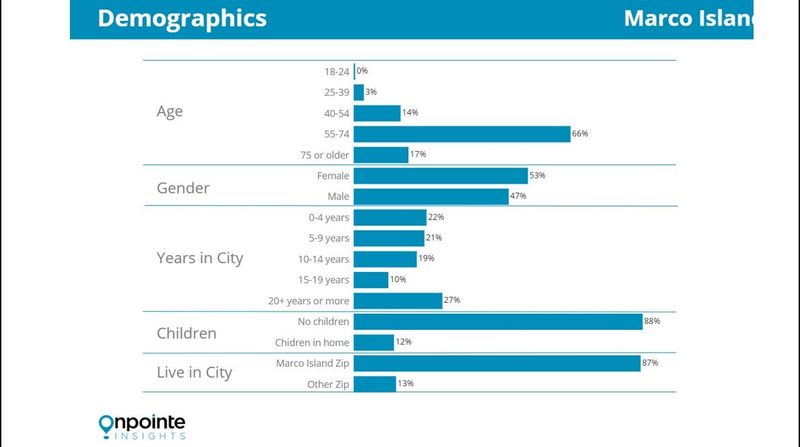
According to the U.S. Census Bureau, the median age is 67.4, with 27% of the population aged 60-69; 18% in the 70-79 range; and 13% 40-49. A 2022 citizens survey commissioned by the City of Marco Island shows the largest age group 55-74 at 66% of the 3,208 respondents. There are three schools on Marco Island: Marco Island Academy high school; Tommie Barfield Charter Middle School and Tommie Barfield Elementary School.
“I do think this is a retirement community,” Brechnitz said.
“If I were asked whether Marco Island was a retirement community, a family community, or a vacation community, my answer would be ‘yes,’ City Manager Mike McNees said in an email when answering questions from the Naples Daily News.
Palumbo said it’s good to talk about the issues residents bring up because “you can’t solve a problem without talking about it.” However, he isn’t sure the problem is as widespread as to require a new ordinance.
“We’re making it sound like noise Armageddon and that you can’t get a moment’s quiet and I don’t see that,” he said. “If you look at the noise complaints and the data, there’s no data to support it.”
“You also have an intolerance level on Marco that you don’t have other places. This is a tremendously entitled community that complains about everything combined with some real challenges.”The Marco Island Police Department asks residents to report complaints, including noise, parking, or trash, by calling the Police Non-Emergency Line at 239-389-5050.
What about water quality?
Taking care of residents and their quality of life is a continuing theme in the city’s water quality issues.
Marco Island’s waterways are made up of more than 100 miles of canals, four bays and Collier Creek. Large areas of the community – Capri Pass, Caxambas Pass, and Big Marco River – are not city waterways and are administered by Collier County and the U.S. Coast Guard.
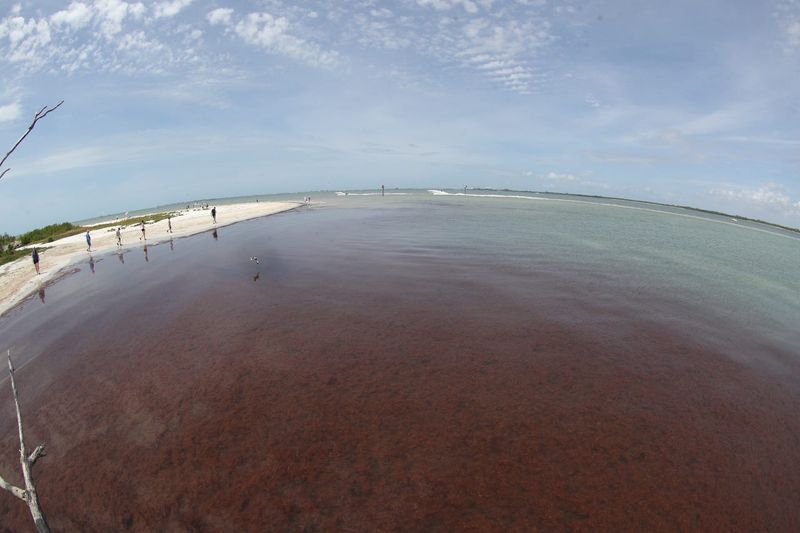
Marco Island has been on the Florida Department of Environmental Protection’s (FDEP) water impairment list since 2019, which was after two years of higher than acceptable nitrogen levels in water that flows through city. Excess nitrogen can cause overstimulation and growth of aquatic plants and algae. Excessive growth of these organisms, in turn, can clog water intakes, use up dissolved oxygen as they decompose, and block light to deeper waters, according to United States Geological Survey.
FDEP accepted the city’s plan for lowering nitrogen levels in September 2023 and moved to the the study list for the 2022-2024 period after submitting its alternative water plan, called an FDEP 4e plan. Marco Island’s restoration plan has already begun and is scheduled for completion in 2029.
The city will remain on the U.S. Department of Environmental Protection’s impairment list – 303(d) – while Florida officials evaluate the city’s progress towards attainment of water quality standards, according to the FDEP.
Marco Island also is impaired for Fecal Coliform (SEAS Classification) because “the shellfish harvesting classification is not fully approved by the Shellfish Harvest Area Classification Program of the department of Agriculture and Consumer Services.” Fecal coliform is bacteria associated with humans or animal waste.
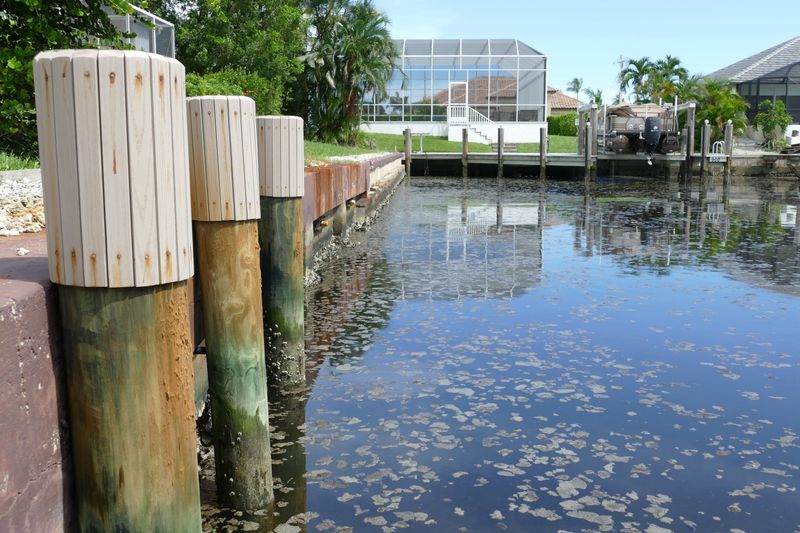
As the city works through the projects in the FDEP plan, residents are asking about goopy, nasty-looking canals behind their homes – what is causing it and what is to be done? They have been doing their own lab work and pointing fingers at the city’s reclaimed water plant. City officials, including Water and Sewer Utilities and General Manager Jeff Poteet, say the city’s water and sewer plant is state of the art and not the issue.
What would definitely help, Poteet says, is replacing the septic systems of Goodland and Isles of Capri with sewer systems like Marco Island has. All septic systems within the Marco Island city limits have been eliminated, but Marco also services the two communities to its northwest and southeast.
Newly elected city council members campaigned about water quality in the fall of 2024. They said they would take action.
Councilor Tamara Goehler held a town hall for residents in January 2025. The consensus among those attending was that the city should pursue an Advanced Wastewater Treatment (AWT) plant, replacing the existing standard Reclaimed Water Production Facility, something Goehler is pushing. This, despite Poteet’s opinion that it wouldn’t actually make a difference for water runoff and nutrients that encourage algae growth getting into the city’s canals and bays.
Clean Marco Waters LLC, created by a group of residents, also is pushing for an AWT plant, based on independent testing in 2025 that it says shows reclaimed water is an issue in the canals. The group’s study was conducted by partners and retired Marco Island residents: Bob Roth, a civil engineer; Rick Woodworth, a former Marco Waterways Advisory Committee chairman; Dave Rasmussen, engineer; and Andrew Tyler, who has a PhD in chemistry, Roth said.
“Our only skin in the game is we are all residents of Marco Island who care about protecting the water quality to the best reasonably extent possible,” Roth said in an email.
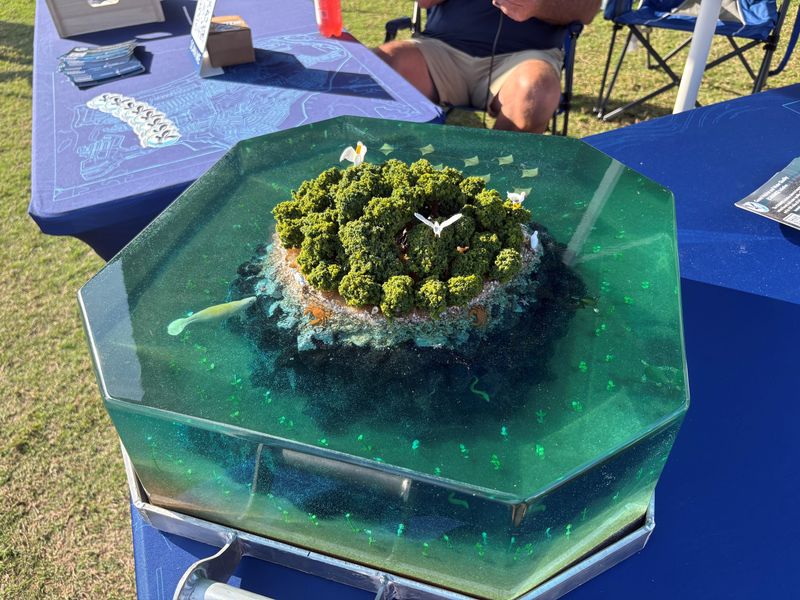
Earthwerks Land Improvement & Development Corp made a presentation to the city council this year offering a modern dredge process via a public-private partnership. Called the C-HAWQ Initiative, City Council has not voted on whether to hire the company and try the process that would use the dredge material to create natural islands in the canals and the Marco River.
That’s just this year.
City Council has asked for and received bids for dredging the canals to remove decades of muck. The cost was too high, at about $200 million, so no action was taken.
In September 2021, city council members heard a presentation: Marco Island Hydrologic/Nutrient Budgets and Water Quality Management Plan by Environmental Research & Design Inc., also known as the Harpert report.
In July 2022, they heard another presentation: Jacobs Evaluation of Potential Reuse Nutrient Impacts and Nutrient Removal Strategies, along with Jacobs’ review of the ERD report.
With all of that and the FDEP 4e plan, whose projects are in the works, City Manager McNees pushed the seven-member City Council, five of whom are new to the council, to hold the July 7 public workshop to hear from city staff about the history of Marco Island’s water issues and what studies and actions previous councils have commissioned, heard and reacted to.
This article originally appeared on Marco Eagle: Noisy neighborhoods, clean water pushed to forefront for Marco Islanders and City Council
Reporting by J. Kyle Foster, Naples Daily News / Marco Eagle
USA TODAY Network via Reuters Connect