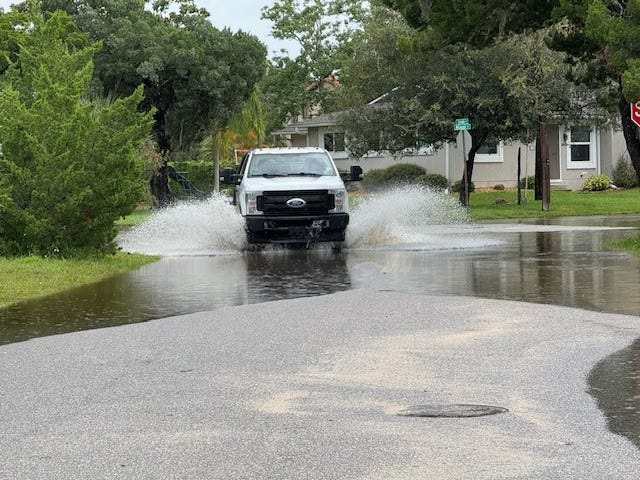
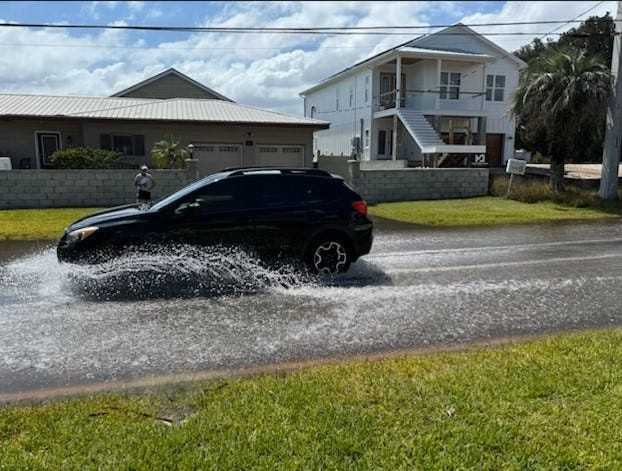
As St. Johns County deals with seasonal king tides, residents living in flood prone areas may see justice served for drivers who carelessly speed through waters, creating wakes high enough to damage homes and property.

Say hello to CS/SB 462, a lengthy transportation bill that Gov. Ron DeSantis signed into law in June. Within the bill’s many pages stands a single sentence that affects driving through flooded streets.
“Operating Vehicles and Vessels; Provides that person may not drive on street at unlawful speed; prohibits operation of motor vehicle, vessel, or other conveyance at speed that creates excessive wake,” states the bill.
The legislation, which took effect July 1, allows law enforcement officers to issue tickets to drivers barreling through floodwaters, creating destructive wakes.
Drivers who disregard the law in the City of St. Augustine will chalk over $166 for a moving violation that adds points to your driver’s license.
The St. Augustine Record spoke to Jennifer Michaux, chief of the St. Augustine Police Department, after Mayor Nancy Sikes-Kline said that Michaux championed the law to the Florida Police Chiefs Association after Hurricanes Helene and Milton.
Modeling a Louisiana law passed in 2018, Michaux said she knew something had to be done to minimize damage caused by drivers creating wakes that destroy yards and residences during times of excessive flooding.
“Without a law we couldn’t enforce stopping big trucks from driving through floodwaters and causing damaging wakes,” she said. “Because we deal with the law, a crime must be committed. For this, we could only enforce criminal mischief.”
Michaux said that wake water can cause extensive damage, especially to homes located in historic downtown.
“Water enters historic homes from the ground up because we are below sea level,” she said. “Residents already dealing with what’s coming from the ground shouldn’t have to deal with trucks pushing water into their homes from the roadway. Water damages flooring, carpeting, furniture, and drywall.”
Michaux then added mold to the list of damage caused by wake waters.
“Homeowners avoid a hurricane and then a truck drives wake water into your living room,” she said. “Residents protect their homes with barricades and trucks push water over the barriers. Drivers need to be more responsible.
“We can’t block cars from driving down every street,” she said. “We can’t prevent people from going into the heart of the city. And we can’t necessarily pinpoint areas hardest hit. That depends on where the storm comes in and how strong the winds and the tides are. This really is a safety issue.”
Michaux underscored that driving through floodwater is not only dangerous, but the mostly salt water can also ruin your vehicle.
“You can’t trust what’s beneath floodwaters,” she said. “Flooded roadways can wash away potholes and manhole covers, leaving a big hole or random debris that could damage the car.”
Donna Dove, a resident of south Davis Shores, said that she often sits in fear as water from excessive rain or a king tide or storm surges into her street, yard and her home.
“My hopes are shattered when a vehicle that shouldn’t be driving on a flooded road comes plowing through the water, seeming to joyously create a wake that pushes water into my home, which damages the flooring, cabinets and appliances,” she told the St. Augustine Record.
Dove said that she hopes that the No Wake Law ends bad behavior that costs a property owner “money, peace of mind and security.”
Tickets will be dispensed at the discretion of the officers.
“It will be judgment calll,” Micheaux said. “Because the Florida Department of Law Enforcement has yet to update the statute into its databases, we can’t write citations because everything is electronic. For now, we’ll issue warnings to curb the behavior.”
With hurricane season and king tides still active, Micheaux said the police department will advise residents about the dangers of wakes through social media.
St. Augustine Beach Police Department
T.G. Harrell, the assistant chief of police for the St. Augustine Beach Police Department, underscored his committment to prioritizing safety, education and public awareness.
“The legislation authorizes cities and counties to designate special slow-speed zones during periods of street flooding and grants law enforcement the authority to issue citations to individuals who create hazardous wakes,” he told the St. Augustine Record via email. “Our primary objective is to safeguard the well-being of our residents and protect their property. “
Mayor Dylan Rumrell echoed that sentiment.
“When floodwaters rise, our streets become part of the neighborhood, and that means every wave matters,” he said. “Driving through flooded streets is reckless and dangerous. Florida’s no wake law will protect lives and property. Together we all slow down and together we prevent damage.”
This article originally appeared on St. Augustine Record: No-wake zones aren’t just for boats anymore. Florida law targets cars driving in floodwaters
Reporting by Lucia Viti, St. Augustine Record / St. Augustine Record
USA TODAY Network via Reuters Connect