

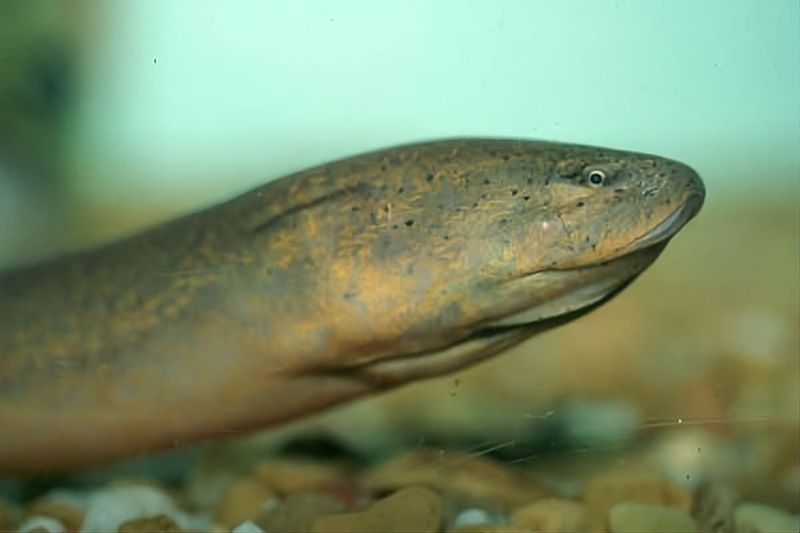
The invasive Asian swamp eel was patient in its ambush.
It lay in wait, innocuous for 15 years, an air-breathing environmental timebomb, a brooding mucus covered virus in the freshwater veins of Florida canals, until like a match to gasoline it unleashed an ecosystem extermination that scientists warn could be more catastrophic than even the invasive Burmese python.

That’s because the snake-like fish popular in Asian cuisine eats its way from the bottom up, decimating the food chain at its roots and causing an avalanche of prey loss for everything that follows.
It has already gorged its way through crayfish and small fish populations in parts of Everglades National Park and was recently linked to the devastation of amphibian populations across the southern reaches of the state. In some spots, only less accessible tree frogs cling to a fragile existence on shrubby islands.
There were no southern leopard frogs — a previously abundant long-lived species — found south of I-75, according to a 2025 report.
“Not to take anything away from the pythons, but from an Everglades perspective, I don’t think they are as bad as this swamp eel,” said South Florida Water Management Wildlife Ecologist Mark Cook. “In the Everglades itself, the swamp eel is quite scary.”
From its earliest stirrings in the canals of Tampa and southeast Florida, the Asian swamp eel has spread to streams and rivers and waterways from Orlando to the mangrove stands dug into the fringes of Florida Bay.
Tampa, Sarasota, Fort Myers, West Palm Beach, Miami and most areas of the Greater Everglades Wetlands are polluted by the Asian swamp eel.
With a population of eels as far north as Atlanta, scientists are also concerned that freezing temperatures may not be a barrier, leaving the endemic crayfish species of Florida Panhandle wetlands and seepage ravines to fall prey to the spread.
In the normally staid language of scientific reports, researchers are ramping up verbiage like “ecosystem collapse” and “unnatural condition” to raise a red alert.
Florida’s Asian swamp eel invasion thought to be harmless at first
“Swamp eels flew under the radar for over two decades and now they perhaps present themselves as future contenders for the title of one of the most destructive aquatic animals ever introduced into the United States,” researchers wrote in a 2024 report published in the journal Aquatic Invasions.
Asian swamp eels were first reported in Florida in 1997, with populations near Tampa and Miami, and likely introduced as a food source or when someone released them from a fish tank. The Florida Fish and Wildlife Conservation Commission describes swamp eel meat as mild tasting and a delicacy in areas throughout Asia.
Two years after the first report another population was found in Homestead, and a decade after that, they had squirmed beyond their canal confines into more general wetlands.
Initial assessments concluded they were little threat to Florida’s aquatic ecosystems. They were wrong.
“The big concern is they are removing the prey base for the Everglades,” said Chris Searcy, an associate professor of biology at the University of Miami. “Asian swamp eels wipe out all the smaller aquatic species which would be the prey for the other species.”
Swamp eels especially like crayfish, then move onto insects and small fish and tadpoles.
Crayfish populations in parts of Everglades National Park have seen a 99% decline with small fish populations dropping 46% to 99% in four out of six previously most common small fish species, according to the 2024 report titled “Asian swamp eels in Florida: distribution, spread, and range of hydrologic tolerance over twenty-seven years.”
An 80% drop in amphibian populations across the Everglades was recorded between 1996 and 2019.
That’s on top of a mid-Century decimation from over harvesting by unregulated frog gigging “marsh cowboys” and environmental disruption from rampant development that destroyed amphibian habitats.
Searcy, Cook and a handful of colleagues set out a few years ago to study frog distribution in the Everglades, looking for declines possibly linked to nutrient levels and pH values as water flows south from Lake Okeechobee.
What they found was that the strongest link to a lack of frogs was the density of the Asian swamp eel population.
“The places in the Everglades where the eels were there the longest, we didn’t capture a single aquatic amphibian,” Searcy said. “We heard a few tree frogs calling, but those were the only species in any abundance.”
Asian swamp eels breathe air and are slimy for better burrowing
Asian swam peels are especially worrisome because of the evolutionary advantage it has over the historic Everglades ecosystem.
Typically, during dry periods in the Everglades, larger predatory fish will migrate to deeper pools, leaving crayfish, frogs and small fish alone to spawn and grow. By the time the rains swell the landscape again, the small prey are big enough to survive a return of larger fish.
But the air-breathing Asian swamp eel can withstand long dry periods with little to no water by hibernating in the mud.
“The swamp eels burrow down and so when the water levels come up, they are right there to consume all the animals and there is no relief period for the crayfish and frogs to grow,” Cook said. “There’s never a lag period to escape predation.”
Asian swamp eels have spread to Palm Beach County, the Hillsborough River, Lake Wales and Orlando
Researchers found that there was a rapid expansion in swamp eel territory beginning in 2015 either through migration due to manmade hydrologic changes or new introductions.
In 2015, swamp eels were found in the Palm Beach Canal near Palm Beach International Airport. It’s believed this was a new introduction because the next closest population was nearly 40 miles south. A year later, they were found in a manmade wetland attached to the Arthur R. Marshall Loxahatchee National Wildlife Refuge west of Boynton Beach.
The Tampa population has since spread throughout the region, bounded by the Lake Wales Ridge to the east and the Caloosahatchee River to the south.
In 2021, they were found in the Myakka River State Park. By 2022, the swamp eels had spread to the Hillsborough River. That same year, they showed up in the Mead Botanical Garden in Winter Park.
In May, an eel was found at Manatee Park in Fort Myers.
“These fish are difficult to find,” said University of Florida wildlife ecology professor Frank Mazzotti in a request for the public’s help in tracking Asian swamp eels. “We can’t be everywhere all the time, but collectively, the public can.”
UF created an environmental DNA detection tool to sniff out Asian swamp eels. One study also suggests restricting migration by targeting choke points with electric barriers.
Cook believes the ongoing restoration of the Everglades that aims to better replicate original water flows will hamper the spread.
“At least we can knock the numbers back,” Cook said. “It’s not set in stone that this is going to be an ecological disaster, but right now, it’s concerning.”
Anyone who spots an Asian swamp eel should take a photo and report it to FWC’s “I’ve Got One” hotline at 888-Ive-Got1(483-4681), or to www.IVEGOT1.org.
Kimberly Miller is a journalist for the USA TODAY NETWORK FLORIDA. She covers weather, the environment and critters as the Embracing Florida reporter. If you have news tips, please send them to kmiller@pbpost.com. You can get all of Florida’s best content directly in your inbox each weekday by signing up for the free newsletter, Florida TODAY, at palmbeachpost.com/newsletters.
This article originally appeared on Palm Beach Post: Move over pythons: This invasive scary invader may be worse for Florida
Reporting by Kimberly Miller, USA TODAY NETWORK – Florida / Palm Beach Post
USA TODAY Network via Reuters Connect
By Kimberly Miller, USA TODAY NETWORK – Florida | USA TODAY Network
