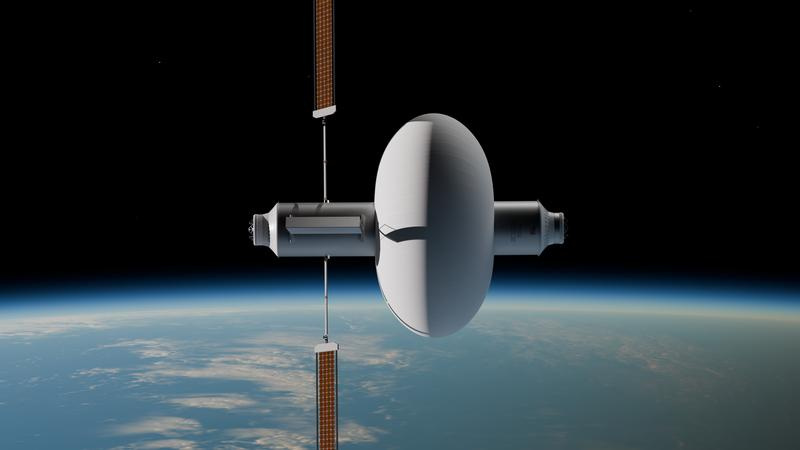
A company establishing a manufacturing presence at Kennedy Space Center plans to use innovative Kevlar-like materials to build an expandable space habitat for low Earth orbit in a bid to answer NASA’s call for a permanent presence on the moon and, someday, even Mars.
Max Space, a company establishing manufacturing at Exploration Park in Kennedy Space Center, recently released to the public the concept for its upcoming Thunderbird Station. Unlike other space stations designs, made up of interconnected metal modules launched individually, Max Space is taking a different approach.

Built with layers of materials like Kevlar, a lightweight fiber material, durable habitats can be packed for launch and deployed once in orbit, and even expanded upon with little construction involved. The company said the material has been tested to stand up to vibration, temperature, vacuum, and even micrometeoroid impacts. They are building off the success demonstrated previously by companies such as Bigelow Aerospace.
To kick the effort off, Max Space will send up a small scale demo mission consisting of a five cubic meter test version of the habitat’s technology. It will launch on a SpaceX Falcon 9 rideshare mission slated for 2027. From there, the company will move onto the expandable Thunderbird Station, which could launch as soon as 2029.
Future goals call for establishing these expandable habitats on the moon and Mars, hoping to benefit from the new NASA administration’s reinvigorated goal of establishing a human presence in deep space.
“The space superiority bill that President Trump signed talks about the US reestablishing its leadership in space. It talks very clearly about getting to the moon and getting to Mars first, being that pioneering leader,” said Max Space CEO Saleen Miyan. “Jared Isaacman, the new administrator of NASA, restated that commitment in his opening addresses. We are very firm supporters and very big believers of that.”
Currently working with Space Florida, Max Space is moving toward setting up operation in Exploration Park on Space Commerce Way, and has already begun hiring. While the company already has a address in Exploration Park, they are seeking to set up in an existing 20,000 to 30,000 square-foot manufacturing facility. This is where the large space habitat modules will be manufactured.
While Space Florida confirmed Max Space’s intentions to move into the area, no further details were provided.
Max Space said they expect to bring 30 to 50 new hires onboard within the first half of 2026.
Max Space coming to Kennedy Space Center
“I think in people’s minds, there’s this like ‘oh my gosh, it’s fabric. How could that possibly (be)?’,” said Max Space lead astronaut, Nicole Stott, who retired from NASA in 2015. “The science behind the materials and the construction of this are really extraordinary in that, you know, this has been looked at for a long time, and now these guys are, I think, in the greatest possible way, bringing it to life.”
Miyan explained that Max Space was founded approximately four years ago through a collaboration with cofounder Aaron Kemmer. Kemmer brought to the table considerable experience having worked with Made in Space, a company which was acquired by Red Wire.
Made in Space had been sending experiments to space, using the unique environment of microgravity to make advancements in fiber optics. All the testing was being done in small-sized containers. While the results were lucrative, much more space was needed in space.
Enter Maxim de Jong, who had worked on the successful Bigelow Aerospace Genesis 1 and Genesis 2 inflatable habitat prototypes. Launched in 2006 and 2007 respectively, both operated for years and remained in orbit up until 2025.
Bigelow also designed the expandable BEAM (Bigelow Expandable Activity Module) module for the ISS. Launched in 2016, it is currently still docked and used for effective storage space.
“We ended up coming together … looking at options around expandable architectural real estate for space, and what was available and what the future of that may look like,” said Miyan.
Max Space believes Thunderbird will provide the solution, providing space not only for science but eventually for astronauts. Bigelow dissolved in 2020, but the lessons learned with Genesis 1, Genesis 2 and BEAM are helping to create this new habitat.
Stott told FLORIDA TODAY expandable habitats could make it easier to set up camp on the moon, including inside lava tubes, which are naturally hallowed out tunnels formed ages ago from lava flow. Setting up habitats in these tunnels would help shield astronauts from radiation and micrometeorites.
Max Space’s demo mission to launch on SpaceX Falcon 9
The uncrewed demonstration of Max Space’s habitat technology is slated to launch in 2027 on a SpaceX rideshare mission.
“It will have some small payloads in there, a lot of sensors, a lot of cameras. We’re going to be testing out a few of the technologies that we’ve tested fully and robustly on the ground, in orbit, just to make sure that everything is doing exactly what it should be doing when we go for larger launches,” said Miyan.
The design also enables external integration of components like windows, docking adapters, robotic arms, cameras, or satellite communication devices without altering the module’s overall architecture.
“So that allows us to manufacture quickly. It allows us to be very flexible with customer requirements,” said Miyan. “It allows us to get from LEO (low Earth orbit) to moon to Mars without any redesign requirement, which is incredible, and it’s exactly what the innovation of real estate in space has needed.”
Thunderbird Station − What’s in a name?
Thunderbird will be the name of that scaled up version, which will be able to host upwards of eight astronauts in low Earth orbit. This includes four full-time crew members, with allocation for an additional four for a short stay.
Should all go well, Thunderbird Station could launch as soon as 2029.
Miyan told FLORIDA TODAY the name was derived from the idea of doing big things at extraordinary speed. While ‘Big Bird’ was an original option, the team settled on the name which most encompassed their vision.
When the time arrives, Thunderbird Station will be able to launch on one Falcon 9 flight, eliminating worries about accessibility and cost.
Building from there, it’s onward to the moon and eventually Mars.
What’s the benefit of all these space stations?
One might wonder just why all these companies are launching space stations.
Stott told FLORIDA TODAY it’s essential to keep a continuous human presence in low Earth orbit, ensuring that microgravity research continues and grows.
“But ultimately, it’s about bringing that understanding back to Earth,” she said.
“We go to space to explore, to learn more about ourselves and who and where we all are.”
Brooke Edwards is a Space Reporter for Florida Today. Contact her at bedwards@floridatoday.com or on X: @brookeofstars.
This article originally appeared on Florida Today: Max Space looks to Kennedy Space Center to manufacture space habitats
Reporting by Brooke Edwards, Florida Today / Florida Today
USA TODAY Network via Reuters Connect