Good news, skywatchers in Florida: Your three-month wait since the peak of the last meteor shower is almost over.
The Lyrids meteor shower, which first became visible April 14, is about to become its most active as Earth passes through the densest portion of leftover particles from comet Thatcher. That should excite stargazers in the U.S., who were likely left disappointed at the beginning of January when the Quadrantids – the first major meteor shower of 2026 – were largely outshone by a full moon.

What’s more, the Lyrids also kicks off a summer of meteor shower activity that hits a high point in August with the Perseids. The Lyrids may not be as fast or as plentiful as the famous Perseids, but they are still well-known for producing fast and bright fireballs.
The oldest known meteor shower, the Lyrids become visible to us here on Earth like clockwork every April as our planet passes through Thatcher’s debris trail and bright whizzing fireballs appear in our night sky.
Here’s everything to know about the Lyrids meteor shower, its impending peak and how you can spot them in Florida.
When is the Lyrids meteor shower?
Meteor showers occur on a predictable schedule each year, with some lasting for mere days and others stretching on for weeks.
In 2026, the Lyrids meteor shower is scheduled to last between April 14 and April 30, according to the American Meteor Society. The timing means the Lyrids activity will overlap with another meteor shower known as the Eta Aquariids, which won’t hit its peak until May 5 and 6.
When is the Lyrids meteor shower peak activity?
A meteor shower is at its best when the Earth passes through the densest part of the associated cosmic debris. That window, otherwise known as the shower’s peak activity, is when stargazers will want to be on the lookout for meteors.
The Lyrids meteors will hit their peak in activity between April 21 and April 22 as Earth passes through the densest part of Thatcher’s cosmic debris, according to the Planetary Society.
Lyrids meteor shower 2026. How many meteors will be visible?
While NASA notes that the Lyrids can surprise watchers with as many as 100 meteors seen per hour, in general, 10-20 Lyrid meteors can be seen per hour during the peak.
Lyrids don’t tend to leave long, glowing dust trains behind them as they streak through the Earth’s atmosphere, but they can produce the occasional bright flash called a fireball.
Could the moon interfere with the Lyrids in April?
A waxing crescent moon that won’t even be a quarter full on either night of peak activity will not interfere with the Lyrids meteor shower.
Where, what time are the Lyrids visible in Florida?
In general, the best time to see meteors are typically between midnight and dawn. The Lyrids are best viewed in the Northern Hemisphere during those dark hours.
Visit the website Time and Date to find the best times and viewing directions for your location.
Weather, cloud forecast for Florida for meteor shower
Of course, clouds in the sky could hamper the views.
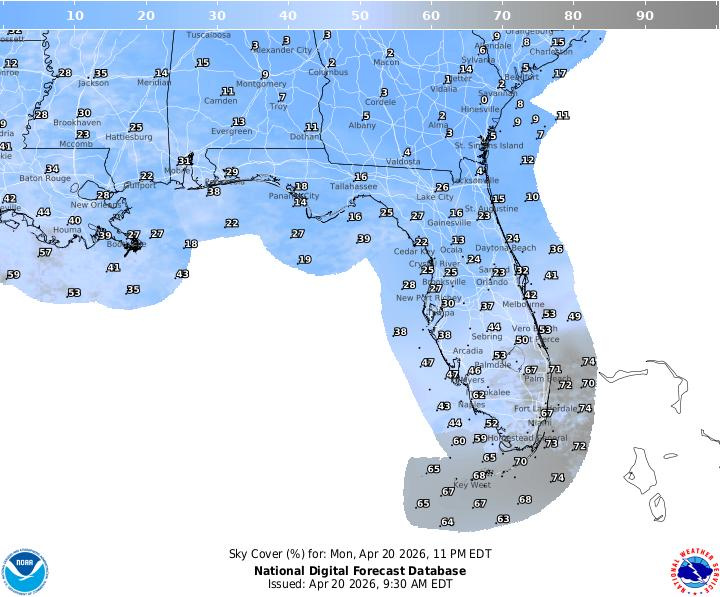
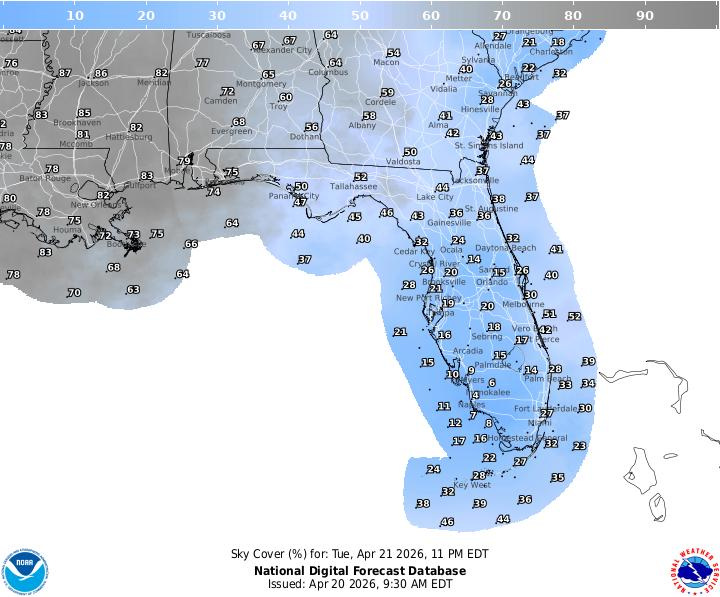
The National Weather Service shared a graphic showing clear skies forecasted for both nights of the meteor shower’s peak in most Florida – as indicated by the blue shading. Some gray shading and higher percentage numbers portend a good chance for clouds on night one in parts of southern and southeastern Florida, including Palm Beach, Fort Lauderdale and Miami.
Where are the Lyrids visible? Florida locations to spot meteors
The Lyrids should be easily seen across the United States.
Want to find a dark area near you? DarkSky International is a U.S nonprofit that maintains a list of designated dark sky communities around the world, including 173 in the United States.
That includes these three locations in Florida:
How to spot Lyrid meteors
The meteors seem to emerge – or radiate – from the constellation Lyra, specifically a bright star named Vega, according to astronomers.
Seasoned stargazers should easily be able to find Vega in the night sky, but if you need help locating it, look above the horizon toward the northeast between about 9 and 10 p.m. ET. Vega will then continue to climb upward until it is high enough in the sky that meteors radiating from that direction streak across, according to Earth Sky.
But while the radiant appears to be the “source” of the meteors, looking away from it will in fact make the meteors “appear longer and more spectacular,” according to NASA. Getting away from city light pollution and street lights will also help to unveil the best sights.
What are the Lyrids? Here’s what causes the meteor shower
Meteor showers occur when Earth passes through dusty debris trails left by comets and other space objects as they orbit the sun.
The debris – space rocks known as meteoroids – collides with Earth’s atmosphere at high speed and disintegrates, creating fiery and colorful streaks in the sky, according to NASA.
Those resulting fireballs, better known as “shooting stars,” are meteors. If meteoroids survive their trip to Earth without burning up in the atmosphere, they are called meteorites, NASA says.
The Lyrid meteor shower is composed of pieces of debris from the Comet C/1861 G1 Thatcher on its orbit around the sun, which is thought to take nearly 416 years. The comet is named for A.E. Thatcher, who discovered it in 1861.
The meteor shower itself, though, has been observed for 2,700 years ever since the first recorded sighting was made in 687 BC by the Chinese, according to NASA.
Eric Lagatta is the Space Connect reporter for the USA TODAY Network. Reach him at elagatta@usatodayco.com
This article originally appeared on Palm Beach Post: Lyrids meteor shower to hit 2026 peak. Where, how to watch in Florida
Reporting by Eric Lagatta, USA TODAY NETWORK – Florida / Palm Beach Post
USA TODAY Network via Reuters Connect