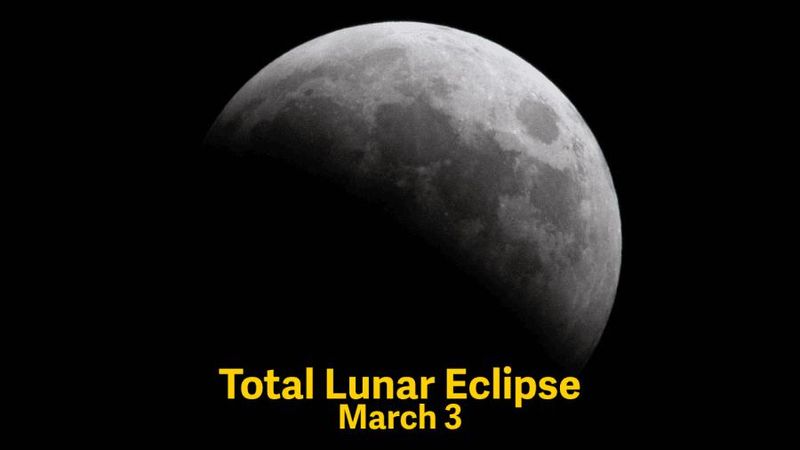
Tomorrow’s full moon will be a memorable one. Not only will it be a blood moon, but it will also coincide with the only total lunar eclipse of 2026.
As the Earth’s shadow passes across the moon, March 3, the moon will appear red or orange. That’s why it’s commonly called a blood moon. While most Florida residents won’t be able to see the Earth’s shadow totally cover the moon, the start of the eclipse will be visible from Florida.

Here’s when to look up to admire the March full moon and how much of the total lunar eclipse Florida residents will be able to see.
What is the date of the next Full Moon?
The next full moon will peak tomorrow, Tuesday, March 3, at 6:38 a.m. ET. The full moon in March is known as the worm moon.
When is the next supermoon?
The first full moon of 2026, on Jan. 3, was the first of three supermoons of the year. You’ll have to wait for the next two:
What is a supermoon?
A supermoon is a full moon that occurs when the moon is near perigee, or the closest point to Earth in its orbit, which it reached Jan. 1, according to astronomy.com.
“At its closest point, the full moon can appear up to 14 percent bigger and 30 percent brighter than the faintest moon of the year, which occurs when it’s farthest from Earth in its orbit,” NASA says.
When are full moons in 2026?
Here’s when to expect the remaining full moons this year:
Why is the March full moon called the worm moon?
Moon names come from Native American, colonial American, or other traditional North American sources passed down through generations, according to the Old Farmer’s Almanac.
“For many years, it was believed this name referred to earthworms appearing as the soil warms in early spring —drawing birds such as robins and signaling the changing season.
“However, historical research suggests another explanation. In the 1760s, Captain Jonathan Carver recorded that the name referred to beetle larvae — another type of ‘worm’ — which emerge from thawing tree bark and winter hiding places at this time of year.”
Why are there 13 full moons in 2026?
There will be 13 full moons in 2026, with two occurring in May: May 1 and May 31.
“Most years have 12 full moons. About every 33 months, however, there are 13 full moons in a single calendar year,” according to the Old Farmer’s Almanac.
“This happens because 12 lunar cycles total about 354 days, while our modern Gregorian calendar (a solar calendar) is about 365.25 days long. That roughly 11-day difference adds up over time, resulting in an extra full moon.”
The second full moon falling within the same month is known as a blue moon.
What is a blue moon?
A blue moon is the second full moon in a single calendar month, according to space.com.
What else can you see in night sky in March?
Here’s a look at what you’ll be able to see in March:
Total lunar eclipse coming March 3
The first and only total lunar eclipse in 2026 will occur March 3. Western and central regions of the U.S. will enjoy the best views of the total lunar eclipse.
In Florida, residents will be able to see the start of the eclipse at 3:44 a.m. ET, but totality will come at 6:33 a.m. when the moon is low on the horizon and close to sunrise at 6:43 a.m.
Will we be able to see any of the total lunar eclipse in Florida?
While most Florida residents wont be able to see the Earth’s shadow totally cover the moon, the lunar eclipse will begin at 3:44 a.m. ET March 3. At that time, you’ll be able to see the Earth’s shadow start to move across the face of the moon.
Look low on the horizon to the west and slightly to the south. Totality will happen at 6:33 a.m. on March 3, which unfortunately occurs right before sunrise.
Could Florida see a ‘moonbow’?
“If conditions are just right and there’s a bit of mist or rain in the air, you may even spot a rare phenomenon called a moonbow,” according to the Old Farmer’s Almanac.
Also known as a lunar rainbow, a moonbow is a rainbow created by moonlight instead of sunlight. Moonbows are most likely when the full moon is low in the sky.
Conditions necessary for moonbow to occur, according to darksky.org:
Why is a total lunar eclipse called a ‘blood moon’?
“During a total lunar eclipse, the Moon appears dark red or orange. This is because our planet blocks most of the Sun’s light from reaching the Moon, and the light that does reach the lunar surface is filtered through a thick slice of Earth’s atmosphere. It’s as if all of the world’s sunrises and sunsets are projected onto the Moon.
When is the first day of spring?
March 20 is the spring, or vernal equinox, marking the first day of astronomical spring in the Northern Hemisphere. To be precise, it happens at 10:46 a.m. EDT.
What is the spring equinox?
“On the March equinox, the Northern Hemisphere and Southern Hemisphere receive roughly equal amounts of sunlight; neither hemisphere is tilted more toward or away from the sun than the other,” according to the Old Farmer’s Almanac.
After the spring equinox on March 20, many places will experience more daylight than darkness. Daylight hours will continue to increase until the summer solstice on June 21.
Equinoxes are the only two times of year when the sun rises due east and sets due west for all of us on Earth.
This article originally appeared on Florida Today: Lunar eclipse, full moon coincide. Timing, how to view from Florida
Reporting by Cheryl McCloud and Lianna Norman, USA TODAY NETWORK – Florida / Florida Today
USA TODAY Network via Reuters Connect