A decades-old citrus grove could be replaced by hundreds of homes in eastern Collier County.
At a board meeting May 27, county commissioners agreed to send a required amendment to the county’s growth management plan to the Florida Department of Commerce for its input.

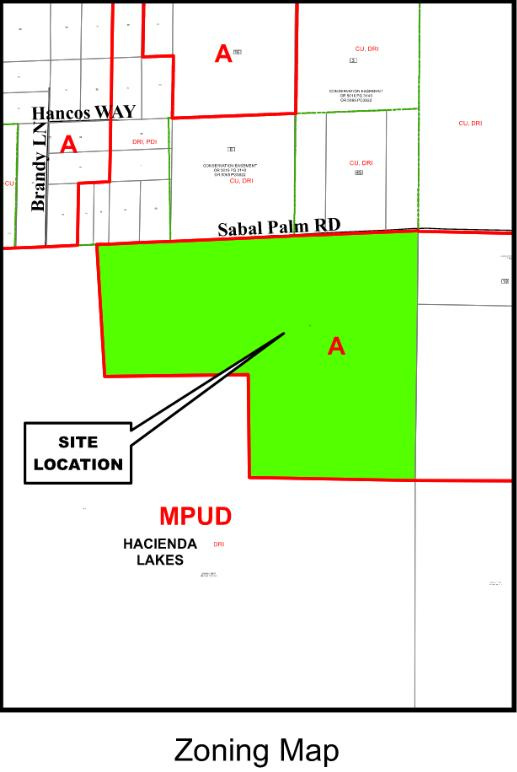
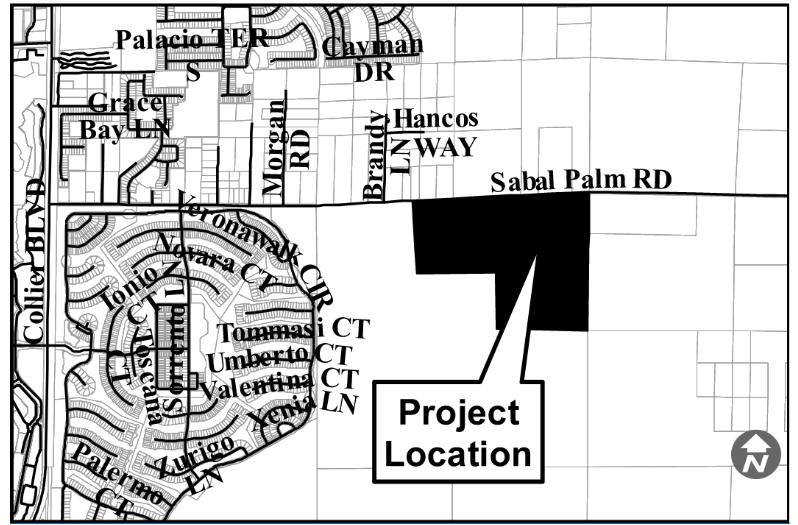
The plan amendment, requested by a developer, who is seeking a rezoning, would create a new residential subdistrict on what’s now agriculturally-zoned land — at 341 Sabal Palm Road.
After hearing opposition from neighbors, county commissioners emphasized they weren’t taking any final action, just allowing the proposal to move forward in a multi-step zoning and hearing process that still has a long way to go.
“Allowing this to go to the state and come back with more information gives us a starting point,” said commissioner Rick LoCastro.
He added: “It’s going to make us more educated on the property. We’ve approved nothing today for construction, nothing.”
He shared some of his own concerns about the proposal, which involves land in his district. One of his biggest worries is about the traffic it would generate.
The development would replace the South Naples Citrus Grove.
The request by SWJR LLC 1, headed by Jon Rubinton, a long-time developer, is to change the designation of the roughly 169-acre site, near the Picayune Strand State Forest, from sending to receiving. In sending areas, land is considered more environmentally valuable and sensitive, and more protected under the county’s land development code.
The rezoning would allow up to 423 single-family and townhomes, at a density of 2.5 units an acre.
Now, a density of one unit per 40 acres is allowed because the land is within the Rural Fringe Mixed-Use District. With a rezoning, it would be taken out of that district, and put into its own subdistrict.
Under the proposal, 63 of the townhomes — or about 15% of the total number of homes in the development — would be set aside as income restricted, and reserved for households making no more than 120% of the area’s median income, which now tops $113,600 in Collier County.
The more affordable homes would be offered up for sale, rather than for rent, which is unusual in the county.
All of the homes in the community would be built for sale.
Over a couple of decades, Rubinton has designed and delivered a myriad of multimillion-dollar communities, such as Mangrove Bay and Bonita Bay, and he’s built luxury custom homes across Southwest Florida, including in Port Royal and Aqualane Shores.
The owners of the grove could not immediately be reached for comment about their interest in selling the property for development. With this season’s harvest over, the grove and its farmer’s market are closed until next season begins in the fall (except for the sale of frozen orange and grapefruit juice, according to an automated phone message).
County staff and the Collier County Planning Commission recommended in favor of sending the requested growth plan amendment up to the state for review.
Initial development plans modified to meet concerns
Mike Bosi, the county’s planning and zoning director, told commissioners that staff raised a number of concerns about the original application, but through negotiations with the developer many of those concerns had been addressed, with a reduction in density, and the addition of more open space and buffering.
“This land, the 169 acres, is … a farm field, an active farm field,” he said. “It’s not environmentally sensitive.”
The orchard has been around since 1979.
Bosi pointed out the development of the land would come with benefits, including much-needed affordable housing. He described the for-sale housing as a “unique commodity,” saying it’s never been provided by a for-profit developer, only by the nonprofit Habitat for Humanity.
With the modifications to the proposal, including density, he said: “I think we have a good project.”
A handful of residents spoke against the proposed amendment and rezoning, however, raising concerns about the project’s impact on drainage, traffic and the environment.
A petition to save the grove, promote conservation and stop “overdevelopment” in the county has garnered nearly 900 signatures.
Neighbor Christine Briggs, who started the petition, asked county commissioners to table their discussions on the amendment, and to explore an acquisition of the property through Conservation Collier, the county’s land preservation program.
“You might want to reconsider this in light of Florida’s sudden wake-up realization that it’s about to lose what used to be a $7 billion industry in 2021 — of citrus orchards,” she said. “They have supposedly committed $190 million to help the independent citrus grower.”
She was referring to a budget proposal by the state Legislature aimed at bolstering the state’s citrus industry, battered by hurricanes and disease, especially citrus greening, a tree-killing disease caused by bacteria, with no cure.
“It seems to me, it would make great sense for us to look at another option that keeps this as a sending property, and keeps the orchard,” Briggs said.
She suggested a still-functioning orchard could be used as an educational opportunity, if purchased by Conservation Collier.
While the sellers will benefit greatly from the sale of their property, it could potentially harm thousands of neighbors living near it, if it’s developed with hundreds of homes, in such a flood-prone and environmentally sensitive area, Briggs said.
Other opponents agreed.
Bonnie Murphy, who lives in Tamarindo, off Sabal Palm Road, said her community already faces serious drainage and infrastructure problems, with new home sales halted, as the developer works to address flooding.
She pointed to the plethora of existing and planned housing in the area, targeted at “all income levels.”
Beyond the impact on humans, she said the new development could damage an already fragile ecosystem, including the endangered Florida panther.
“Continued development in this sensitive area leads to habitat destruction, disrupts wildlife corridors, and weakens the region’s already stressed environmental systems,” Murphy said. “Once this natural land is gone, it cannot be reserved.”
Proposed development stirs environmental concerns
Brad Cornell, a policy associate for Audubon Western Everglades and Audubon Florida, recommended denial. Years ago, the two environmental organizations collaborated with the county in creating the Rural Fringe Mixed-Use District, to protect agriculture and the environment, he said.
To put homes in place of citrus trees on the property, as proposed, he argued, would be “urban leapfrog, sprawl, unsupported by public facilities, and in conflict with the wetlands and imperiled species, including Florida panthers, wading birds and red-cockaded woodpeckers,” which are dependent on prescribed burns in the area that can prevent, or lessen the risk of larger, more destructive wildfires.
More development in the area, he said, could also increase the risk of more harmful algal blooms, degrading water quality.
“Audubon recognizes the need for affordable housing in this area,” Cornell said. “But that should not undermine long-term land use conservation plans by placing ill-sited urban development in conservation lands. There are more appropriate urban sites for affordable housing.”
Rich Yovanovich, the land-use attorney representing the developer, told county commissioners the land targeted for homes had been “disturbed” for years as a working citrus grove, and that its owners weren’t aware of what was going on when the Rural Fringe Mixed-Use District was established, with “no specific notices” provided by the county about it, as part of the process.
“Candidly, the owner of this property wasn’t paying attention to what was happening,” Yovanovich said, and as a result the property got designated as sending lands, “even though it was already impacted.”
“Had they paid attention,” he continued, “this would have never been designated as sending lands in the first place.”
He added: “The property is basically less than a half a mile from the urban boundary.”
Further, he pointed out that Habitat for Humanity only targets households making 80% or less of the area’s median income, while the new development would reach those making up to 120%, making the housing available to higher-income earners, such as nurses, firefighters and police officers, who are critically and vitally important to the county.
He pointed to a county staff report highlighting more than 51,000 households are cost-burdened countywide, due to the high cost of housing, with nearly half of those households considered severely so, and forced to spend more than 50% of their monthly income on rent, or a mortgage.
“It’s a small project, but it’s a much-needed project,” Yovanovich said.
He argued the development would enhance water quality in the area, not harm it, with the creation of a new flow way, and improve transportation by bringing Sabal Palm Road up to county standards.
“Yes, we add trips, but the road has the capacity to handle our units,” Yovanovich said. “This is right by the urban area.”
Commissioners encourage developer to continue improving plans
Several county commissioners expressed concerns about the proposed development’s impacts, including on traffic.
Commission chairman Burt Saunders encouraged the developer’s representatives to continue meeting with neighbors, to try to resolve their concerns, as the petition moves forward.
Commissioner LoCastro said he’s confident commissioners will do a “deep dive” into the rezoning application, when the time comes for its consideration, and make sure the developer is not “shoehorning” more than 400 homes into a place where they don’t fit.
“This is my district,” he said. “I’m very concerned about that … road, the fires and all that,” he said.
If the project moves forward, commissioner Bill McDaniel said he’d want to see the developer contribute to the cost of a new traffic light, at Sabal Palm Road and Collier Boulevard. He noted the number of new rooftops could equate to twice as many cars, or more than 800.
McDaniel also expressed concerns about flooding. “We still have a lot of data to collect,” he said.
The rezoning application will require its own public hearings.
Once the county receives comments back from the state on the proposed growth plan amendment, a neighborhood information meeting can be held on the companion request for a rezoning.
Following that neighborhood meeting, the rezoning request could be considered by the planning commission for a recommendation, then move on to the county commission for a final decision.
A final decision on the amendment and the rezoning, which will likely be considered at the same time, is not expected until the fall.
“Some people are talking like we’re at step 10 right now. We’re like at step 5,” LoCastro said.
This article originally appeared on Marco Eagle: Long-time developer wants to replace a citrus grove with homes in eastern Collier County
Reporting by Laura Layden, Naples Daily News / Marco Eagle
USA TODAY Network via Reuters Connect