LAKELAND — Speaking in the county where Florida’s first “hyperscale” data center might be built, Gov. Ron DeSantis struck a rather unwelcome tone toward such facilities.

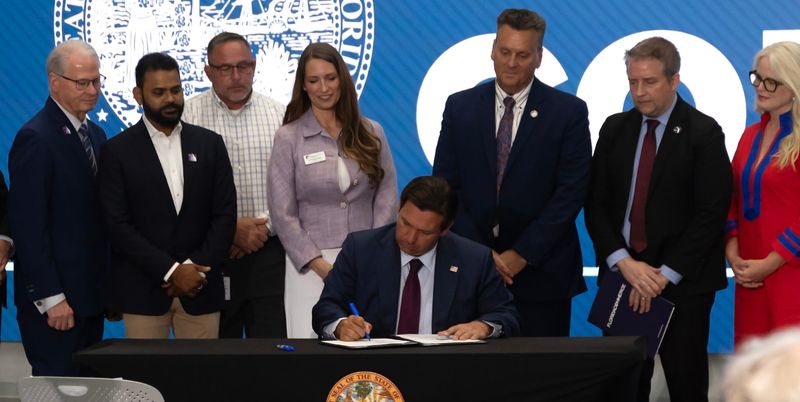
DeSantis appeared May 7 at Florida Polytechnic University in Lakeland to sign SB 484, a bill creating regulations for data centers, the computing facilities that enable AI programs. The university sits about 40 miles from Fort Meade, the rural community in Polk County where a 4.4-million-square-foot data center is planned.
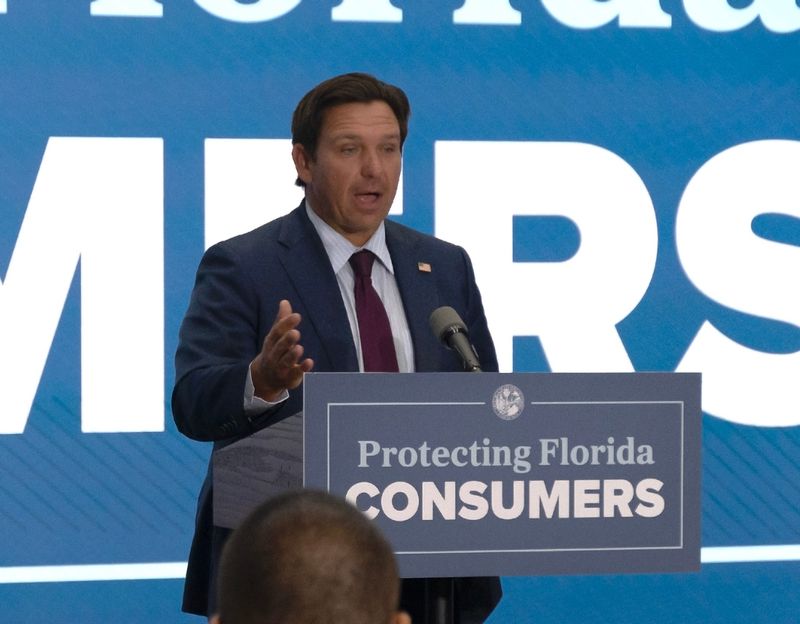
Standing before a giant digital screen that declared “Protecting Florida Consumers,” DeSantis touted the legislation as necessary to get in front of the rapid spread of data centers. Along with the Fort Meade facility, at least three large-scale data centers are under consideration in Florida.
SB 484, introduced by state Sen. Bryan Avila, R-Hialeah Gardens, creates detailed requirements for the approval and operations of data centers, focusing particularly on power and water use. All of Polk County’s six legislators voted for the bill, which passed easily in both the House and Senate.
“So, this makes sure that local governments are ultimately in control about how their communities are developing vis-à-vis these hyper-scale data centers,” DeSantis said. “It also includes strict definitions of large-scale data centers so that costs are not permitted to be passed on to consumers.”
As the 12-page bill states, the Legislature finds that data centers and other large-load utility customers “may present unique planning, infrastructure, and compatibility considerations.” The bill says that such concerns should be addressed through local comprehensive planning and land-development regulations.
When one class of utility customer requires “uniquely large electrical loads at a single location, it imposes a disproportionate risk on the other ratepayers of this state,” the bill says. As a result, the Florida Public Service Commission must enforce rate structures to prevent the shifting of costs for serving large-load customers onto all ratepayers, the legislation says.
The measure defines a large-load customer as one needing a monthly peak load of 50 megawatts or more of electricity. The Fort Meade data center is expected to require 1.2 gigawatts at full capacity.
The bill bars public utilities from providing power to large-load customers if they are foreign entities.
DeSantis blasts tax breaks
Before signing the bill, DeSantis listed various concerns about the construction of large-scale data centers. He focused largely on the potential for increased utility rates and developers’ claims of economic development.
“Some of these jurisdictions have given them tax breaks to do the data centers, because they say it’s going to be good for the economy,” DeSantis said. “The problem with that is — whoever builds it, gets paid to build it, that is definitely an economic benefit for that company who gets contracted to do it. But once the data center is built, it doesn’t employ very many people. It’s mostly just servers.”
Stonebridge has said that its data center would create 456 jobs when fully operational, with an average salary of more than $100,000.
The Polk County Commission voted unanimously in November to offer a 10-year, $140 million tax abatement to Stonebridge, the developer of the Fort Meade data center. DeSantis was asked if commissioners were wrong to approve those tax breaks.
“These guys, you should be charging them more,” DeSantis said. “They’re trying to take data centers all over the place. These are rich companies. … I would charge them more if you’re going to do it. I’m not saying to do it, because I know the people in Fort Meade didn’t want to do it, but … certainly not the (tax) breaks. I don’t think … that’s the way to go.”
Almost all public speakers at recent Fort Meade city meetings opposed the project, though city commissioners have said that an equal number of citizens quietly support the plan.
Stonebridge leaders have not revealed who the ultimate owner and operator of the Fort Meade data center would be.
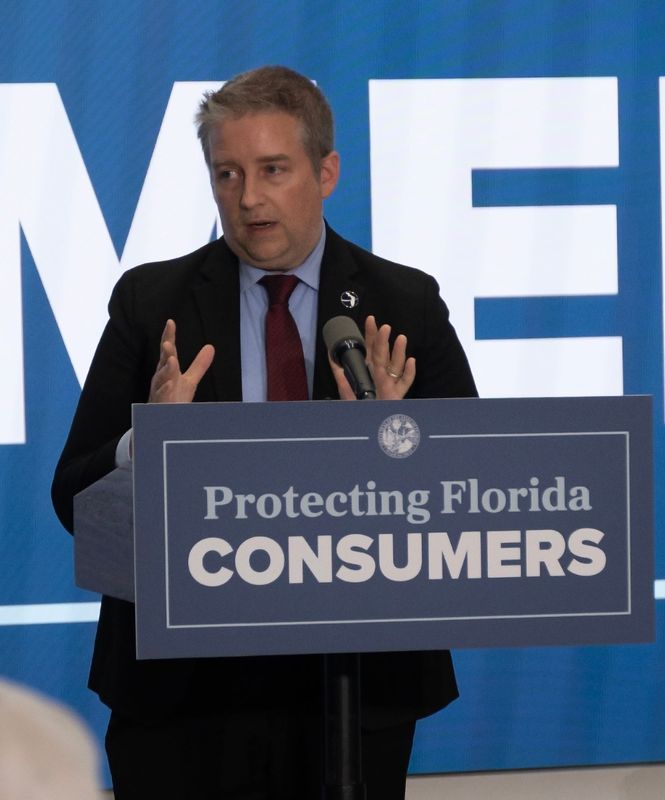
Florida Secretary of Commerce Alex Kelly also spoke at the bill signing. He cast skepticism on the economic promises made by developers of data centers.
“They come to towns, cities, counties, with, you know, big, shiny economic development objects and with lots of promises,” Kelly said.
But those promises often come with “a lot of catches,” he said.
Governor: Project is ‘not viable’
Fort Meade’s City Commission approved zoning and land-use revisions last year that enabled Stonebridge to build the data center on a 1,300-acre property. At its April 14 meeting, the commission voted 5-0 to approve a 20-year development agreement with Stonebridge.
The developer agreed to pay a $10 million advance on future property taxes, plus $300,000 to help Fort Meade secure future water supplies.
One day after the vote on the development agreement, Kelly sent a letter to Fort Meade Mayor Jaret Landon Williams describing the city’s approval process as “fundamentally flawed.”
DeSantis, speaking at the bill signing, said the project was “not viable.”
The legislation sets a deadline of Oct. 1 for all public utilities to submit proposed rates for large-load customers to be approved by the PSC.
The bill addresses concerns about the effects of large data centers on water supplies. The facilities use water to cool their masses of computers. Facilities will need approval from water-management districts through a hearing before gaining water-use permits.
As part of the state oversight of data centers, the Office of Program Policy Analysis and Government Accountability will contract for “an independent, interdisciplinary study of policy considerations related to the construction and operation of large-scale data centers,” the bill states. The study will consider economic development and tax revenue impacts, the effects on natural resources, energy use and rate impacts, and public health.
DeSantis held the event at the state university most focused on technology to sign a bill that sets restrictions on facilities that power the suddenly dominant form of technology, artificial intelligence.
Florida Poly, the only state university focused on STEM subjects – science, technology, engineering, and math – has moved in recent years toward deep involvement with AI technologies.
For example, in January, the university announced that it would receive close to $3 million in federal funding to launch an applied AI and cybersecurity lab. The same month, Florida Poly reported gaining a $500,000 grant from Google to help embed AI into its entire STEM curriculum.
DeSantis said that he acknowledges the many positive impacts that AI can make in such areas as defense, robotics, and medical research.
Gary White can be reached at gary.white@theledger.com or 863-802-7518. Follow on X @garywhite13.
This article originally appeared on The Ledger: In Lakeland, DeSantis signs bill setting guidelines for data centers
Reporting by Gary White, Lakeland Ledger / The Ledger
USA TODAY Network via Reuters Connect