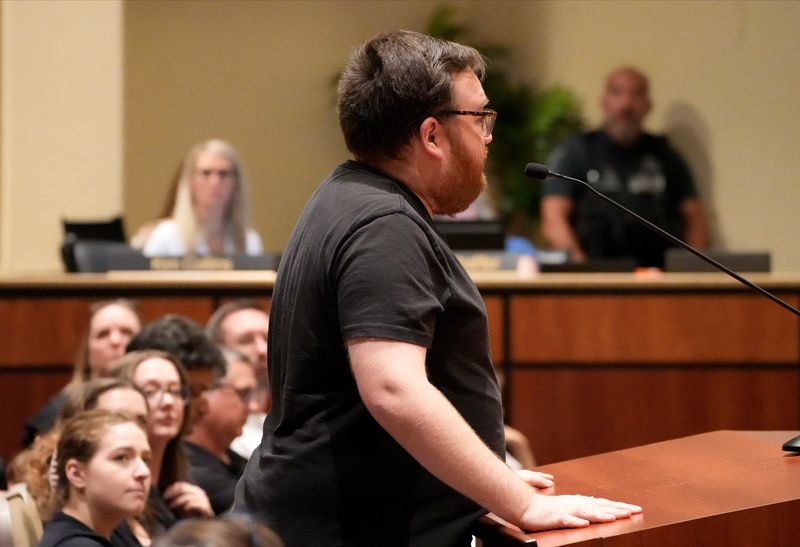
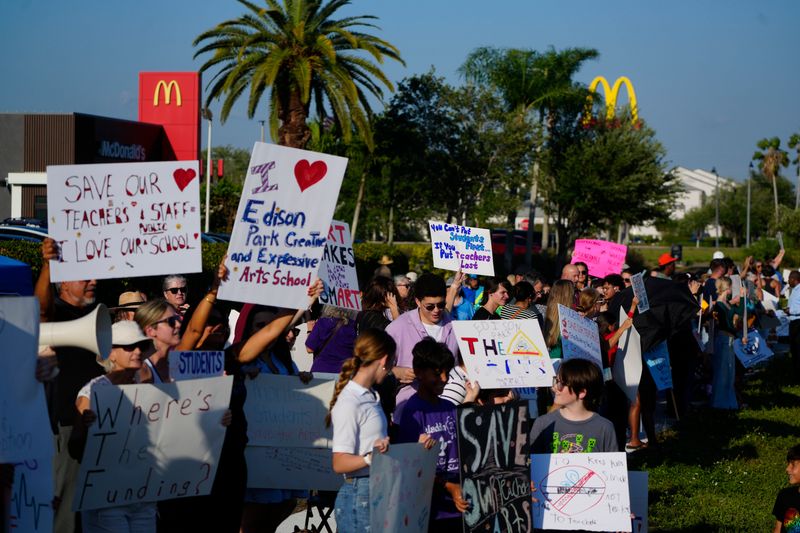
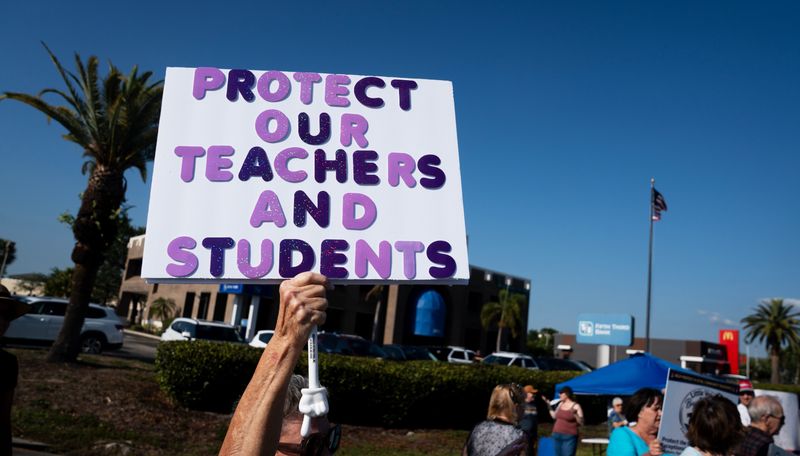
Parents, teachers and students packed the Lee County School Board chambers Tuesday, May 12, to speak out against budget changes and teacher cuts as the district faces a projected $92.4 million deficit.
Public commenters raised concerns about teacher contract non-renewals, special education consolidation and a proposed plan to relocate students from Buckingham Exceptional Student Center.

While the School District of Lee County (SDLC) described the changes as part of a “right-sizing” initiative meant to better align school budgets with state funding, residents argued the approach prioritizes administrative growth over classroom stability.
How is the district handling its debt, and how does it affect schools?
Deputy Superintendent Ken Savage introduced the “SDLC Right Size and Efficiency Initiative” during the board’s afternoon workshop, describing it as a response to long-standing overspending.
Savage told the board that individual schools have historically been allocated funding above what their enrollment supports under the state’s student-based funding model.
“This wasn’t $35 million of cuts that were schools. It was actually just taking all above formula allocation. So every dollar beyond what a school actually earned based on the weighted FTE, the projected weighted FTE for that school amounted to $35 million. So it wasn’t that we went in and just cut the schools. It was strictly a different allocation,” Savage said.
The changes translate to a projected average reduction of about 3% across the district. Principals have been directed to prioritize classroom instruction while streamlining administrative staffing and converting some coaching roles back into teaching positions.
Why are teachers and parents protesting the budget changes?
While the district characterizes the process as a realignment, dozens of teachers have received preliminary notices that their contracts will not be renewed for the upcoming school year.
Gage Griffin, the husband of a teacher whose contract was not renewed, spoke during the board meeting Tuesday, his voice breaking.
“It’s because of her that we could afford to buy our first home. It’s because of her I was able to go back to school. And it is because of you she no longer has a job,” he said. “It’s hard to believe that you can say fiscal responsibility is the reason that you’re cutting waste when what’s being cut is my wife’s job, my family’s home. And it’s shameful saying that she’s waste, and to stand in front of us and lie about what you can do is wrong.”
Griffin was referring to recent district statements framing the staffing changes as an effort to reduce waste
“Taxpayers expect fiscal discipline, and that is exactly what we are delivering,” said Superintendent Denise Carlin in a district statement released April 29. “These efforts are about reducing waste, not cutting the budget for education, athletics, or the arts. Too much money has drifted away from the classroom, and to stay in line with the state’s funding model, we must realign spending so it follows the student based on current enrollment. Our top priorities will always be improving student achievement, strengthening school security, and paying our teachers more. By eliminating waste and unnecessary spending, we can direct more resources to those priorities while also reducing overall costs. This realignment is designed to deliver long-term results and put our district on a stronger, more fiscally responsible path.”
Parent India Palencia, who’s also running for school board, criticized the district’s priorities during public comment.
“This community is being asked to accept deep school cuts as responsible leadership, but you cannot claim students come first when classrooms are the ones absorbing your instability,” she said, adding that teachers, support staff, arts, electives, technology programs and student services are what disappear when cuts are made.
“A potential $92 million deficit does not happen overnight. That points to years of failed forecasting, failed planning and failed oversight,” Palencia continued. “Schools are absorbing the instability while administrative growth and expensive spending continue. And now the public is being told these will continue to be ongoing cuts. The district keeps discussing symptoms while avoiding the root causes. You cannot fix what you refuse to face.”
Concerns over special education restructuring
The district’s plan to consolidate Exceptional Student Education (ESE) students by disability type into specific schools drew sharp criticism from parents and displaced staff.
Todd Dusenberry, a life skills teacher at Cypress Lake High School, told The News-Press & Naples Daily News that the model isolates vulnerable students.
“If you don’t get buy-in from the administration and from the students, you’re almost isolating them, because you don’t have unlike students around them. What we have right now, we have a mixture of all the ESE kids, and we work together,” Dusenberry said.
Trea Grimmitt, a senior at Cypress Lake High School, told the board how she felt alone and out of place after moving to Lee County from Illinois during her sophomore year.
“That changed because of one teacher, my world history teacher. He made me feel seen and welcome. He connected with his students every day,” she said. “I’m speaking about him in past tense because you guys cut him.”
“From a student’s perspective, this feels driven by money, not people,” Grimmitt added. “When you remove teachers, you remove stability. When you move ESE students, you remove belonging.”
Buckingham relocation remains a concern
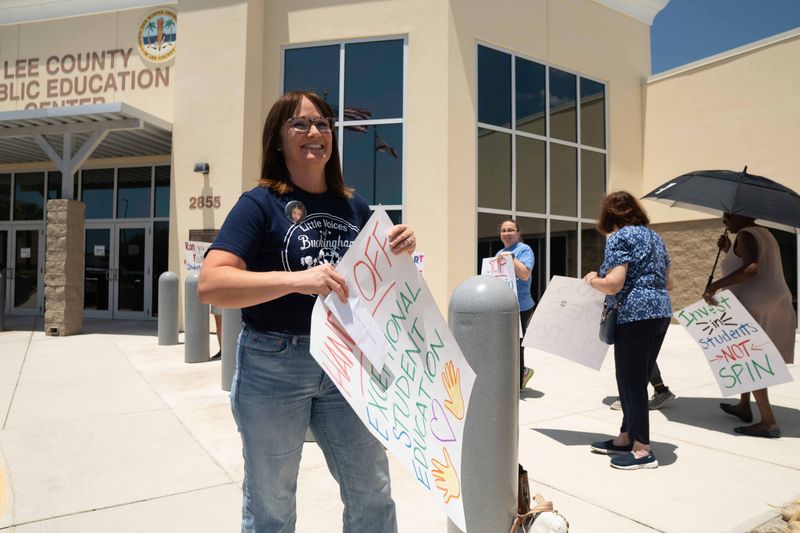
Just before a protest April 29, the district announced it had paused a highly contested plan that would relocate students from Buckingham Exceptional Student Center, a specialized school for children with medical needs, to Royal Palm Exceptional Center, a campus currently serving students with behavioral challenges.
Despite the pause, residents remain wary and demand a permanent halt.
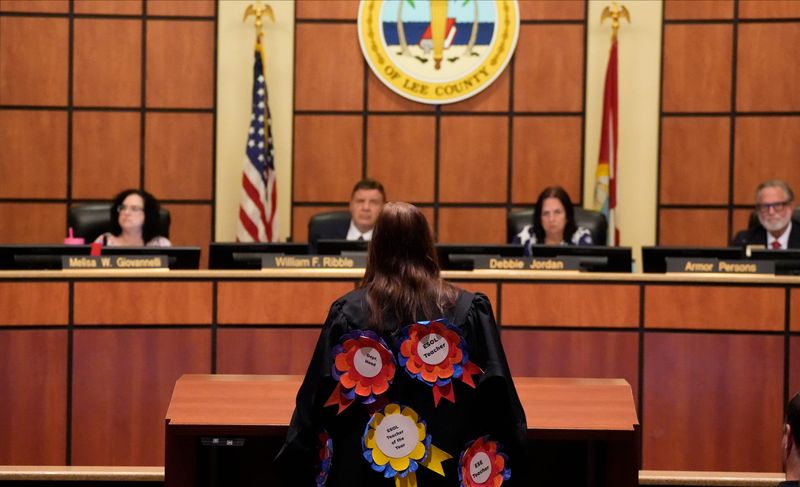
Former ESE teacher Cc Canciani, who spent 25 years in the district before her position was eliminated in March, wore a black graduation gown decorated with handmade paper flowers with writing that acknowledged accolades, including “ESOL Teacher,” “Dept. Head,” “ESOL Teacher of the Year” and “ESE Teacher.”
“I know that it has been put on pause, but that is just a pause, and I’m afraid of the storm that might come,” Canciani said to the board. “Do I think it could be a success? Absolutely, I do. But do I think it can happen overnight without any funds? No, I do not.”
Kassandra Stafford, whose son Victor made progress at Buckingham, also spoke.
“This school is not just a building. It’s a lifeline,” Stafford said. “Our children do not fit in a one‑size‑fits‑all environment. They need stability, routine and people who truly understand them. Please see the human side of this decision. Nothing about us without us.”
Buckingham parent liaison Katie Peterson, whose daughter Grace is a second‑grader at Buckingham and is blind, addressed the board.
“I first want to thank you for pausing the relocation of the Buckingham students. I continue to urge you to make the pause permanent, but tonight I want to initiate a broader conversation,” Peterson said, then asked the board, “When people pass by individuals with visible exceptionalities, why do they so often avoid engaging with them?”
She questioned why students with visible disabilities are often excluded from district messaging, such as on social media posts, and why families were not consulted before decisions were made.
“I doubt these decisions are made with malicious intent,” Peterson said. “But while I appreciate the desire to not do the wrong thing, I believe we need to swing the pendulum the other way and instead focus on doing the right thing and see how truly exceptional these students really are.”
Both Buckingham and Royal Palm campuses will operate as they currently do when the new school year begins, the district told The News-Press & Naples Daily News.
“The pause reflects the district’s commitment to ensuring community voice is part of this process. We are reviewing concerns that have been raised and giving serious consideration to interests that have emerged from the community, including exploration of a potential charter designation for the school,” district spokesperson Riley Kempton said in a statement. “Any future decision will be made with meaningful engagement from the families and staff most affected.”
How are art programs faring amid budget cuts?
Attendees also raised concerns over reductions to arts and specialized programs across the district.
Anne Levesque, a junior at Gateway High School, told board members that hundreds of positions have been eliminated districtwide, including at least 100 art teachers, according to students. She said Gateway’s theater program had been eliminated entirely and other arts programs, including dance, were being scaled back.
“While this may not be significant to some, a lot of people’s worlds were turned upside down due to this decision, as theater was their livelihoods,” she said.
Levesque said students launched a petition calling on the district to reverse those decisions. The petition titled “Restore arts departments at Gateway High School” gathered more than 630 signatures as of Thursday, May 14.
Cypress Lake High School senior Jianna Zaliagiris, who will attend Florida State University to study physics and astrophysics, credited her success to teachers who supported both academics and the arts.
“Teachers are the foundation of our education,” Zaliagiris said. She referenced instructors who led championship teams, stayed late to rehearse musical performances and helped students balance coursework with extracurriculars.
“There are students who want to be involved in everything just like I have, and they deserve to have their voice heard as well as the ability to be able to do so,” she said.
Students urged the board to reconsider cuts and seek a more balanced approach between athletics and the arts.
In a statement released April 21, the district said elective opportunities would remain available.
“We hear you, and we want you to know: our programs will remain. Arts, athletics, and extracurricular activities will continue,” the statement read. “The delivery model may evolve, but the district’s core mission does not change.”
Carlin also addressed the issue during a press conference May 1.
“I am not anti-arts. I am for the arts, I am for athletics,” Carlin said. “Those are some great things that help our children stay engaged into the instruction that occurs in our classrooms.”
She added that she reviews each school budget to ensure district priorities are met and that “arts and athletics remain part of a well‑rounded education for our students.”
How did the superintendent and board members respond?
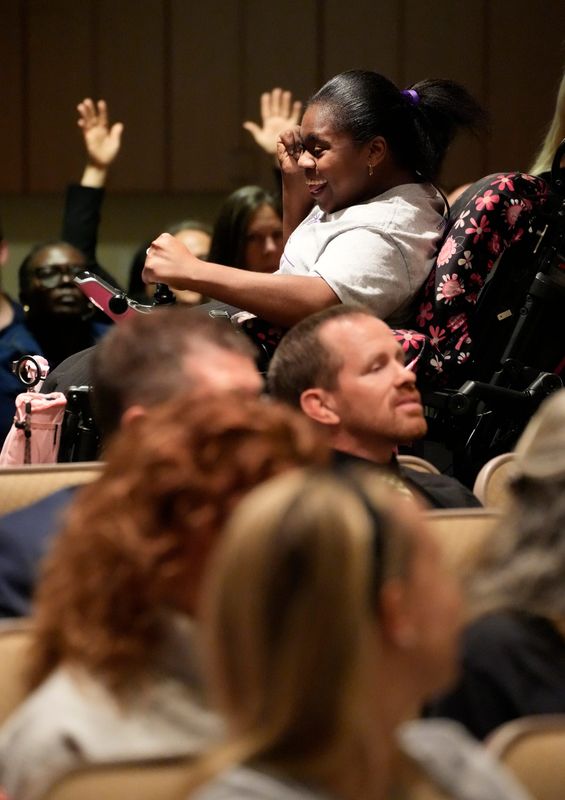
Officials repeatedly asked attendees to stop clapping during public comment. Some showed support with “jazz hands,” raising their palms and wiggling their fingers in silent applause.
After the final speaker, attendees chanted “shame” when board member Armor Persons described the public comment period as “basically civil,” prompting the board to call a five‑minute recess.
Carlin defends the budget changes as part of a broader push for fiscal responsibility, saying the district first cut spending at the central office level. She has noted her administration reduced central office costs by nearly $16 million as part of the effort.
Savage echoed that message during the board’s afternoon workshop, describing the overhaul as a long‑overdue correction to years of over‑allocation at schools. He said the district was not “cutting schools,” but rather removing funding that exceeded what enrollment supports under the state’s formula.
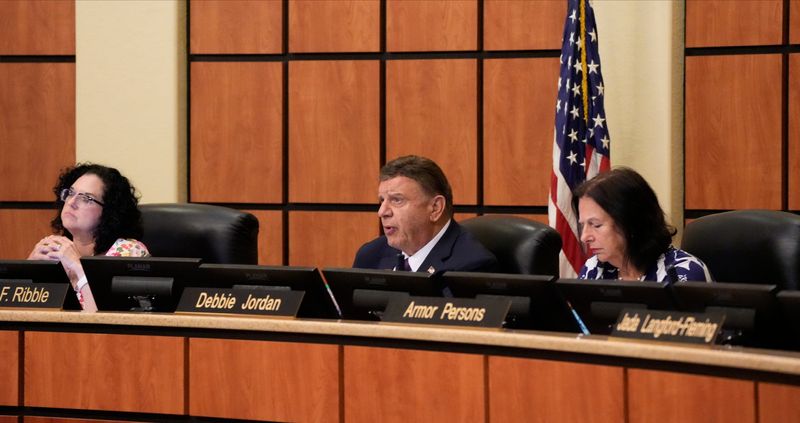
Board member Bill Ribble supported the district’s “right‑sizing” efforts, comparing it to private‑sector management. “This right-sizing effort happens every day in corporate America,” he said. “If no one’s buying your widgets, you have to figure out how to address your inventory.”
By contrast, board members Debbie Jordan and Melisa Giovannelli raised repeated concerns about optics, timing and public trust.
Jordan questioned whether the district was modeling the fiscal discipline it was asking of schools. During the workshop, she asked, “How do we ensure that this process is about strategic efficiency rather than simply balancing a budget on the backs of employees and schools?”
She added, “We need to make sure that we’re completely transparent.”
Giovannelli pulled several agenda items for discussion, including new job descriptions and contracts, saying the moves sent the wrong message while teachers were losing jobs.
“This is not the time,” she said. “We’re asking schools to get lean and cut budgets when teachers don’t have jobs. It looks terrible on us.”
Despite those objections, the board ultimately approved the items through majority vote.
What happens next for the district budget?
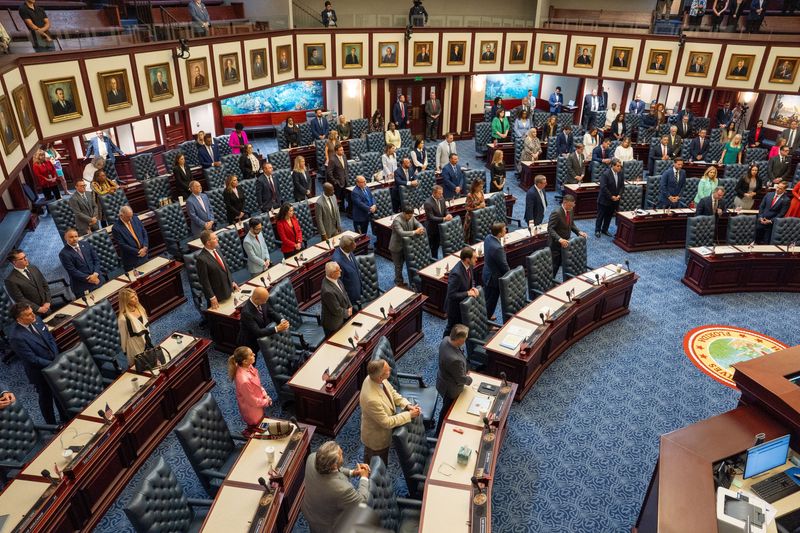
Regarding the broader budget, the district is currently operating without a finalized state budget. Florida lawmakers returned to Tallahassee May 12 for a special legislative session to reach an agreement on the state budget.
The school district will continue a department-by-department review over the next 8 to 12 months to identify further efficiencies in the district’s central office. The final budget for the 2026-27 school year is scheduled for adoption in September.
Do you have an opinion about this topic? Write a letter to the editor and send it to letters@naplesnews.com and/or mailbag@news-press.com. Keep it to 250 words or fewer and include your contact info. Have more to say: Send a guest column of no more than 600 words.
Mickenzie Hannon is a watchdog reporter for The News-Press and Naples Daily News, covering Collier and Lee counties. Contact her at 239-435-3423 or mhannon@gannett.com.
Please support local community journalism and stay informed about Southwest Florida news by subscribing to The News-Press and Naples Daily News; download the free News-Press or Naples Daily News app, and sign up for daily briefing email newsletter, food & dining and growth & development newsletters here and here.
This article originally appeared on Fort Myers News-Press: Lee County teachers, parents plead against school budget cuts
Reporting by Mickenzie Hannon, Fort Myers News-Press & Naples Daily News / Fort Myers News-Press
USA TODAY Network via Reuters Connect