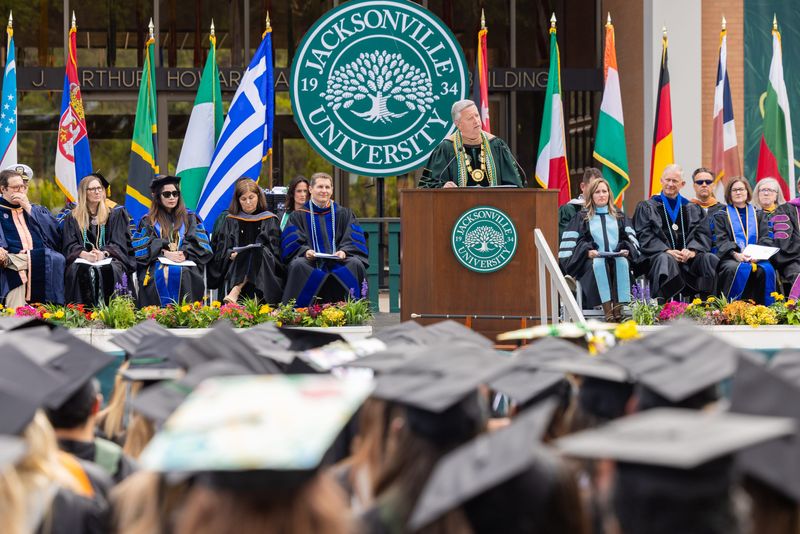
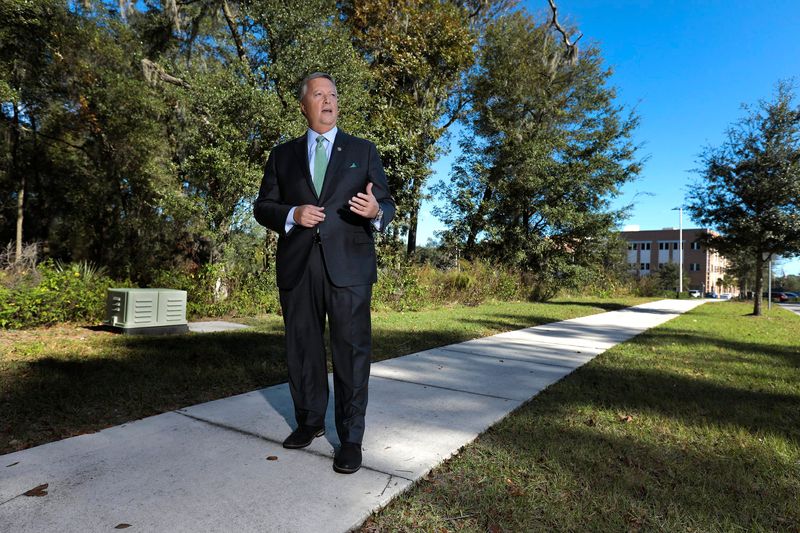
Jacksonville University President Tim Cost is leaving the school’s top job in 2026, creating uncertainty about its future as University of North Florida officials also mull choosing a new leader.
Cost said he’ll become JU’s chancellor on July 1, focusing on external relationships in a long-vacant position held 31 years ago by his onetime mentor, the late President Frances Bartlett Kinne.

“I didn’t say I was retiring,” added Cost, 66, who said he’ll concentrate his efforts in areas where he can be useful to the next president. Cost has led JU since February 2013 and said he’s looking forward to having more time to deal with students.
His transition was announced the same morning trustees at the University of South Florida had scheduled to interview UNF President Moez Limayem and sign off on a search committee’s recommendation to make Limayem USF’s ninth president.
USF’s prospective president must still be approved by the state university system’s board of governors, while JU’s trustees have the final word on Cost’s successor.
JU “plans to conduct the customary search” for that replacement, the school said in a release Oct. 21.
Cost said trustees have discussed him stepping down for years and that a committee recently shortened a list of candidates from a dozen to no more than five. Cost’s five-year contract as president, last renewed in 2022, specified he could choose to become chancellor at any point after July 2025.
Stressing that he’s not involved in choosing his successor, Cost said he thought JU’s trustees could pick an interim president by mid-November. The Jacksonville Business Journal quoted unnamed sources as saying UNF’s trustees are considering two of their own, former Jacksonville City Council President Kevin Hyde and former state Sen. Rob Bradley, to succeed Limayem.
Cost, a 1981 JU graduate, was a trustee before becoming president after a corporate career that included being executive vice president of food and drink giant PepsiCo.
The college generally gained popularity and image during Cost’s administration, earning spots on Forbes’ 500-entry America’s Top Colleges list for the past two years. Tied for 62nd best Southern regional university in U.S. News & World Report’s 2017 college rankings, the school stood at 37th place when the 2026 ratings appeared in September.
Of more consequence, student applications to enter JU rose roughly 90%, from 4,298 in fall 2018 to 8,176 in fall 2024, according to “common data set” admission figures on the school’s website. Figures for 2025 haven’t been released yet.
Cost said he has made a point of trying to align JU’s courses and degree programs with subjects that people in Northeast Florida said they needed someone to teach.
JU’s Keigwin School of Nursing and the Brooks Rehabilitation College of Healthcare Science launched during Cost’s tenure, as did its College of Law, whose inaugural class graduated in May. The university added more novel elements as well, such as the 30,000-square-foot STEAM Institute (science, technology, engineering, arts and math), an area for applied learning in fields ranging from animation and fintech to cybersecurity and robotics.
But Cost also oversaw the retirement of dozens of “under-enrolled” majors and layoffs of about 40 faculty members in April, four months after the body that accredits JU and other colleges across the South issued a December 2024 warning that the university had to correct findings from a 2024 audit that said JU failed to “manage its financial resources in a responsible manner.”
The accrediting board, the Southern Association of Colleges and Schools Commission on Colleges, agreed to revsit the situation this December, with JU’s finances scheduled for revew again after June 2025. The longest the association will allow a college to remain “on sanction” is two years, but Cost said Oct. 20 that the 2025 financials didn’t repeat the previous year’s problems.
“Did we have a clean audit? Yes,” Cost said, adding that talks with the accrediting board have been going well ahead of accrediting staff reevaluating JU in December.
Cost said some ideas he’s worked on are still coming to fruition, including an initiative involving artificial intelligence and the opening in 2026 of the Lake Erie College of Osteopathic Medicine’s new campus, called LECOM at JU, where a partnership agreement ensures some JU students will enroll at Jacksonville’s first four-year medical school.
Although elements of JU’s change during Cost’s tenure have sometimes been controversial, his record has drawn praise for invigotating the 91-year-old institution.
“President Cost’s exemplary leadership over the past 14 years has transformed our university in remarkable ways,” said JU Board Chair John Miller said in comments included in the university’s release. “Under his guidance, we’ve enjoyed growth in undergraduate and graduate enrollment, developed countless strategic partnerships in and outside of our community, and elevated our profile both in the region and beyond.”
This article originally appeared on Florida Times-Union: JU President Tim Cost leaving role in 2026, adding to local colleges’ changes
Reporting by Steve Patterson, Jacksonville Florida Times-Union / Florida Times-Union
USA TODAY Network via Reuters Connect