The House Oversight Committee, seeking more information about the Jeffrey Epstein case, has issued subpoenas for six former U.S. attorneys general and two former FBI directors to testify in hearings starting Aug. 18.
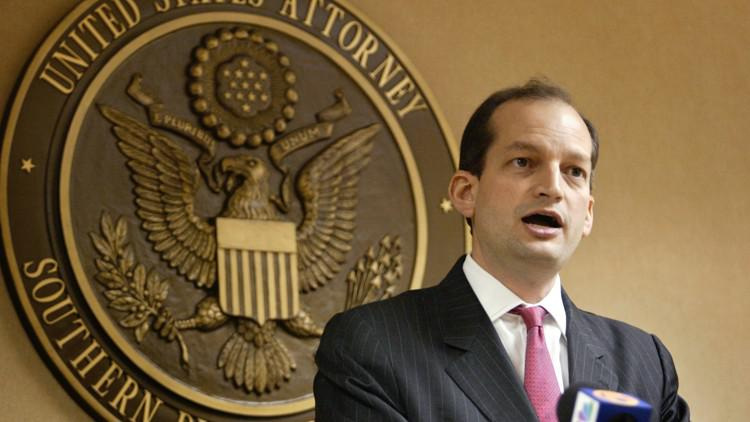
Absent from that list is Alexander Acosta, the former South Florida U.S. attorney who approved the “deal of the century” for Epstein in 2008 in Palm Beach County, freeing up the predator to sexually abuse more minors until New York prosecutors charged him with sex trafficking them in 2019.

Epstein pleaded guilty to two prostitution-related felonies in 2008 as part of that deal and was sentenced to 18 months in the county jail. Had the charges recommended by Palm Beach police, who had found dozens of victims, been prosecuted, Epstein would have faced decades in prison.
Survivors are not happy that they won’t be hearing from Acosta.
“How can any genuine investigation into the federal government’s sweetheart deal with Epstein (including the extraordinary grant of blanket immunity to all his named and unnamed co-conspirators) omit Alex Acosta?” Epstein victim attorney Jack Scarola of West Palm Beach told NBC News in a statement.
Alexander Acosta resigned from Trump’s Cabinet during 2019 maelstrom
Acosta, the former secretary of labor during President Donald Trump’s first term, resigned in 2019 amid the first Epstein firestorm concerning Acosta’s role in approving the deal. Epstein had just been arrested on sex-trafficking charges in New York.
Now, Trump is dealing with another swirl of controversy over DOJ’s declaration that it had reviewed its Epstein evidence and saw no reason to release any more of it. A batch that was already public was released in February.
Victims attorney Gloria Allred, in introducing a newly identified survivor on Aug. 6 who said she reported Epstein to Santa Monica, California police in 1997, urged Congress to require Acosta to testify.
Does Acosta’s former boss know anything?
One of those subpoenaed, former U.S. Attorney General Alberto Gonzalez, was Acosta’s boss in 2006-07 when Epstein signed the first version of the deal. Yet Gonzalez is not even mentioned in an 347-page report from a DOJ disciplinary investigation into how federal prosecutors handled the case in 2006-08 that ended with Epstein escaping a 60-count federal indictment.
Though Acosta didn’t sign Epstein’s deal, he participated in putting together the first draft and sometimes spoke to defense attorneys.
The DOJ investigation found no professional misconduct by Acosta or his prosecutors. But investigators did say he exercised “poor judgment” in relying too heavily on then-Palm Beach County State Attorney Barry Krischer, who’d already scuttled his own case before a 2006 grand jury and whom Acosta had no authority over.
Acosta relied on Krischer, for example, to give victims a heads up that Epstein would be pleading guilty in state court on June 30, 2008. Routinely, victims are allowed to give an impact statement in such circumstances. The state prosecutor told the judge that she had alerted the victims, but there is no evidence among state attorney documents that she had.
As soon as Epstein’s sentence was pronounced, the judge placed the agreement under seal for unknown reasons. The Palm Beach Post joined victims in getting it unsealed a year later.
One week later after the sentencing, survivor Courtney Wild filed suit, alleging that the prosecutors had violated her rights under the federal Crime Victims Rights Act, which requires victims be given a chance to confer on any plea deal and be given notice of any court proceeding.
She sought to invalidate Epstein’s deal. U.S. District Judge Kenneth Marra ruled in 2019 that prosecutors had indeed violated that law, but it became moot when Epstein was found dead in his jail cell months later.
These days, Acosta is a member of the board of NewsMax, which has among its headquarters a base in Boca Raton. He was appointed in March and serves as chair of the board’s audit committee. He reportedly lives the Washington D.C. suburb of McLean, Virginia.
What did the ‘deal of the century’ say?
Epstein pleaded guilty to two state charges though it had been federal prosecutors who negotiated the deal with Epstein’s high-powered attorneys not to launch a federal prosecution. He was sentenced to jail, not prison, for 18 months and then was to serve 12 months on house arrest.
Epstein was also required to register as a sex offender and to pay for a lawyer to represent victims and to not oppose lawsuits, if filed under a certain federal statute, for restitution. The FBI and state attorney furnished Epstein’s attorneys with a list of victims they had found.
In addition, it grants immunity to four named “co-conspirators” and any “potential” ones. Epstein also gave up any rights to appeal.
Epstein was to be given notice of any FOIA request or subpoena for the agreement before it would be disclosed.
If Epstein violated the non-prosecution agreement, he was to face the federal charges.
Acosta told DOJ investigators they wanted what the victims would have gotten if Epstein had been convicted at trial, “no more, no less.”
Epstein signed the first version of that agreement in September 2007. Then his attorney, former Whitewater special prosecutor Kenneth Starr, went to work on Acosta’s bosses at DOJ while the deal was put on hold.
Starr complained to the chief of the criminal division about the restitution provision and requested a meeting. It never happened.
While the lead line prosector, Marie Villafana of West Palm Beach, prepared an answer to Starr’s letter, she told her bosses she was working on finding all the ways Epstein had already breached the agreement in order “to convince you guys to let me indict.”
Acosta defended deal during 2017 confirmation hearing
Acosta, speaking before U.S. senators in 2017 during confirmation hearings to be labor secretary, defended the deal by pointing out that the Palm Beach County state grand jury had delivered an indictment on only one count of solicitation of prostitution, “carrying no jail time at all.”
The charge was a third-degree felony, which in Florida carries a maximum penalty of five years in prison. Epstein ultimately was sentenced to 18 months in the county jail, not prison, and was allowed out six days a week/12 hours a day in the Palm Beach County Sheriff’s Office work release program.
Acosta testified that he opposed the incarceration arrangements and pointed out that “the world was put on notice” when Epstein was required to register a sex offender.
The DOJ investigators ultimately concluded that Acosta and his prosecutors had not committed professional misconduct because they did not “intentionally or recklessly” violate “a clear and unambiguous standard governing the conduct at issue.”
They did conclude, however, that Acosta had shown poor judgment.
Acosta said he accepted responsibility for the deal, the summary says, and DOJ investigators agreed.
Holly Baltz is an editor at The Palm Beach Post. You can reach her at hbaltz@pbpost.com.
This article originally appeared on Palm Beach Post: Jeffrey Epstein: Congress not seeking to hear Florida’s Alex Acosta, who OK’d special deal
Reporting by Holly Baltz, Palm Beach Post / Palm Beach Post
USA TODAY Network via Reuters Connect