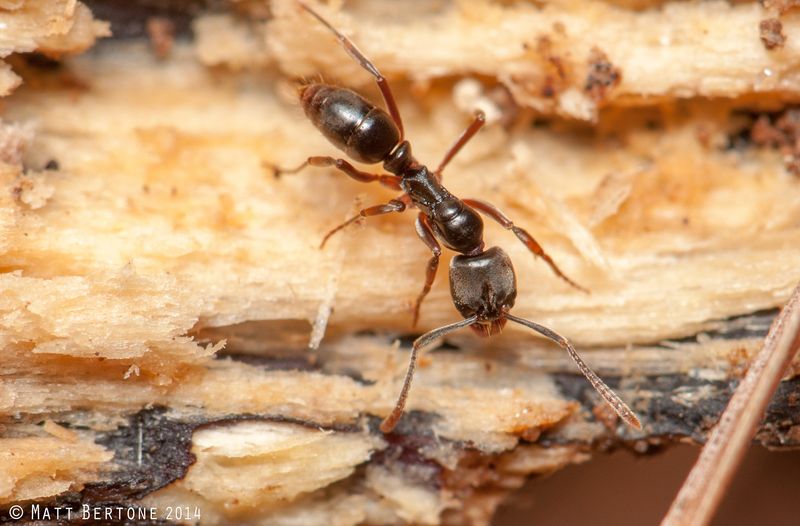
An inconspicuous insect with a potentially lethal sting has invaded the United States and is spreading across the country, wreaking havoc on local ecosystems. The insect, known as the Asian needle ant, is venomous and delivers a painful sting that can cause severe allergic reactions – and its spread across the country worries experts.
“Asian needle ants are in or under nearly every stump, log or branch on the forest floor,” Emilee Poole, an entomologist with the U.S. Forest Service, said of Georgia’s heavily invaded forests. But they aren’t just an issue for people going on a hike – they can easily adapt to living in urban and suburban areas, as well as forests.

Here’s what you need to know about the invasive ant and how to protect yourself and your family.
Can they hurt people?
Yes, the ant’s venom can cause a “throbbing, stinging sensation that can last over 30 minutes,” Poole said. “The throbbing and stinging can come back later in the day.”
Poole, who has been stung, said the sting site was red, itchy and mildly swollen.
However, the reaction may vary from person to person and may be worse for someone who is allergic to insect stings. People have reported severe reactions, including anaphylaxis, after being stung by the ant.
The Asian needle ant’s venom is a bit more likely to cause an allergic reaction than the sting of a honeybee, according to North Carolina State University.
Invasive ants go unnoticed
Identifying Asian needle ants can be tricky, as they look similar to other ant species.
The ants are shiny and range from dark brown to black, according to the Forest Service. But their back legs and antennae are an orange/brown color. And they are small, with workers being about 0.2 inches long.
The colonies are also smaller than those of other ants commonly found in one’s home, according to NC State University.
“The species does not build obvious mounds like the well-known, imported fire ant,” said Poole. “Asian needle ant colonies can go easily unnoticed.”
These insects don’t call a typical ant hill home, and instead are found in the following things, according to Poole: Mulch, potted plants, cracks in branches, logs, railroad ties, under leaf litter, potting and landscaping soil, wood chips.
Where the ants can be found
The ants – which are native to Asia, with a natural range that includes China, Japan and North and South Korea – have been reported in the following states, according to Ant Maps: Arkansas, Alabama, Connecticut, Florida, Kentucky, Georgia, Maryland, Massachusetts, Mississippi, Missouri, Ohio, Pennsylvania, New York, North Carolina, Rhode Island, South Carolina, Tennessee and Virginia.
The ants also have spread to the West Coast and Midwest, and have been reported in Washington and Wisconsin, according to Ant Maps.
“It is likely the range of needle ants is greater than what is currently known, since the ants can easily go undetected,” Poole stated.
The ants are here to stay
The ants have been in the United States for almost 100 years, Poole said. But the impact they’ve had on local ecosystems wasn’t realized until the past 20 years, according to the Forest Service.
Areas where Asian needle ant populations have been established have seen reduced native ant populations that are key to dispersing seeds of native plant life in forests.
The ants are also “highly predacious” and will hunt other insects and invertebrates or scavenge for food, according to Poole.
Management strategies and bait options are being researched, but despite the negative side effects, the ants are probably here to stay, according to the Forest Service. Not only is it costly to remove, but measures to exterminate the Asian needle ant in forested or remote areas could also harm beneficial species.
“It is extremely challenging to eliminate Asian needle ants once they are established,” Poole stated.
‘Prevention is key’
To avoid spreading Asian needle ants, Poole recommends people be cautious when moving materials, especially wood and other landscaping materials.
How to protect yourself
Asian needle ants aren’t usually aggressive, despite their powerful sting, but people should still take precautions.
“Being careful where you sit or set your belongings is important,” Poole said.
Double-checking where you’re resting or placing your things can help prevent you from coming in contact with colonies that might be nesting there. People should also be cautious while near logs, rotting wood, and rocks.
The Forest Service suggests that those with known allergens or sensitivities to insect venom consider having an epinephrine auto-injector, or EpiPen, on hand.
FLORIDA’S OTHER BITING ANTS
Florida ants that bite or sting primarily include the invasive red imported fire ant, the carpenter ant and the native harvester ant.
Red imported fire ants
The bite/sting: These aggressive ants grab the skin with their jaws and then repeatedly sting with their abdomens, injecting a potent, burning venom.
The symptoms: The stings quickly develop into intense, itchy, white fluid-filled pustules that take several days to heal.
Habitat: Widespread across open grassy areas, yards, and disturbed soil, where they build large, dome-shaped mounds.
Carpenter ants
The bite/sting: They do not sting, but large workers can deliver a very painful defensive bite and may spray formic acid into the wound.
The symptoms: Sharp, immediate pain followed by stinging or burning from the acid, which typically fades quickly.
Habitat: Large ants with orange and black bodies that often nest in rotting wood, trees and occasionally wall voids or attics.
Harvester ants
The bite/sting: They possess a powerful sting that is notoriously painful.
The symptoms: Severe, localized pain and swelling. Their venom is highly toxic and can trigger strong allergic reactions.
Habitat: Primarily found in dry scrub and pine flatwood habitats. Their nests are often surrounded by cleared areas of sand, pine needles, or charcoal.
Minor biting ants
Other species like the acrobat ant or twig ant can also bite; and crazy ants may bite when disturbed; however, their reactions are generally very mild and short-lived.
Additional reporting from Will Watts, and the UF/IFAS.
This article originally appeared on Marco Eagle: Invasive Asian needle ant packs painful sting; hard to spot, here to stay
Reporting by Julia Gomez, USA TODAY NETWORK – Florida / Marco Eagle
USA TODAY Network via Reuters Connect