The Polk County budget director unveiled a $3.91 billion budget on July 17 with an emphasis on public safety, retaining county employees and sourcing additional public water supplies, among others.
“Preparing a cautious, conservative budget is challenging under normal circumstances. However, I would say these are anything but normal times,” County Manager Bill Beasley said while introducing the budget director, Christia Johnson.

“Even with significant potential property tax reform looming, this budget continues to address the demands brought on by population growth, public safety priorities, regulatory burdens, infrastructure demands, community health challenges, environmental preservation desires, affordable housing pressures and economic development goals,” he added.“
The proposed 2026-2027 budget presented to the County Commission represents a 12.9% increase compared with last year’s budget.
The County Commission does have control over the general fund portion of the budget, which is $764.3 million for the upcoming fiscal year, an increase of about $38.35 million. The general fund comprises about 20% of the total proposed budget.
The general fund revenues are generated by property taxes, the half-cent sales tax and a public service tax, with smaller revenues received through fees from licenses and permits, fines, charges for service, interest earnings and intergovernmental sources.
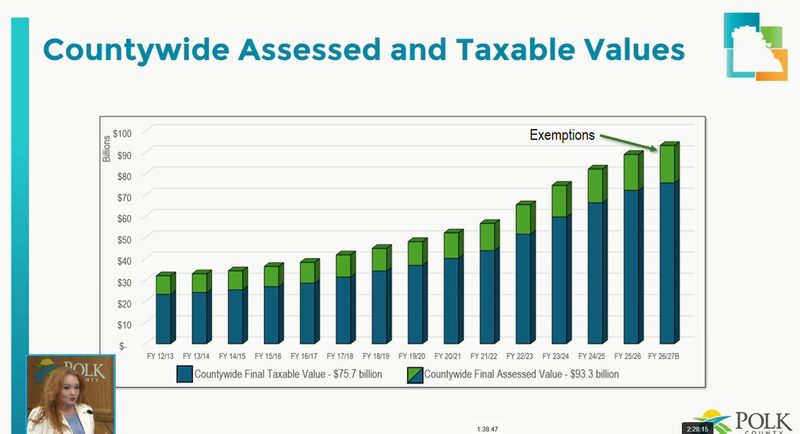
While the proposed 2026-2027 budget will not be impacted by property tax reform, the county could lose up to $100 million in ad valorem tax revenues during the 2027-2028 and 2028-2029 budget years if a much larger homestead exemption is approved in November by 60% of Florida voters.
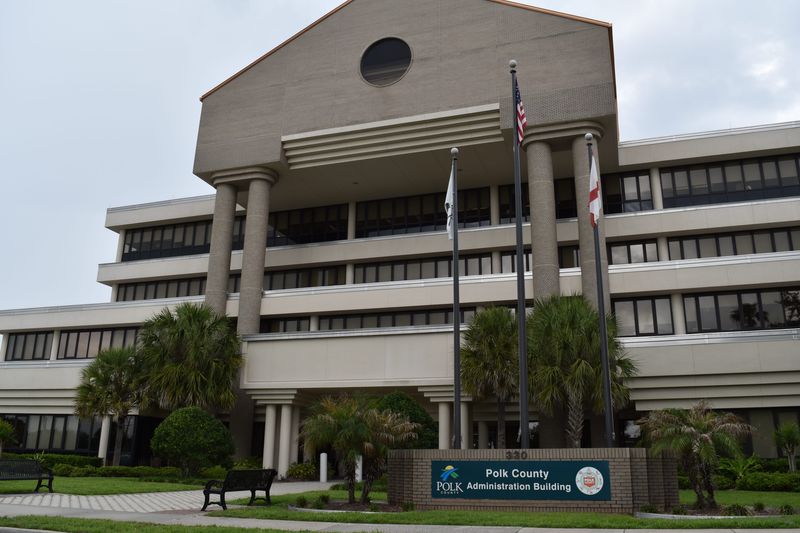
On July 21, the board will adopt the millage rates and assessment fees during its regularly scheduled County Commission meeting. That meeting is at 9 a.m. in the County Commission board room at the County Administration building at 330 W Church St., Bartow.
The first public hearing on the budget will be held Sept. 14 prior to preliminary adoption, and a second hearing will be held Sept. 21, before the budget is voted on for final adoption. The new budget year would begin Oct. 1.
Average Polk County homeowners can expect to pay more
Assuming a homestead exemption of about $51,000 on a home valued at $279,561 (taxable value of $228,150), the increase in residential homeowners’ tax bills will be about $66.36, which includes both ad valorem taxes and assessments. Those other assessments are flat fees for fire service, waste collection and waste disposal.
On such a home, those would be $1,701.09 and $751.80, respectively, for a total payment due of $2,452.89. That only counts the county portion of the bill for unincorporated areas, and does not include taxes for municipalities, the school district, water district or other taxing authorities.
The millage rate is unchanged at 6.6348 mills in the proposed spending plan. The millage rate is used to determine property taxes: 1 mill equates to $100 of tax for each $100,000 of assessed property value.
Funding derived from the countywide levy provides and annual allotment for the general fund, emergency medical, transportation and environmental lands. In unincorporated Polk, there are municipal taxing units for parks, libraries and stormwater as well as one to assist with law enforcement in the Rancho Bonito area.
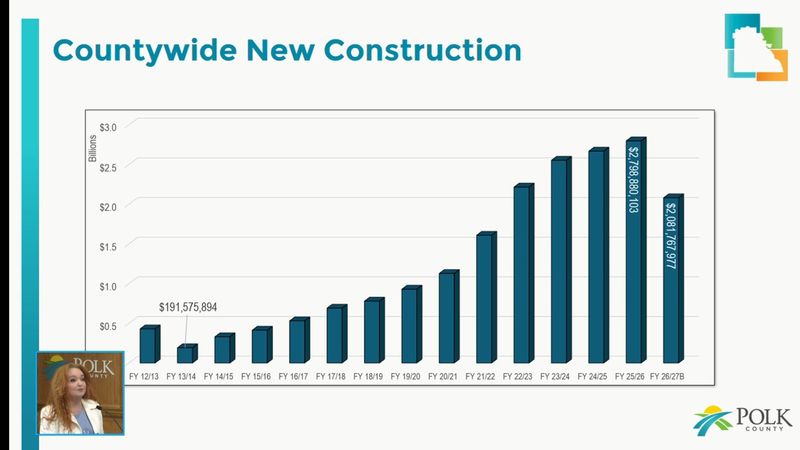
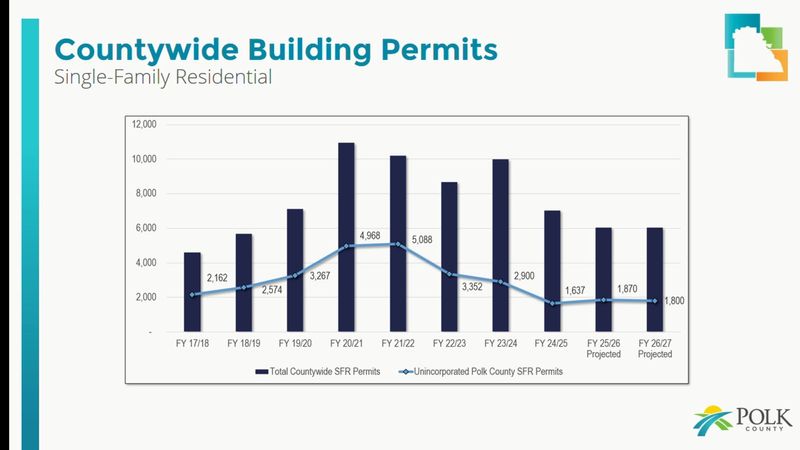
The rate of growth in new single-family home construction has slowed based on building permits issued in the past year. The county has anticipated a property value increase in the proposed budget of 4.83% overall and 2.95% for unincorporated areas.
“For the first time since the fiscal year 2013-2014, we didn’t have a positive growth in new construction numbers,” Johnson said. She added that was also the last time the countywide property tax value increase was below 5%.
Further, countywide single-family residential building permits are expected to drop to about an anticipated 1,800 for 2026-2027, a steep drop off compared with more than 5,000 permits the county issued during the 2021-2022 fiscal year, said Ben Dunn, director of the Office of Planning and Development.
Countywide total building permits, which include commercial, electrical, roofing, plumbing, HVAC, demolition and renovation among others, are also trending downward, he said.
“With that going down, that’s sending me the message that the overall economy is somewhat softening,” Dunn said. “I think it is still fundamentally strong, but its definitely slowing down.” He added that he expects steady growth over the next five years unlike the explosive growth over the past five years.
The budget would continue to prioritize public safety
For the fifth year running, county employees will continue to pay the same rates for their health insurance premiums, but the county expects to pay 5% more. The budget also provides a 2% cost-of-living increase on Oct. 1 to county employees and a 2% longevity-tenure pay adjustment on an employee’s hire date anniversary.
The Polk County Fire Rescue is on track to implement a Kelly Day benefit and the county and the union are in early negotiations to implement a potential fourth shift, to help fire and EMS with work-life balance while aiding in retention of employees within the division.
The budget calls for a commitment to add 54 new positions, which includes 21 positions at Fire Rescue, but 18 of those will not be funded until the next budget year.
The Fire Rescue division gained a huge boost in the arm for recruitment and retention with the recent opening of a new Fire Rescue Training Center. The Polk County Sheriff’s Office also benefited recently with the opening of its own training center and the Matt Williams and Diogi K9 Training Center.
Sheriff Grady Judd opened the budget workshop on July 17 with a request of $297.6 million.
The remaining constitutional officers’ budget requests included:
While Fire Rescue will see the largest addition of positions, the Utilities, and Roads and Drainage divisions are second and third most with position requests of 10 and seven, respectively.
This article originally appeared on The Ledger: How Polk County’s $3.91 billion budget impacts your wallet
Reporting by Paul Nutcher, Lakeland Ledger / The Ledger
USA TODAY Network via Reuters Connect
By Paul Nutcher, Lakeland Ledger | USA TODAY Network