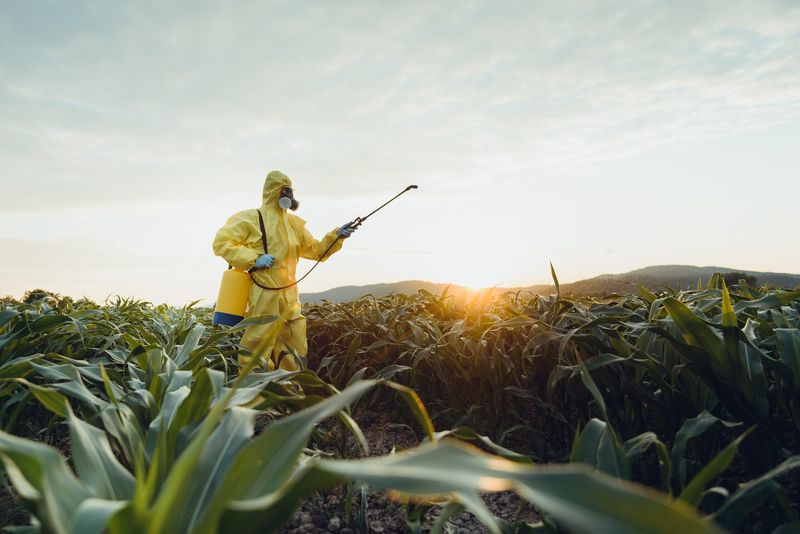
Vermont has become the first state in the United States to ban a herbicide tied by some to a increased risk of Parkinson’s disease.
The bill, if signed by Vermont’s governor, calls for a transition on the use and sale of paraquat before a full statewide ban on the herbicide by December 2030.

The Michael J. Fox Foundation for Parkinson’s Research has been urging states and the federal government for years to ban paraquat.
Paraquat is one of the most widely used herbicides in the United States, according to the U.S. Environmental Protection Agency.
What is paraquat?
Paraquat, or paraquat dichloride, is a synthetic herbicide, according to the National Pesticide Information Center.
“Paraquat kills all vegetation that it touches. This is called a nonselective contact herbicide. It is also used as a desiccant, which dries out the crop before harvest. Paraquat is widely used throughout the United States.
“The U.S. Environmental Protection Agency classified all paraquat products as restricted-use pesticides in 1978 because of paraquat’s high acute toxicity. The U.S. EPA has added additional training requirements for people who use paraquat, and requires special packaging to help prevent exposure.”
Paraquat is used on a wide variety of crops, including grains, vegetables, peanuts, and animal feed crops. It also is used as a plant growth regulator for sucker control on orchard crops, hops, and grapes, according to the National Pesticide Information Center.
Paraquat use restricted to ‘trained certified applicators’
“All paraquat products registered for use in the United States are Restricted Use Pesticides that may only be used by trained certified applicators,” the EPA said.
Does exposure to paraquat cause Parkinson’s disease?
That depends on who you ask.
The U.S. Environmental Protection Agency concluded there was some evidence that people exposed to paraquat on the job may have a higher risk of developing Parkinson’s disease. However, they determined that the data are not strong enough to conclude that paraquat exposure causes Parkinson’s disease, according to the National Pesticide Information Center.
“This means that although a few studies reported that paraquat exposure was associated with Parkinson’s disease, more research is needed to show that paraquat exposure actually causes Parkinson’s disease.”
According to the The Michael J. Fox Foundation for Parkinson’s Research, people who use paraquat have twice the risk of developing the disease than those using other pesticides.
“The evidence linking paraquat exposure to increased Parkinson’s risk is strong and has been building for decades,” said Dan Feehan, Michael J. Fox Foundation’s chief policy and government affairs officer.
“Other states should follow Vermont’s lead — and the federal government has an obligation to protect all Americans with a national paraquat ban.”
Dangers from paraquat
“Paraquat is highly toxic,” the EPA warned.
“One small sip can be fatal and there is no antidote.
“Illegally transferring paraquat to beverage containers and later mistaking it for a drink has resulted in the accidental ingestion of the pesticide and causes approximately 1-2 deaths per year.
“After a thorough review of the best available science, as required under FIFRA, EPA has not found a clear link between paraquat exposure from labeled uses and adverse health outcomes such as Parkinson’s disease and cancer.”
“Paraquat builds up in lung tissue no matter how the person or animal was exposed. As the lung damage increases, breathing becomes more difficult. Patients eventually die because they cannot breathe and their tissues cannot get enough oxygen.”
Is paraquat used in Florida?
Paraquat is among the most toxic pesticides used in agriculture, according to the University of Florida’s Institute of Food and Agricultural Science.
The pesticide is allowed in Florida but “every person handling, applying, or otherwise working with paraquat MUST be a licensed applicator.
“In addition to requiring all purchasers, handlers, and applicators to possess a pesticide license, all operators must also complete a specific training module before paraquat products can be used.”
“Paraquat is unique among pesticides in that it has more rules and regulations associated with it,” UF said.
Anyone using paraquat:
Is paraquat available to homeowners?
No. The EPA said there are no homeowner uses and no products registered for application in residential areas.
Cheryl McCloud is a journalist for the USA TODAY Network-Florida’s service journalism Connect team. You can get all of Florida’s best content directly in your inbox each weekday day by signing up for the free newsletter, Florida TODAY, at https://floridatoday.com/newsletters.
This article originally appeared on Florida Today: ‘Highly toxic’ herbicide gets first state ban. Will Florida follow?
Reporting by Cheryl McCloud, USA TODAY NETWORK – Florida / Florida Today
USA TODAY Network via Reuters Connect