

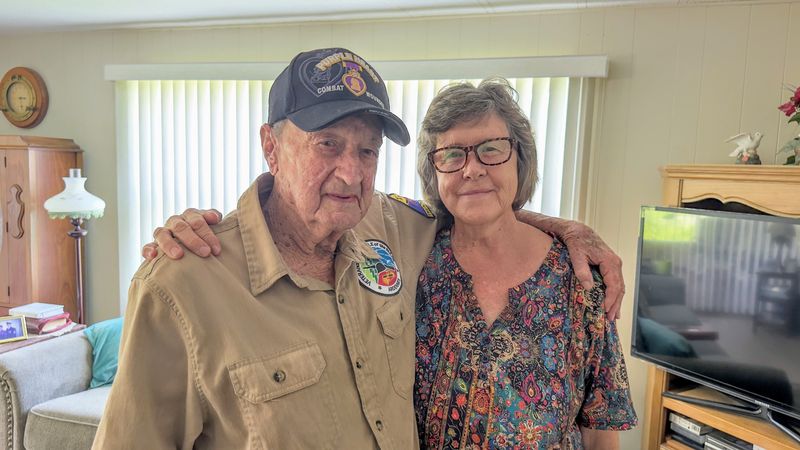
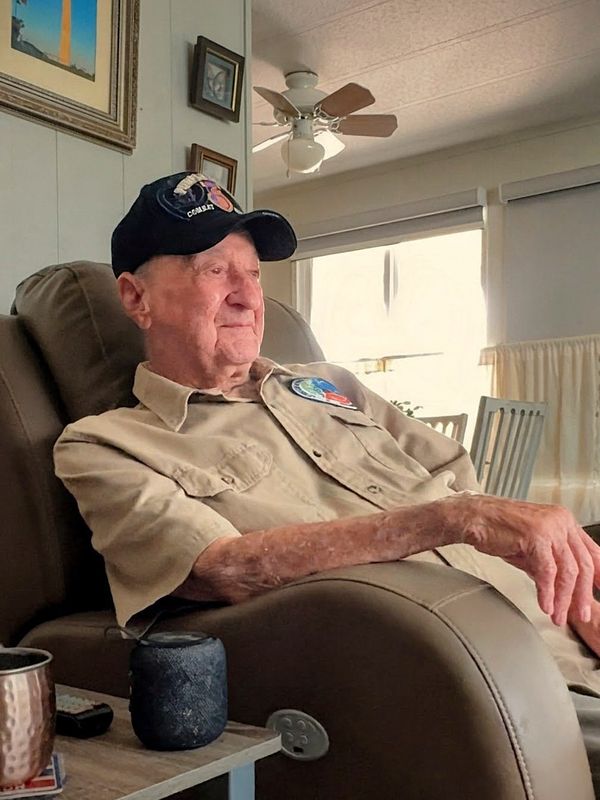
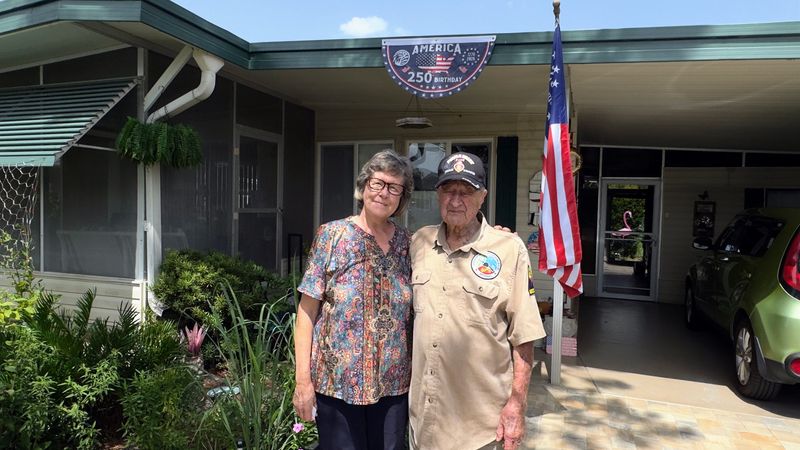
Born July 16, 1924, just outside Chicago, Leesburg resident Hal Urban turns 102 this week. He and his wife, Peg, will celebrate with visiting children and their families.
Their church, Celebration Baptist Church, celebrated Hal during Fourth of July weekend.

The Daily Commercial has followed the living legend through the years. Correspondent Cindy Peterson reported on his lifelong dream to fly in a fighter plane of his youth (he couldn’t join the Air Force because of his eyesight), and we later caught up with him after he turned 100.
How has Hal been able to live so long?
The Daily Commercial visited the Urban household, a cute, immaculate mobile home in Hawthorne at Leesburg, a retirement community. Peg confirmed that Hal always looked and acted young for his age, even in the 1980s, when they met and got married.
“We both have a sense of humor,” she said. Hal later joked that she was going to leave him for an older man.
When asked about how he ate and stayed healthy, his responses didn’t include meditation or yoga. It wasn’t a cocktail of probiotics and supplements, and it most certainly wasn’t a ketogenic diet.
Hal meets with a veterans group weekly at McDonald’s and enjoys Chicken McNuggets. The Mickey D’s at County Road 48 and U.S. 27 even has a booth reserved for the vets.
For Hal, longevity, came from hard work, a can-do attitude, grit and resilience.
He most certainly didn’t avoid stress, and he was married three times.
“I finally smartened up,” he said about Peg, who is 30 years younger. She’s a nature photographer and managed a house-cleaning business in Ontario.
Peg and Hal met in southwest Florida during snowbird season. Surprisingly, her mom played matchmaker.
The feisty Purple Heart recipient did clarify that “never smoked once” his entire life. His father worked for Al Capone, he shared, during the Great Depression. He later straightened up and taught his son not to smoke and to have a work ethic.
Hal added that he has avoided caffeine his entire life.
From trauma to resilience
Hal didn’t want to talk much about his home growing up or his childhood. He grew up during the Great Depression on a farm, where he plowed fields with horses and shot groundhogs that ate the bean crops.
The kids at school teased him about his tattered, patched-up clothes.
At 18, Hal found dignity and equality in the military, but didn’t anticipate the price he’d pay, and keep paying, from fighting in the Battle of the Bulge to painful, debilitating injury that earned him the military’s highest honor.
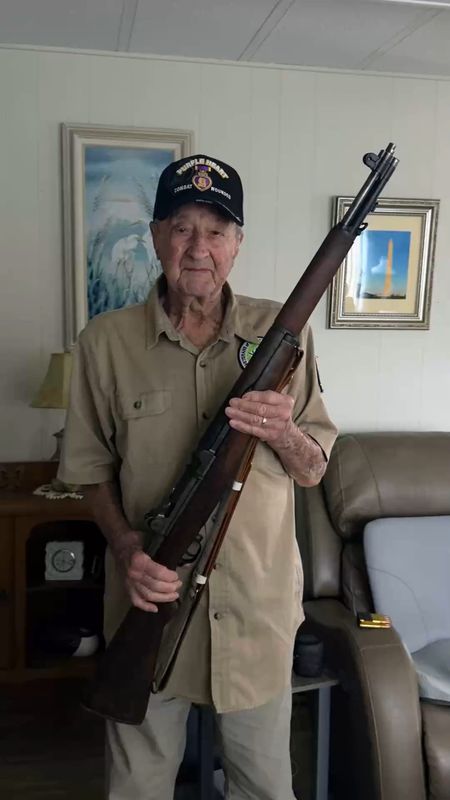
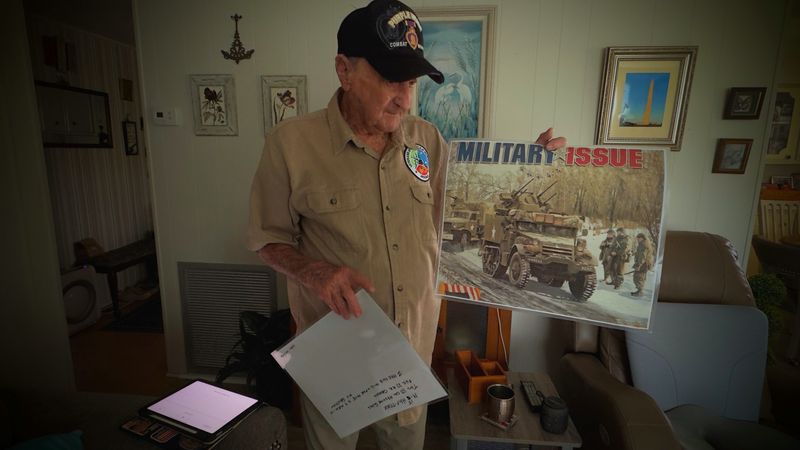
Hal was the commander of an anti-aircraft half-track, an M16 Multiple Gun Motor Carriage armed with “quad .50s” —four .50-caliber machine guns. He served in B Battery, 575th Anti-Aircraft Artillery Battalion, which was attached to the 11th Armored Division.
He didn’t go home after the injury or the battle ended. His commitment extended into the complex and tense period of occupying and rebuilding territories in Europe.
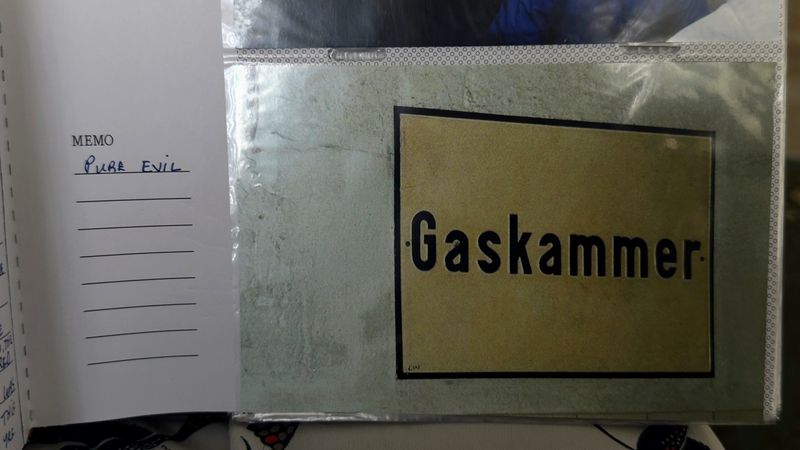
Sgt. Urban and his unit arrived at the Mauthausen Concentration Camp in Austria in May 1945.
His unit faced the grim, immediate task of burying approximately 500 war prisoners, but, most importantly, they helped rescue thousands of Jewish prisoners of war.
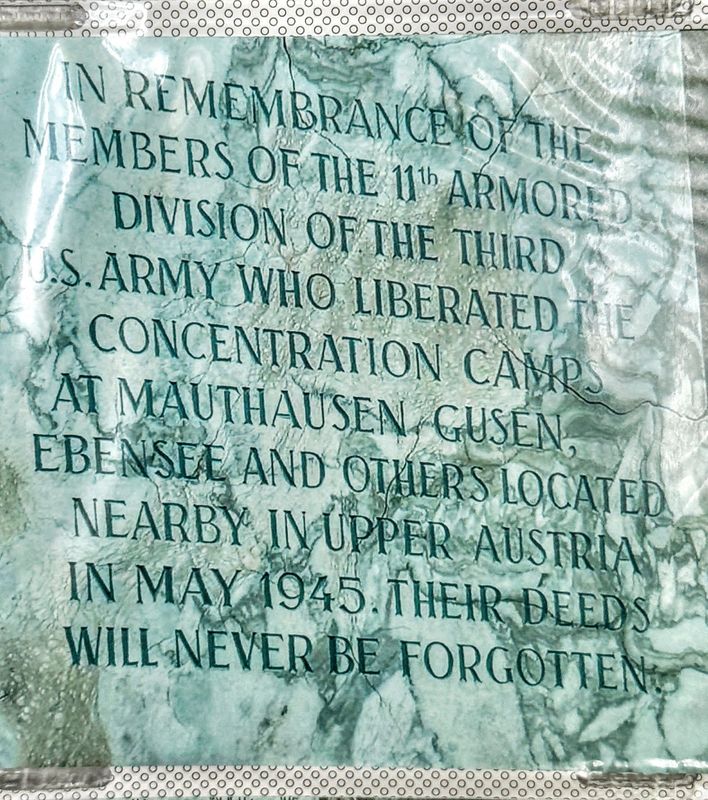
While visiting the Mauthausen main camp during the liberation’s 60th anniversary, he was embraced by former victims who were set free or their family members set free by Hal’s unit. A memorial plaque pays tribute to the 11th Armored Division (specifically the 575th Antiaircraft Battalion).
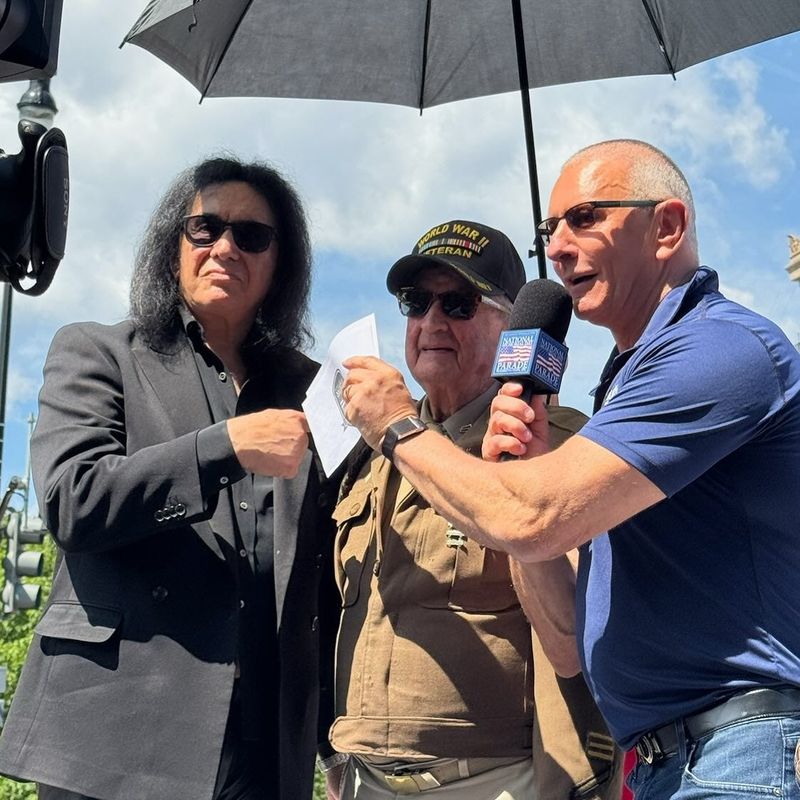
During the 2025 American Memorial Day parade in Washington, D.C., Hal met legendary KISS rock star Gene Simmons.
Simmons’ mother, Flora Klein, was just 14 years old and imprisoned at Mauthausen when Hal’s unit liberated it. Simmons approached Hal — who was still wearing his original military jacket — clasped his hand, and told him, “If there weren’t brave people like you – I wouldn’t be here, and neither would my mother.”
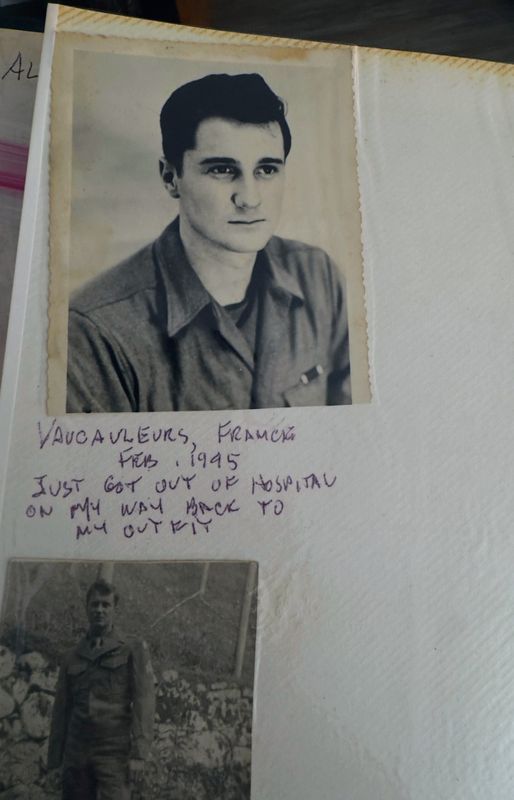
It’s hard to imagine that the young recruit was seriously injured just five months before that fateful day. According to World War II writer Ben Mack Johnson, Hal’s unit came under heavy German mortar fire on Jan. 2, 1945, while outside of Chenogne, Belgium.
“A piece of shrapnel tore through his leg, causing severe wounds,” Johnson wrote.
“After spending five weeks in hospital, Hal rejoined the 11th Armored in mid-February 1945, in time for his unit’s final drive into Germany. While he was gone, two of his best friends were killed in action. Hal still had crutches when he returned to the front line.”
His unit even spent time at a hunting lodge used by Adolph Hitler and Heinrich Himmler. Hal mused that, for around six months, he most likely ate at the same table as the infamous dictator.
A display case full of medals
His Purple Heart is his most notable and recognizable medal. It is awarded in the name of the president to those wounded or killed while serving with the U.S. military.
Other medals include the European-African-Middle Eastern (EAME) Campaign Medal with its green, brown, and striped ribbon, awarded for service in the EAME theater between 1941 and 1945.
World War II Victory Medal with red ribbon with rainbow-colored edges, awarded to any member of the United States military who served on active duty or as a reservist between Dec. 7, 1941, and Dec. 31, 1946.
Army of Occupation Medal has a black, white, and red ribbon, awarded for 30 consecutive days of service in occupied territories (such as Germany, Italy, Austria, or Japan) after the end of World War II.
Army Good Conduct Medal, with three white stripes on each edge, is awarded to enlisted service members who distinguish themselves from among their fellow soldiers by their exemplary conduct, efficiency, and fidelity.
Kill or be killed
There’s a narrow margin between luck and strategy, quick thinking and survival.
When asked about the first time he had to shoot the enemy in hand-to-hand combat, Hal said he shot a German soldier during the Battle of the Bulge in December 1944.
According to the Special Operations Forces Report, the winter of 1944-45 in the Ardennes was one of the coldest on record in Europe. Temperatures dropped well below freezing, and both sides suffered thousands of casualties, from trench foot to frostbite to freezing to death in their foxholes and trenches. It was common for patrols to come across soldiers from both sides, frozen perfectly upright or in firing positions, appearing alive from a distance.
Hal recounted the first time he had to shoot someone.
I’ll tell you a little story,” Hal began. “We were just starting to go into combat. The ground was all snow, and everything, and I had to get out of my half-track to pee. You always had to have a rifle. Out of the corner of my eye, I saw this German…in a trench. So I whipped her out, and I put three rounds in him.
“He never bowed. He was frozen to death.”
When asked if he still had dreams about the war, Hal said he dreamt over the years that S.S. were about to put him “in one of the ovens.”
He visited a VA psychiatrist to help him with his dreams and other traumas. The doctor explained that the dreams would come and go throughout his life. Mercifully, he isn’t having them anymore.
A peaceful retirement
Before semi-retiring, Hal worked for the Northern Illinois Gas Company for 38 years and farmed on the side.
Not quite yet fully retired, he still does contract work for the county at PEAR Park.
For the past 25 years, he’s worked as a contractor for the county, most recently taking care of the grounds at PEAR Park — he’s there twice a month in the winter and much more often in the warmer months.
The county even posted a “Hal’s Habitat” sign in tribute to Urban for his contributions to the area.
Both Hal and Peg love nature, and spent some time in the early 2000s running a boat charter in Lake County.
Nowadays, they stay closer to home and enjoy the activities at their church and at Hawthorne, taking walks and afternoon naps.But on most mornings, you’ll see Hal riding an air-conditioned mower at PEAR with help from his granddaughter.
This article originally appeared on Daily Commercial: Hal Urban turns 102 years old and reflects back on an eventful life
Reporting by Julie Garisto, Leesburg Daily Commercial / Daily Commercial
USA TODAY Network via Reuters Connect
By Julie Garisto, Leesburg Daily Commercial | USA TODAY Network
