The South Florida Water Management District has dropped its enforcement case against the Good Mood Ranch in East Naples.
Based on a neighbor’s complaint, the ranch’s owners — Luc and Karen Goemaere — found themselves in hot water with Collier County Code Enforcement and the Water Management District for clearing and filling land and disturbing wetlands without permission or permits.

As a result, the Goemaeres feared their one-of-a-kind ranch, which they’d sunk their life savings into and turned into a local attraction, could get shut down. Late last year, they sought relief from the Florida Department of Agriculture and Consumer Services in the form of an agricultural exemption — and they succeeded.
The exemption is meant to protect bona fide agricultural operations by reducing regulatory burdens, specifically by limiting local government restrictions and easing permitting and building code requirements on farm-related land alterations and construction. It was granted to the Goemaeres in March, with the signing of a “binding determination.”
“The Florida Department of Agriculture and Consumer Services determined that the activities at Good Mood Ranch were exempt from regulation by the South Florida Water Management District. As such, the enforcement case against Good Mood Ranch by the District has been closed,” said Jason Schultz, a public information coordinator for the governmental agency that manages the water resources in the southern half of the state, in an emailed statement.
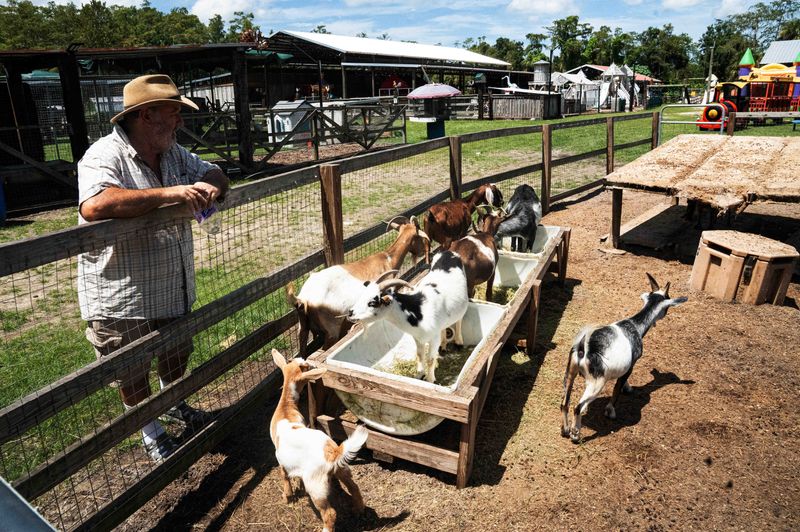
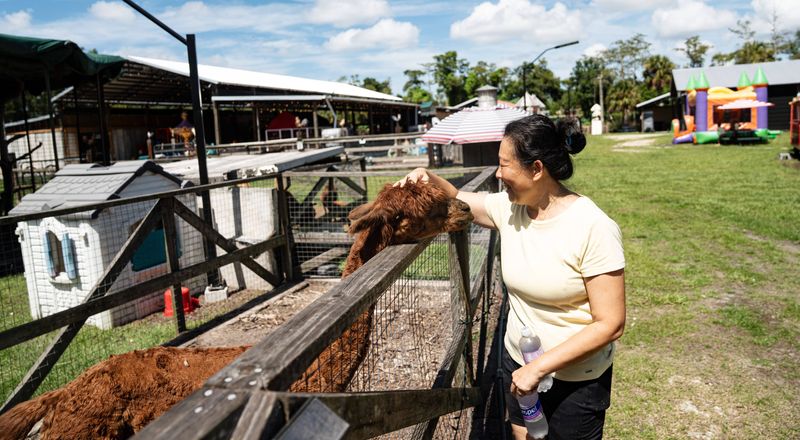
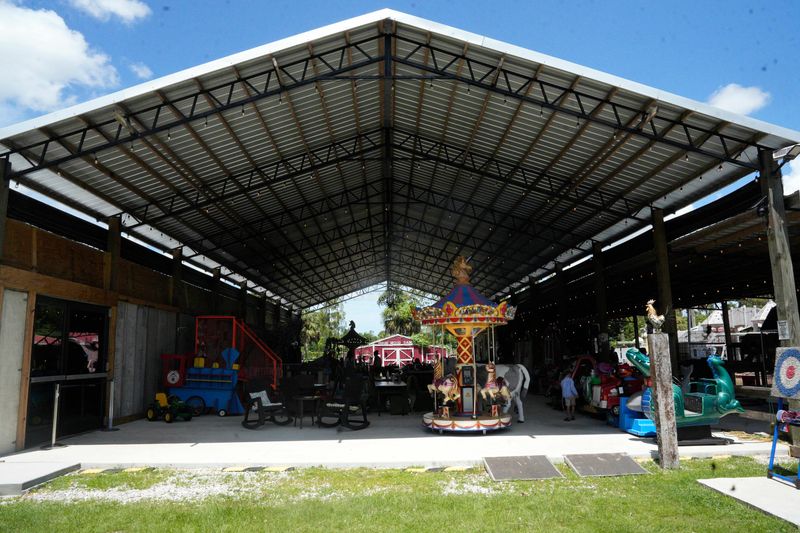
Good Mood Ranch operates as a family-friendly attraction, with hundreds of animals, along with kiddie rides, playhouses, a zipline, mini-golf and more — spread across more than 20 acres in a rural area, off Sabal Palm Road.
Neighbor’s complaints stir concerns about destroying wetlands
The drastic changes made to the property didn’t sit well with the Water Management District, which opened an enforcement case against the ranch in 2022, following a neighbor’s complaints.
From 2022 to 2024, the district issued two notices of violations, one for unauthorized clearing and dredging in wetlands and another for failing to acquire an Environmental Resource Permit before eventually impacting nearly 9.5 acres of wetlands and “altering local hydrology.”
Before the Florida Department of Agriculture granted an agricultural exemption, the Water Management District sought restoration of the property.
A settlement offer included requirements to “remove all debris, equipment, animals, and structures from the impacted wetlands,” within 60 days of its signing. The agreement would have also forced the Goemaeres to pay nearly $19,500 in civil penalties and costs, including the ater district’s investigatory expenses.
Last summer, when asked about the proffered agreement, Luc Goemaere described it as unreasonable. So, he had no intentions of signing it.
Agricultural exemption resolves code enforcement case
In September 2025, the ranch owners sought a determination from the Florida Department of Agriculture on whether their activities qualified for an agricultural-related exemption, as a way to avoid the requirement of an environmental resource permit for site development. They argued their alterations to the property were normal and customary for an enterprise of their kind, including “livestock and waterfowl production.”
In reviewing the request for an agricultural exemption, the Florida Department of Agriculture found all the conditions had been met for it to intervene. The months-long review included a site visit in December.
During the visit, the state agency’s staff saw active production and sales on site, along with livestock on exhibit, indicative of “an ongoing agricultural operation,” and determined that the fencing, buildings, ditches, ponds and roads added to the site were a necessary part of the business.
Agency staff found that much of the vegetation stripped from the wetlands was toxic and invasive, including Melaleuca, the removal of which the state strongly encourages. Staff determined that the primary purpose for all of the alterations on the site was to support the agricultural operation, not to impede or divert the flow of surface waters, nor to otherwise harm the wetlands.
The Goemaeres could not be reached for comment.
With the binding agricultural determination, they were able to resolve a years-long code enforcement dispute with Collier County, but not without a cost. In the end, the Goemaeres had to pay thounsands in fines, plusoperational costs for the case.
The county’s code enforcement case started in 2022.
Owners of Good Mood Ranch admitted to code violations
In June 2024, the Goemaeres were found in violation of county code for removing trees and vegetation from their property and bringing in fill without the appropriate county permits, or other county approvals, at a code enforcement hearing — after they admitted to it, signing what’s known as a “stipulated agreement,” or settlement.
Patrick Neale, the county’s special magistrate for code enforcement, granted the Goemaeres three extensions to correct their violations before imposing daily fines.
In July of last year, Neale denied a request for another extension. As a result of that decision, fines of $100 a day began accruing.
The county considered the violations resolved the day the Goemaeres formally asked for the agricultural determination from the Florida Department of Agriculture on Sept. 9, 2025 — and the daily fines stopped growing.
Special magistrate agreed to reduce code enforcement fines
At a code enforcement hearing on April 3, Neale agreed to reduce the fines for the admitted county violations from $6,000 to $3,000. In part, he did so because the Goemaeres took action to resolve the case by applying for the state agricultural exemption, and based on other factors, including that the violations were not considered a health or safety threat.
In total, the Goemaeres were ordered to pay $3,112.50 to resolve the case, including the operational costs for the final hearing. They had already paid operational costs for past hearings.
During the final hearing, Luc Goemaere argued that he shouldn’t have to pay anything more, with the Florida Department of Agriculture’s determination that his business is an exempt agricultural operation and the South Florida Water Management District’s subsequent decision to drop its enforcement case.
“I feel that we are not in violation, and I respectfully request this case and all the fees and fines to be dismissed,” he said.
He said he and his wife should have been considered bona fide farmers much sooner by the county, with their property classified as agricultural by the Collier County Property Appraiser’s office more than three years ago. The Goemaeres requested the county designation in July 2022, and it got approved in January 2023.
Adam Collier, a county code enforcement officer, explained that when the Goemaeres signed a stipulated agreement in 2024, they admitted guilt and agreed to forego a formal hearing and their right to present their legal defenses in the case “in favor of a quick and expeditious resolution to the matter.”
Neale agreed it was too late for the ranch owners to argue their case.
“Unfortunately, for you, you had agreed that you’re in violation,” he said. “Just like in court, if you give a consent judgement, you can’t just go back and argue, ‘Oh, by the way, I should have argued this.'”
Luc Goemaere expressed frustration with the enforcement process, saying English wasn’t his or his wife’s first language. He suggested they didn’t understand what they were doing when they signed the stipulated agreement and that they felt forced to do it by a code officer.
“This is something that should never have happened,” he said.
Neale, a business, real estate and land use attorney, emphasized that, as in a real court of law, “if you don’t raise the defense at a certain time, you’re precluded from raising that defense.”
New code enforcement case brought against Good Mood Ranch
At the hearing, Luc Goemaere brought up a new code enforcement case the county is pursuing against him and his wife involving some of the farm buildings they’ve constructed on their property, hoping it could get dismissed.
According to the case file obtained by the Daily News, Jaime Cook, the county’s director of development review, found that structures were built “outside of what has already been through the FEMA review process,” and determined that they require a review of their own.
There might be a need for permits, or for a written approval from the county for the buildings in question, which are not only used for farm equipment, animals and employees, but for entertainment.
Neale explained to the Goemaeres that he could only rule on the case before him, not on the latest one.
“I cannot hear a future case,” he said. “You cannot bring up anything about a future case. That’s completely inappropriate.”
In reaction, Luc Goemaere, clearly upset, commented that he just hoped to be able to do what he’s wanted to do four years ago, without the county continuing to interfere with his business. His vision for the ranch is even bigger.
Neale stressed that if the new code case ends up before him, he would have to consider and rule on whatever evidence and arguments he’s presented with at the time.
“Every case is different,” he said. “Every case is individual.”
Laura Layden is a business and government reporter. Reach her by email at laura.layden@naplesnews.com.
Please support local community journalism and stay informed about Southwest Florida news by subscribing to The News-Press and Naples Daily News; download the free News-Press or Naples Daily News app, and sign up for daily briefing email newsletter, food & dining and growth & development newsletters here and here.
This article originally appeared on Naples Daily News: Good Mood Ranch in East Naples avoids closure with agricultural exemption
Reporting by Laura Layden, Fort Myers News-Press & Naples Daily News / Naples Daily News
USA TODAY Network via Reuters Connect