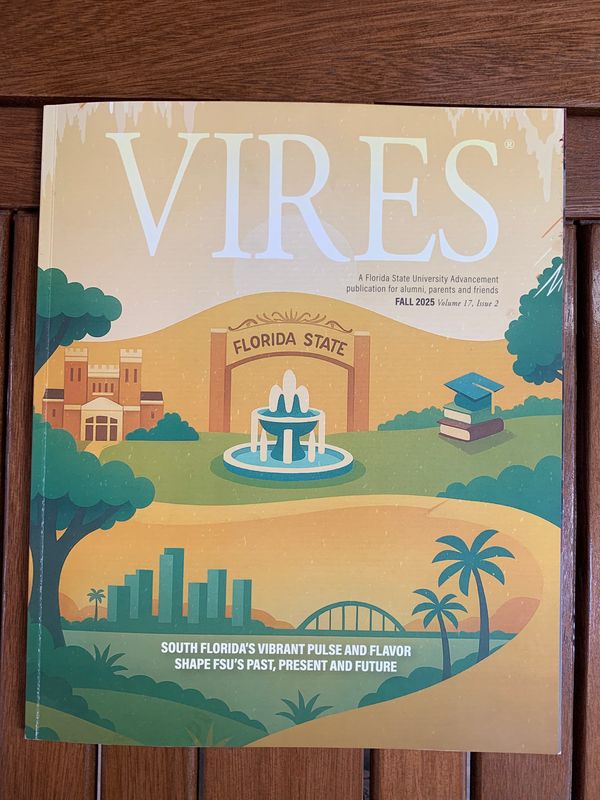
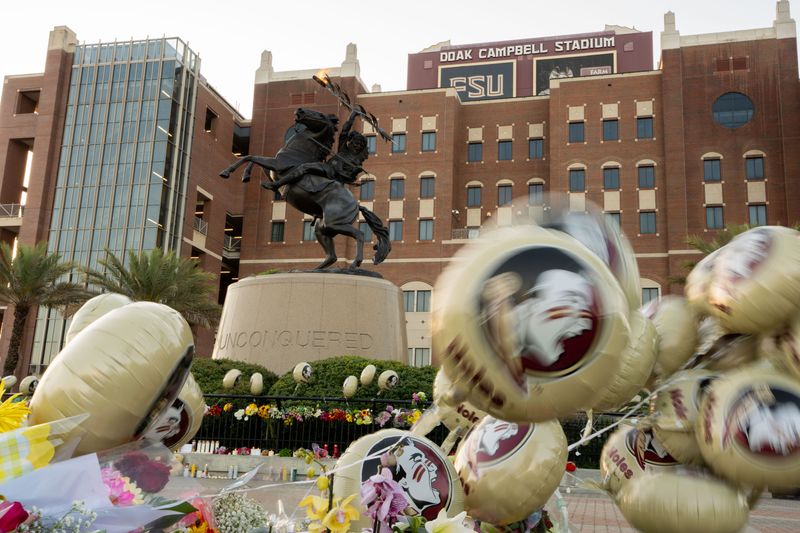
Our fall edition of VIRES, a Florida State University Advancement Publication for alumni, parents and friends, arrived in the mail last week. Without saying why, my husband encouraged me to open the front cover to the first page, where I found a stunning two page spread photograph of students gathered at a memorial on campus to pay tribute to those who died there on April 17, 2025.

The carefully chosen words on the page were few and powerful, but the expressions on the faces of those gathered speak beyond the words, of the horrifying question, “why?”
Named after the first torch in the FSU seal, the magazine title, VIRES, represents strength of all kinds: physical, mental, and moral. And it has taken strength of all kinds for those closest to this tragedy to find a way to, little by little, embrace life again.
FSU families suffering
As one of her many friends who wants to support and encourage my former colleague and forever friend, Betty Morales, and her beloved daughter, I am repeatedly reminded of how little I understand the ways in which the sorrow of April 17, 2025, impacts their lives daily. Beyond the personal reminders that are many, they are a part of an ongoing criminal investigation process with numerous ramifications that sometimes catch them by surprise and always render pain.
That such horrific events continue to happen in our country and in our world is yet another painful heartache for them and the countless wives, husbands, children, parents and loved ones who know such traumatic grief personally. Compartmentalizing is not an option.
It was shocking waking up to the news on Sunday past that there had been two shootings, one on the first night of Hanukkah in Sydney, Australia, which is 16 hours ahead of EST, and the other at Brown University in a study hall the afternoon before. My first thoughts went to Betty and her daughter, and the many like them who know first-hand the horror and unfathomable pain of such senseless violence.
I was reminded of an interview outside the student union at FSU that I heard on the television the day of Robert’s death, as I was desperately trying to learn what I could about the tragedy. A student was asked if he ever imagined that he would be a part of such a tragic event. Without hesitation he said to the reporter, “Of course I imagined. I have been a participant in active shooter drills since I was in kindergarten.”
His honesty and courage to speak his lived truth was powerful and heartbreaking. It begs the question of “why?” that can be read on the faces of so many students pictured in the VIRES magazine as they gathered at the memorial. Why can we not find the will to do something about the ongoing killing of our children and their teachers and staff members in schools?
Tragedy in Australia
In Sydney, Australia, at Bondi Beach, Jewish faithful by the hundreds gathered to celebrate the first night of Hanukkah. A father and son armed team mounted a footbridge overlooking the group and opened fire. People scattered and one courageous bystander ran toward one of the gunmen, tackling him and no doubt saving lives by his courage. Ahmed el Ahmed, a Muslim, has been rightfully hailed as a hero.
According to the New York Times, “Bondi Beach has been at the core of Sydney’s Jewish community ever since the first refugees fleeing the Holocaust settled there after World War II.” How poignantly sad that a Holocaust survivor was among the 15 people killed there on Sunday, along with 42 injured.
In a picture in the New York Times of a makeshift memorial at the Bondi Beach pavilion, near where the horrific massacre took place, the faces of the survivors show the same emotion of disbelief, the same look of “why?” that is seen in the VIRES magazine photo taken at FSU.
Australia already has some of the strictest gun laws in the world, but antisemitism has been on the rise there, as it has been elsewhere around the world. Why can we not live peaceably together, respecting one another’s differences and honoring our common humanity?
Brown University and a public health crisis
On June 25, 2024, then U.S. Surgeon General Vivek Murthy, M.D., officially declared firearm violence a public health crisis, with over half of U.S. adults having either experienced gun-related violence themselves or having a family member who has. 1 in 15 Americans have survived a mass shooting, defined as a shooting where four or more people were killed (excluding the shooter), and survivors defined as those who were in immediate proximity to the shooter.
One of the students on lockdown in her dorm at Brown was Mia Tretter, who had been shot in the abdomen at age 15 in a mass shooting in California that left two of her best friends dead.
On Wednesday before the shooting at Brown, Tretter was in Washington, D.C, where she sang, “Imagine” by John Lennon at the national vigil for all victims of gun violence, which was organized by the Newtown Action Alliance, a nonprofit founded in the wake of the 2012 shooting at Sandy Hook Elementary School. She sang for Robert and for all those whose tragic loss has left a void for so many people.
I know that there are arguments all around this issue, but I also know that we have many smart, reasonable, moral people in our country who can work on a viable solution.
The FSU student who bravely told the report that “of course he could imagine being in an active shooter situation” also said, “and not even a mile from here there are elected officials who can do something about this if only they will.” Some of our lawmakers are hard at work. Perhaps some of us can join them or one of the many organizations that is encouraging a solution.
Light in the darkness
In this season of the year when goodwill seems to be on the rise, it is my earnest prayer that more of us citizens will commit to do whatever we can to end the senseless violence too many of our children, grandchildren, teachers, and youth, too many of our Jewish brothers and sisters, have endured for too long.
It begins in our hearts, when we take personal agency and decide what matters most to us. On the darkest day of the year, as winter begins, perhaps we can vow to be light to those who suffer in the darkness of grief over those lost to gun violence.
As Hanukkah continues, as Christmas is coming, as people of goodwill still reeling from the horrors of last weekend, may our own inner fortitude grow so that 2026 will be the year that we stop asking “why?” and start answering “how” we can end gun violence.
The Rev. Candace McKibben is an ordained minister and pastor of Tallahassee Fellowship.
This article originally appeared on Tallahassee Democrat: Getting from why to how: Gun violence plagues the world
Reporting by Rev. Candace McKibben, Guest columnist / Tallahassee Democrat
USA TODAY Network via Reuters Connect