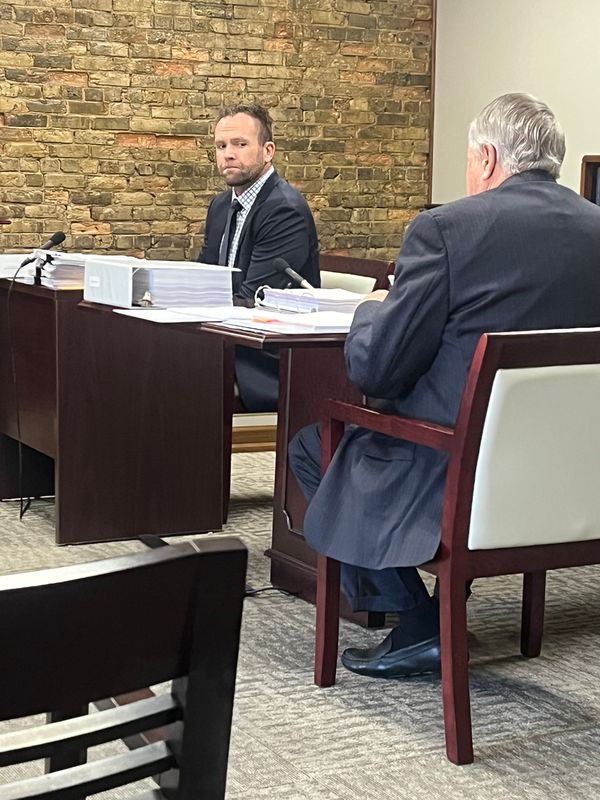
The attorney for Dr. Ben Brown, a Gulf Breeze plastic surgeon accused of manslaughter in the death of his wife, has asked the judge in the case to limit the testimony of Medical Examiner Dr. Deanna Oleske to matters outside the realm of toxicology.
A motion filed May 6 by attorney Mark O’Mara questions Oleske’s finding that Brown’s wife, 33-year-old Hillary Ellington Brown, died due to complications brought on by lidocaine toxicity. It requests a hearing be held to determine whether she should be allowed to offer her opinion on the topic as an expert witness.

“In her deposition (conducted March 19) she specifically testified that she was not a toxicologist … She has no training or expertise in the area of toxicology,” the motion states. “It is clear that Dr. Oleske does not have the expertise to opine as to whether the levels of lidocaine in a person’s system at the time of the incident were lethal or not.”
The motion claims allowing “a non-expert” to provide inaccurate and unsupported testimony would be unfair to Brown.
O’Mara’s request that Judge Clifton Drake conduct what is known as a Daubert hearing was granted and a date for it set for July 7. Brown’s trial is slated to get underway Aug. 17.
The Daubert hearing, according to the motion, will determine whether Oleske’s testimony regarding toxicology is based on sufficient facts or data, on reliable principles and methods and whether those principles and methods have been applied reliably to the facts of the case.
“The ultimate question is whether the expert’s opinion rests on a reliable foundation or is instead built on speculation, assumption or untested assertion,” the motion states.
Attorneys for the prosecution have not filed a response to the defense motion. Assistant State Attorney Trey Meyers said his office could not comment on the motion or a possible response.
Dan Russell, an attorney with the Tallahassee-based law firm of Jones Walker who is representing Oleske, spoke dismissively of O’Mara’s efforts.
“So there’s a defense attorney trying to keep evidence out of a trial,” he said. “In other news, water is wet.”
Hillary Brown went into cardiac arrest Nov. 21, 2023, as Brown was performing several procedures on her in his office, Restore Plastic Surgery, in the Tiger Point area of Gulf Breeze.
She never regained consciousness and died a week later when her family made the decision to take her off life support.
Brown was arrested June 17, 2024, on the charge of manslaughter by culpable negligence. An arrest report states that along with injecting Hillary with a toxic dose of lidocaine he also failed to instruct his staff to call 911 when it became clear she was experiencing a medical emergency.
The report also states Brown failed to monitor what medications Hillary was ingesting prior to the surgery and failed to dilute some quantity of the lidocaine before injecting it.
O’Mara contends that Oleske reached her determination that lidocaine toxicity had caused Hillary Brown’s death based on “a rule-out theory” that made it the most likely alternative.
The motion cited findings of an administrative law judge at a hearing to determine what, if any, sanctions Brown should face regarding his medical license.
Judge Yolanda Green noted in her decision to recommend Brown be suspended from practice for a year that Oleske testified she had done no postmortem or antemortem toxicological analysis to support her autopsy conclusions.
Green found the testimony of an expert witness for Brown, Dr. Christopher Borgert, more credible than that of Oleske, the motion states. In the motion for the hearing O’Mara contrasts Oleske’s expertise and knowledge to that of Borgert, “a well-known toxicologist.”
Borgert testified at the administrative hearing that lidocaine toxicity could not have been the cause of Hillary Brown’s death. He went so far as to correspond with the medical examiner to suggest she amend her cause of death decision.
Oleske testified in her deposition that “she did not make much of the letter” she received from Borgert.
O’Mara states in his motion that a medical examiner’s cause of death opinion is subject to scrutiny under the Daubert standard and the court has no obligation to rely on a medical examiner’s testimony simply due to the “official position” Oleske holds.
It seeks to limit Oleske’s testimony to that of a medical examiner and exclude any testimony related to anything toxicology related.
“Realizing her lack of qualifications in this area of study her testimony will be, by definition, incompetent in that area,” the motion states. “Worse, the jury may infuse credibility into her testimony, undeserved as it would be.”
This article originally appeared on Pensacola News Journal: Dr. Ben Brown questions medical examiner’s expertise ahead of manslaughter trial
Reporting by Tom McLaughlin, Pensacola News Journal / Pensacola News Journal
USA TODAY Network via Reuters Connect