A set of tiny electrical leads, one computer screen and a little less than five minutes on the clock might be all it takes for Anastasia Aston and her colleagues to save lives across the Sunshine State.
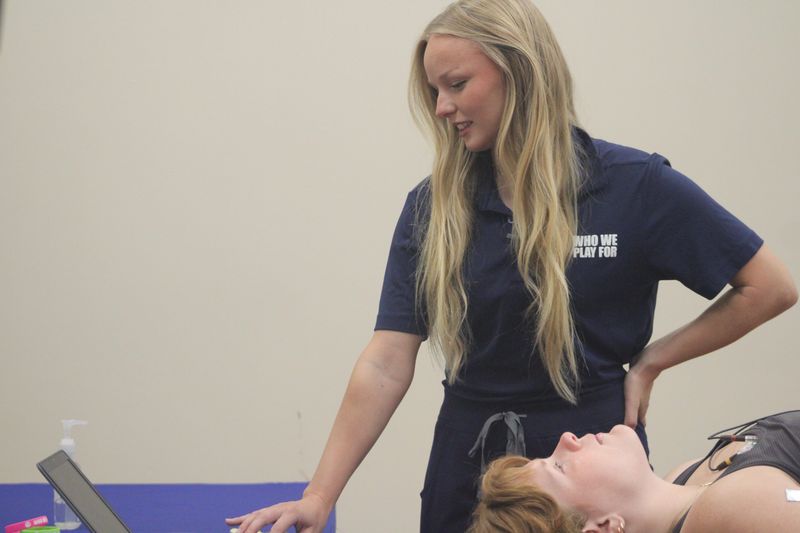
“30 seconds… then a beep,” said Aston, screening site director for health nonprofit Who We Play For, demonstrating the test awaiting young athletes in a small room inside Florida State College at Jacksonville’s Downtown Campus.

There’s the pause. There’s the beep.
For thousands of rising high school students across the Sunshine State during the summer, this test will become one more step in the pathway to the playing field. For some, the test might save a life.
“Even though it might seem a little scary, it’s super easy, quick and painless,” said Mary Kate Heekin, who underwent the test June 2 during an ECG demonstration at FSCJ.
Starting July 1, any Florida student entering high school sports for the first time must undergo an electrocardiogram, or ECG, to scan for heart abnormalities that increase the risk of sudden cardiac arrest.
School districts and the Melbourne-based nonprofit organization Who We Play For are teaming up to help fulfill the requirements of the Second Chance Act (Senate Bill 1070), passed by the Florida Legislature and signed by Gov. Ron DeSantis in June 2025.
The act is named for Chance Gainer, a Port St. Joe High School senior who collapsed and died on the field during a September 2024 football game against Liberty County.
Current eighth-grade students who will be entering their freshman year in August will need an ECG before they can participate in tryouts, conditioning, practices or games. So will other students who have not previously participated in high school athletics, regardless of academic year.
For these students, Who We Play For is conducting scans both inside and outside Northeast Florida.
The organization launched nearly 19 years ago in honor of Cocoa Beach High School sophomore Rafe Maccarone, who died at age 15 in 2007 from sudden cardiac arrest during soccer practice. Subsequent testing found that Maccarone had hypertrophic cardiomyopathy, a thickening of the heart muscle that likely would have been detected by an ECG.
Nearly two decades later, their work carries on.
SUDDEN CARDIAC ARREST RECOVERY: ‘A ROLLER COASTER’
For Clay County residents Christian and Jennifer Broadhurst, the quest to guard young athletes’ heart health has become a mission.
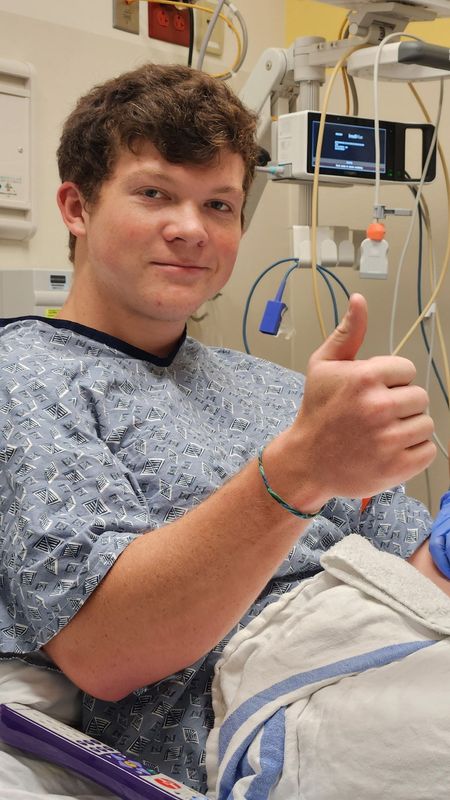
Their son, Riley, was 17 when he suffered a sudden cardiac arrest in December 2023 from a heart condition not previously detected. His collapse didn’t occur in a practice or a game, but during a seemingly ordinary run in his Fleming Island neighborhood.
Riley’s story had a happy ending. A neighbor saw his collapse and began CPR inside 30 seconds. Paramedics arrived within five minutes.
Although Riley’s rehabilitation required many months of intensive medical treatment, multiple surgeries and the installation of a defibrillator pacemaker, he made a full recovery. As outcomes from sudden cardiac arrest go, Christian Broadhurst said, “we won the lottery.”
Riley avoided any major neurological or other complications from the incident, and currently attends the University of Central Florida in Orlando.
“It’s been a roller coaster,” Jennifer Broadhurst said. “Even if your kid survived, [you wonder] if a lot of this could have been prevented if we’d been able to have a diagnosis beforehand.”
For many other young athletes, however, similar collapses end in tragedy. A Journal of Athletic Training study from 2017 found that sudden cardiac arrest — not heat illness or injury from competition — is the most frequent killer of student-athletes. Historically, the survival rate in similar cases is close to 10 percent.
Sudden cardiac arrest in young athletes, Aston said, occurs more frequently than many assume.
Conditions potentially leading to sudden cardiac arrest appear in about 1 in 300 young athletes, as calculated by national organization Parent Heart Watch from research from numerous studies stretching from the 1990s to the 2010s.
While precise estimates vary, those numbers are often replicated elsewhere, even across continents. A 2018 study published in the New England Journal of Medicine evaluated more than 11,000 young soccer players across the United Kingdom and found a rate of 0.38%, slightly more than 1 in 300, with conditions associated with sudden cardiac arrest.
These heart conditions can strike without prior symptoms, even for young athletes otherwise in prime physical condition. Chance Gainer, the Port St. Joe student for whom the law is named, competed in both track and football, and had even scored a 70-yard touchdown earlier in the game before his collapse.
Sudden cardiac arrest entered national headlines in January 2023, when Buffalo Bills defensive back Damar Hamlin collapsed on the field during a nationally-televised NFL game against the Cincinnati Bengals. Hamlin eventually recovered and returned to football.
Jennifer Broadhurst said that Riley’s story soon came to the attention of Who We Play For impact director Shawn Sima, a Jacksonville native whose daughter Lexi likewise survived a sudden cardiac arrest. Now, the family connects with others going through similar challenges.
“It’s a weird situation you find yourself in, dealing with something you’ve never dealt with before,” Christian Broadhurst said. “You don’t know how to deal with it, you’re alone, and then all of a sudden, out of the blue, someone throws you a lifeline.”
SPREADING THE WORD
With the July 1 deadline approaching quickly, schools are taking on the task of informing families about the new requirement, so that prospective athletes don’t get left on the sidelines for the coming school year.
Northeast Florida school officials, from Duval County superintendent Christopher Bernier to hundreds of high school and middle school coaches and administrators across the region, have spent the spring spreading the word to families.
“It’s a big adjustment,” Fletcher High School athletic director Brian Gilbert said. “But it’s saving kids’ lives. It’s worth it.”
Fletcher is among the schools launching a social media blitz to make sure incoming students understand the new law, including an Instagram video at the end of May that Gilbert said has received nearly 17,000 views. The school will hold a Who We Play For clinic on site as well, performing ECGs inside the cafeteria from 9 a.m. to 12 p.m. on Wednesday, June 10.
Coordination in the district across both high schools and middle schools has helped boost awareness of the Second Chance Act, Gilbert said.
“We’re really trying to communicate this as best we can, so this goes as smoothly as possible,” he said.
To reduce the financial burden for the screenings, which can frequently cost $50 or more, Duval County Public Schools and Who We Play For launched an initiative to provide ECGs for young athletes at free or significantly reduced cost.
Even counting wait times, Aston said, students are typically in and out in about 15 minutes.
“I go to the schools, and a lot of them think, ‘Is this going to hurt? Are there needles? Is there something that’s going to be painful?'” Aston said. “None of it hurts. It takes less than five minutes.”
Once the test is complete, the results are loaded into a secure database and subsequently evaluated by a cardiologist. Participants receive their results within 15 business days, typically via e-mail. However, Aston said families will receive direct communication by phone if a scan turns up something concerning.
“We’re hoping that this legislation makes treatable, identifiable heart problems able to be corrected,” Christian Broadhurst said, “before these things go to where they can go.”
SCHEDULED WHO WE PLAY FOR SCREENING EVENTS
Nassau County: 10 a.m. to 2 p.m. Saturday, June 6, Wildlight YMCA, 251 Breezeway Street, Suite 120, Yulee. Cost: Free, but donations appreciated. Online registration at whoweplayfor.jotform.com/261136951587061
St. Johns County: 4 p.m. to 7 p.m. Wednesday, June 17, Ponte Vedra High School, 460 Davis Park Road, Ponte Vedra Beach. Cost: $20. Financial assistance available through Florida heart screening grant program. Online registration at whoweplayfor.jotform.com/261414846229056
Duval County: 10 a.m. to 2 p.m., Saturday, June 20, FSCJ Downtown Campus, 101 W. State Street, Jacksonville. Cost: Free, but donations appreciated. Online registration at whoweplayfor.jotform.com/261265141826051
This article originally appeared on Florida Times-Union: Florida’s ‘Second Chance Act’ requires heart tests for athletes
Reporting by Clayton Freeman, Jacksonville Florida Times-Union / Florida Times-Union
USA TODAY Network via Reuters Connect