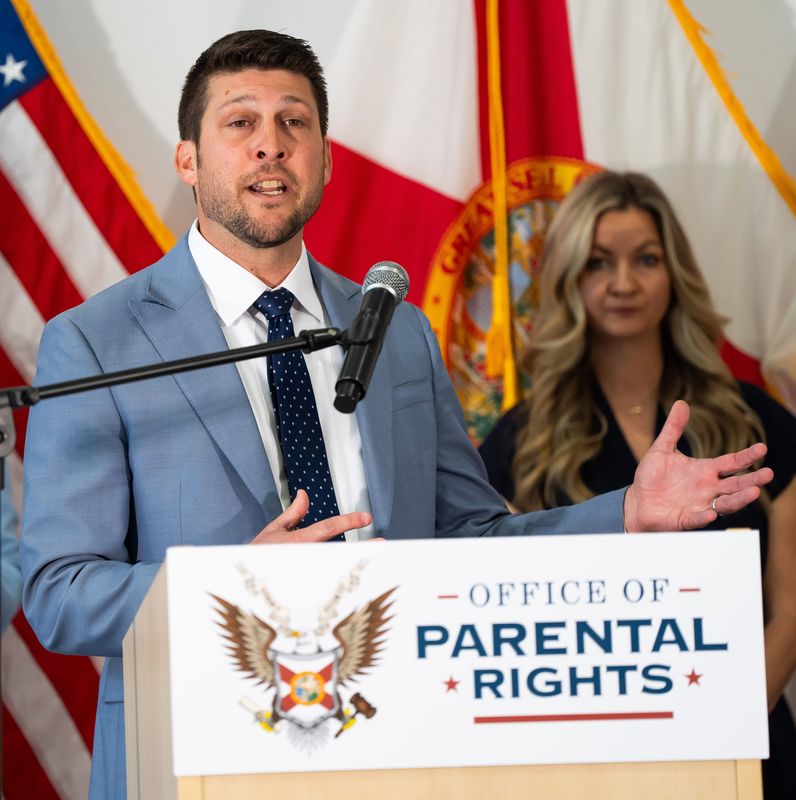
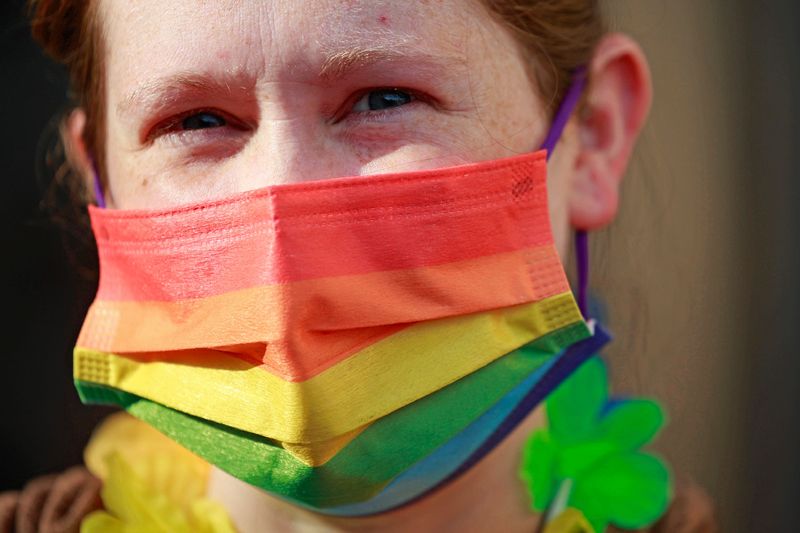
The Florida parents who spearheaded a movement for parental rights and limiting classroom instruction on gender and sexuality are asking the U.S. Supreme Court to affirm their rights in a dispute over their child wanting to use “they” and “them” pronouns in school.
For about four years, January and Jeffrey Littlejohn’s argument has failed in two federal courts. They say the Leon County school system violated their constitutional rights when its employees created a secret “gender-support plan” for their child, who was 13 at the time.

The Littlejohns first filed their lawsuit in 2021. Since then, January Littlejohn’s national profile has risen in the movement to affirm parental rights in schools. Multiple Republican states have followed Florida’s example to limit LGBTQ+ discussions in schools, for example, and create mandatory reporting policies for students who seek to express different pronouns.
The Littlejohns on Sept. 3 requested that the U.S. Supreme Court review a decision from the 11th U.S. Circuit Court of Appeals in March, where a sharply divided panel upheld a district court’s decision to dismiss the lawsuit.
The filing contends that lower courts were “confused” when making decisions in the past, and that the nation’s highest court should review this case to answer one primary question: Whether the Leon County public schools violated the parent’s “fundamental constitutional right” to make decisions for their child.
“Though parental-exclusion policies present one of the most important constitutional controversies in the nation, the question presented affects even more than that,” the parents’ request reads.
The petition to the nation’s highest court was filed by attorneys for the Child & Parental Rights Campaign, a nonprofit law firm focused on advocating parental rights, and Consovoy McCarthy, a conservative law firm known for winning a landmark Supreme Court case in which it decided universities can no longer take race into consideration when granting admission.
President Donald Trump called January Littlejohn a “courageous advocate” for parental rights in his joint session to Congress in March. She was First Lady Melania Trump’s special guest.
The case got national attention, especially from Gov. Ron DeSantis, who advocated for a law in 2022 affirming parental rights in education, dubbed “Don’t Say Gay” by critics. It allows parents to sue school districts over objectionable curriculums and prohibits teachers from discussing gender identity and sexual orientation in classrooms.
How parental rights became a national issue
The argument raised by the Littlejohns became popular among conservative lawmakers and officials, although lower courts didn’t buy it. But in Florida, the call for parental rights has had a profound effect.
After DeSantis signed the “Parental Rights in Education Act,” lawmakers continued to propose further enhancements to parental rights legislation. In 2023, the State Board of Education approved banning this instruction in all grades, not just kindergarten through 3rd grade.
Moreover, DeSantis signed a bill into law (HB 1069) in 2023 that said a person’s sex “is an immutable biological trait and that it is false to ascribe to a person a pronoun that does not correspond to such person’s sex.” This law also prohibited teachers from using their preferred pronouns in classrooms and barred books in school libraries with LGBTQ+ themes that “describe sexual conduct.”
These laws have been challenged in multiple lawsuits, either from teachers claiming the DeSantis administration was violating First Amendment rights by restricting their pronoun use, or that the law used to remove thousands of books in Florida was unconstitutionally restricting free speech and expression.
Nationally, these issues rose in prominence as Florida became known as No. 1 in the nation for book bans, according to free speech group PEN America.
Trump’s third presidential campaign lauded parental rights and pointed to legislative themes that already existed in Florida, such as ending “indoctrination” in schools. The president signed an executive order called “Ending Radical Indoctrination in K-12 Schooling” in January, ordering federal agencies to block funds for schools including curriculums with “gender ideology” and “critical race theory.”
Student wanted to express they, them pronouns
Before the start of the school year in 2020, the Littlejohns’ 13-year-old child asked to use a male name and go by they/them pronouns, according to court records. January Littlejohn told the child’s teacher they didn’t want their child, a girl at birth, to use a different name or pronouns, but that the child can use “J” as a “nickname” in school.
Emails previously obtained by the Tallahassee Democrat, a member of the USA TODAY NETWORK, show that Littlejohn told the teacher that she “won’t stop her” if the child wanted to go by an alternative name with teachers. The teacher asked to share the information with other teachers, and Littlejohn replied, “Whatever you think is best or (name redacted) can handle it herself.”
Another email that same day showed Littlejohn saying that the “gender situation has thrown us for a loop” and that she’s “going to let (the child) take the lead on this.”
The child told a school counselor the changes they wanted in their name and pronouns, and the Littlejohns weren’t notified because of a school system policy guide at the time, which led to the original lawsuit.
U.S. District Judge Mark Walker in Tallahassee dismissed the lawsuit in 2023, and a federal appeals court affirmed Walker’s decision two years later.
This reporting content is supported by a partnership with Freedom Forum and Journalism Funding Partners. USA Today Network-Florida First Amendment reporter Stephany Matat is based in Tallahassee, Fla. She can be reached at SMatat@gannett.com. On X: @stephanymatat.
This article originally appeared on Tallahassee Democrat: Florida parents take gender pronoun dispute at school to U.S. Supreme Court
Reporting by Stephany Matat, USA TODAY NETWORK – Florida / Tallahassee Democrat
USA TODAY Network via Reuters Connect