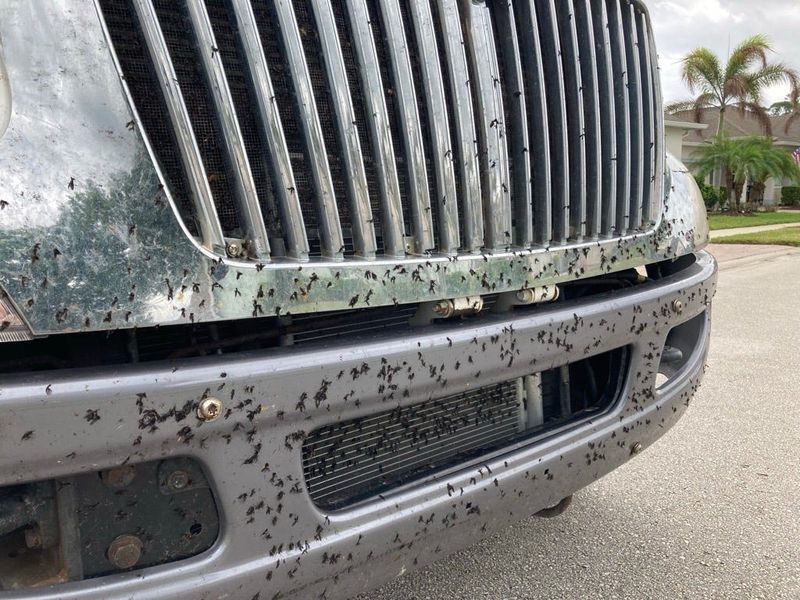
If you’ve been muttering — or maybe it’s a little louder than a mutter — as you’ve been scrubbing the front of your car, there’s no doubt you’ve already encountered the bug Florida residents love to hate.
Lovebugs have been making their presence known around the state, flitting around parking lots, having a fling on our car windows and even bumping into us as they focus on their significant others.

And that’s the good news.
➤ Lovebugs, a fly Florida residents love to hate
For motorists, the evidence of the return of the lovebugs is splattered all over windshields, grills and bumpers.
And if you don’t scrub them off within 24 hours, they could affect your paint.
Here’s what you should know.
What are lovebugs?
Lovebugs are flies related to mosquitoes and gnats, according to the University of Florida’s Institute of Food and Agricultural Sciences.
They have black, slender bodies and a red thorax.
Other common names for lovebugs include March flies, double-headed bugs, honeymoon flies, united bugs, and “some expletives that are not repeatable,” according to Dr. Norman Leppla of the University of Florida’s Entomology and Nematology Department.
When do lovebugs appear in Florida?
Lovebugs generally “appear in excessive abundance” throughout Florida as male-female pairs for only a few weeks every April-May and August-September.
“Although they exist over the entire state during these months, they can reach outbreak levels in some areas and be absent in others. They are a nuisance pest, as opposed to destructive or dangerous, in areas where they accumulate in large numbers.”
Higher temperatures cause adult populations to peak slightly earlier in the southern areas of the state, Leppla said.
How much longer will lovebugs hang around?
The first — sorry, they swarm twice a year — appearance of lovebugs generally is April-May, so we can probably expect a few more weeks of the pesky nuisances, depending on when they first appeared where you live.
Generally, they are only abundant for about two weeks in an area, Leppla said.
On the bright side, there are fewer lovebugs in Florida
“In general, the lovebug, Plecia nearctica, has decreased in abundance at most locations in Florida during about the past four years,” Leppla said via email April 28.
The reason why is unknown.
How long do lovebugs live?
In nature, adult lovebugs live just long enough to mate, feed, disperse and deposit a batch of eggs, about three to four days.
Females lay an average of 350 eggs and up to 600 under decaying vegetation.
The eggs hatch in about 20 days.
Where do lovebugs come from?
There’s a persistent myth lovebugs were created in a lab by University of Florida researchers to control mosquitoes.
➤ Did UF create lovebugs?
Lovebugs are small, slow herbivorous insects that feed on pollen and nectar. They’re active during the day, while mosquitoes are active at twilight or nocturnal.
“For these and many other reasons, the lovebug would be a poor candidate to genetically engineer as a mosquito predator, even if it were possible,” Leppla said.
Lovebugs are not native to Florida or the southern United States.
They reached Florida in 1949 and hit outbreak levels in the 1970s, Leppla said via email April 28.
What attracts lovebugs?
Female lovebugs are attracted to compounds found in automobile exhaust fumes, confusing the chemicals with the odors emitted from decaying organic matter where they like to deposit their eggs.
They’re also attracted by heat, which explains why they’re commonly seen on Florida highways.
They’re also attracted to light-colored and shiny surfaces.
How do you get rid of lovebugs?
Their remains can be removed from surfaces easily if you tackle the job within 24 hours. Don’t leave their remains to bake in the sun, Leppla said.
“Lovebug eggs are somewhat like chicken eggs in not damaging car paint directly. They aren’t acidic or basic, rather it is the action of ‘cooking’ on the paint that causes the damage,” Leppla said.
➤ How to clean lovebugs off your windshield, car, house
Once they’re stuck on though, there are plenty of suggestions on what works:
Leppla’s recommended removal method? “I recommend using wet clothes dryer sheets to remove lovebugs (eggs) from cars as soon as possible.”
How can you avoid lovebugs if you’re driving?
Lovebugs are most dense from 1 to 5 feet above ground, which happens to be the perfect height for being in the way of moving vehicles.
Combine that with the allure of automotive exhaust fumes and the heat from the roads and you have a match not made in heaven for Florida drivers.
There is something you can do, though.
Keep in mind lovebugs do not fly during the night, Leppla said. Peak activity starts at 10 a.m. and they stop flying at dusk.
Lovebugs start flying when the air temperature reaches about 68 degrees. That tip won’t help us as we shift into full Florida summer mode.
Do lovebugs bite? Are they dangerous?
Finally, some good news: Lovebugs do not bite, sting, or transmit diseases and are not poisonous.
They’re also active only during daylight hours and are much less mobile during the early and late daytime hours.
Cheryl McCloud is a journalist for the USA TODAY Network-Florida’s service journalism Connect team. You can get all of Florida’s best content directly in your inbox each weekday day by signing up for the free newsletter, Florida TODAY, at https://news-journalonline.com/newsletters.
This article originally appeared on The Daytona Beach News-Journal: Florida lovebug season is in full swing. How much longer will it last?
Reporting by Cheryl McCloud, USA TODAY NETWORK – Florida / The Daytona Beach News-Journal
USA TODAY Network via Reuters Connect