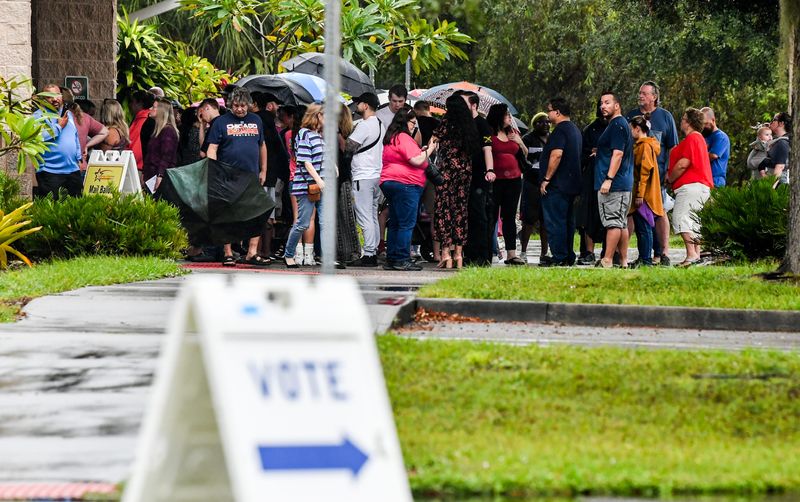
Groups obtaining signatures for marijuana or Medicaid expansion measures for next year’s ballot got an unexpected roadblock from federal judges, who say their First Amendment rights aren’t being violated by a Florida law regulating their conduct.
A sharply divided three-judge panel of the 11th U.S. Circuit Court of Appeals upheld a law that went into effect July 1 (HB 1205) preventing nonresidents and noncitizens from gathering signatures for these measures.

The majority of Barbara Lagoa and Elizabeth Branch, who sided with the state, agreed that the law doesn’t “restrict any speech elements of the petition-circulation process.”
Lagoa and Branch were appointed by President Donald Trump; Lagoa also was on the shortlist to replace former U.S. Supreme Court Justice Ruth Bader Ginsberg, although that spot was ultimately filled by Amy Coney Barrett.
“At most, Florida’s rules for nonresidents and noncitizens ‘collect[ing], deliver[ing], or otherwise physically possess[ing]’ signed petition forms regulate only expressive conduct,” Lagoa wrote. “We say ‘at most’ because we are skeptical that the challenged provisions implicate the First Amendment at all.”
U.S. Circuit Judge Nancy Abudu, a Biden appointee who had been director of legal operations at the ACLU of Florida, disagreed.
Abudu contended that the state had a meager argument that the Florida law covers conduct and not speech. She wrote that argument is “filled with potholes” and completely disregards other court rulings that petition circulation involves “core political speech.”
She also criticized state government, saying Florida was “never one to run out of ideas on how to restrict access to the ballot box and voter engagement.” Abudu wrote that the state “has crafted yet another scheme to limit the ability of their constituent opponents to express their beliefs.”
“Overall, the State’s frontline position represents a drastic departure from First Amendment caselaw and violates the foundational principles upon which the amendment rests,” Abudu wrote in dissent. “If the State prevails, Florida can now criminalize any expressive activity it chooses on the ground that it is the ‘conduct’ portion and not the ‘speech’ it is targeting.”
Florida Attorney General James Uthmeier called the ruling a “win for our Constitution” on his X post Sept. 9. He wrote: “Neither Californians nor Colombians have a right to collect petitions from Floridians who wish to change the Florida Constitution.”
A request for comment is pending from Smart & Safe Florida (adult-use marijuana), one of the petition groups challenging the state’s law regulating signature gathering. Mitch Emerson, the executive director for Medicaid expansion group Florida Decides Healthcare, said in a statement that they’re disappointed in the opinion, but confident in their case and plan to continue “to fight for the people of Florida.”
“By dismissing the First Amendment concerns at stake, the Court ignored clear precedent and the fact that HB 1205 bans entire classes of people from engaging in the core political speech of citizen-led campaigns,” Emerson said.
Other groups involved in the lawsuit are Florida Right to Clean Water, Poder LatinX and the League of Women Voters of Florida.
Groups: Law puts chilling effect on free speech
The opinion comes a year after two major ballot measures failed Florida’s 60% threshold to amend the state’s constitution.
Since the law was signed by Gov. Ron DeSantis, petition groups accused the state of putting a chilling effect on their First Amendment rights to free speech and to petition the government.
The result of this conflict is shown in the lengthy docket history that this case developed in just about four months. Throughout the case, U.S. District Judge Mark Walker has mostly upheld the state’s law, but he specifically drew concern with the provision barring nonresidents and noncitizens from gathering signatures, calling it a “severe burden on political expression.”
The 11th Circuit’s decision comes weeks after Walker handed “complete relief” from that provision to Smart & Safe Florida. The group had said it’s been hindered by the state law.
It asked the judge to block enforcement by not just state officials and supervisors of elections, but also by state prosecutors.
This reporting content is supported by a partnership with Freedom Forum and Journalism Funding Partners. USA Today Network-Florida First Amendment reporter Stephany Matat is based in Tallahassee, Fla. She can be reached at SMatat@gannett.com. On X: @stephanymatat.
This article originally appeared on Tallahassee Democrat: Florida law upheld: Noncitizens can’t gather petitions, federal appeals judges say
Reporting by Stephany Matat, USA TODAY NETWORK – Florida / Tallahassee Democrat
USA TODAY Network via Reuters Connect