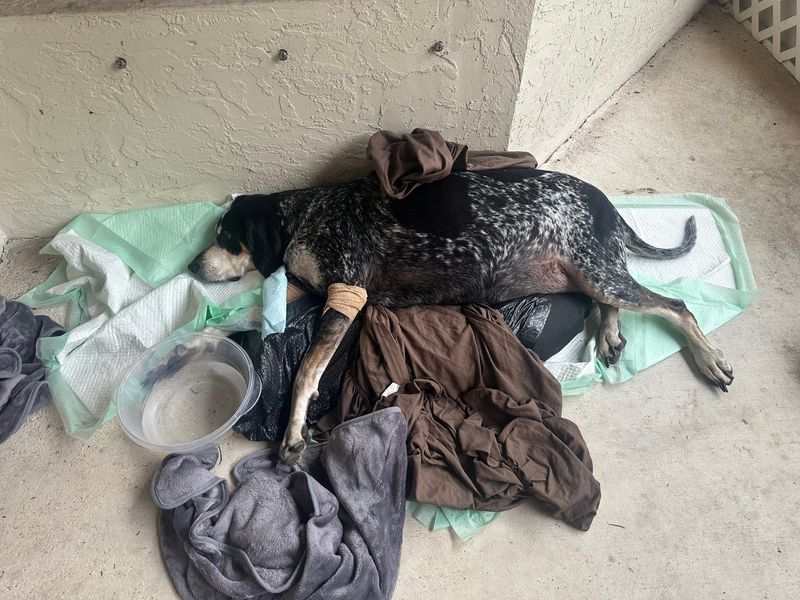
A Florida family’s dog is dead and another partially paralyzed after it’s believed they contracted botulism from eating an iguana that was likely killed during the early February freeze.
Bridget Garrison, who lives in Loxahatchee in Palm Beach County, said she saw her two bluetick coonhounds Tally and Karma playing with something in the backyard on Feb. 12 and later noticed a dead iguana with its arms and legs missing.

Two days later the dogs’ hind ends and back legs were paralyzed. Tally, who was 6 years old, died Feb. 16.
“I just didn’t think about it,” said Garrison, who, like many pet owners, was unaware of the botulism concerns. “Iguanas are in the trees, they died, then the wind shifts, so they are still falling.”
Garrison rushed both dogs to Pet Emergency and Referral Center in Palm Beach Gardens, but there’s no treatment for ingesting the toxin, which first paralyzes the hind legs and can progress to a dog’s lungs and heart with fatal effects.
Why is botulism poisoning a concern for dogs eating iguanas?
Signs of botulism poisoning typically appear 12 to 36 hours after ingestion. There are antitoxins that can be used to treat an animal, but they have to be administered soon after ingestion. It’s also possible that forcing vomiting may help keep some of the toxin from a dog’s system, but that also has to occur almost immediately.
By the time Garrison realized what was happening, it was too late for either measure.
“I still have one pup to take care of,” Garrison said about 8-year-old Karma.
Lynel Tocci, a veterinarian board certified in emergency and critical care medicine, said she was interviewed by a television station ahead of the cold blast the week of Feb. 1 about how to care for pets in frigid temperatures.
She said her biggest concern was the iguanas and the potential for a pet to contract botulism.
“That was my warning message,” said Tocci, who works at Blue Pearl Pet Hospital in Fort Lauderdale. “It’s not the cold. The animals are wearing fur coats. The problem is the botulism and that animals can die if they eat dead iguanas.”
What temperature begins to paralyze iguanas in Florida?
Temperatures between about 40 and 50 degrees can cause iguanas, which are an invasive species in South Florida, to become cold-stunned or temporarily paralyzed. If the temperatures stay cold for too long, it’s a death sentence for the cold-blooded reptile.
During the first week of February, temperatures dropped to near freezing or below freezing deep into the toe of the state. The North County Airport near West Palm Beach hit 28 degrees on Feb. 1. Miami International Airport dipped to 35 degrees. Naples dropped to 37 degrees.
Those temperatures were repeated Feb. 2. And another cold front blew through Feb. 6.
As much as Florida is teased for cold-stunned iguanas falling from trees during winter chills, the iguanas that die stuck in trees may linger for days, or longer, before falling.
“I’m from Massachusetts and first off I had to learn about bufo toads, and then iguanas, now it’s like a dime a dozen,” said Tocci, who as of Feb. 16 had not recently treated a dog with botulism.
What other species could poison pets in Florida?
Bufo toads, also known as cane toads, are an invasive species to Florida whose skin secretes a poisonous toxin that can sicken or kill animals that bite or eat them.
When an iguana dies and its tissues starts to decompose, the bacterium Clostridium botulinum starts to multiply, producing the botulism toxin.
Vultures can feed safely on dead animals even if the toxin is present because they have powerful stomach acids that destroy some of the toxins while concentrating others in their intestines where they further help the vulture digest its meals, according to Audubon.
Garrison’s home is next to a drainage canal in a more rural area of Palm Beach County where lots are more than an acre in size. Because iguanas are good swimmers, they tend to congregate around bodies of water.
But there are still iguanas on the ground in urban areas also. A woman in Riviera Beach, north of West Palm Beach, said on social media on Sunday that she was sitting on her back patio when she heard “the loudest thud.”
“Well now I know what happened to the 5-foot iguana that was living in my backyard oak tree canopy for years,” she said with a picture of a dead iguana on the ground.
There were no estimates of how many invasive iguanas were in Florida ahead of the cold front, and there are no estimates on how many died this month. The last major culling was during a 2010 Arctic blast. Since then, they had become such an expensive nuisance that they were put on the state’s Dirty Dozen list of most damaging invasive species.
Garrison hopes her story will be a warning to other people with pets who may not know the dangers of eating dead iguanas.
“Everyone is telling me they had no idea,” Garrison said.
Palm Beach Daily News reporter Kristina Webb contributed to this story.
Kimberly Miller is a journalist for the USA TODAY NETWORK FLORIDA. She covers weather, the environment and critters as the Embracing Florida reporter. If you have news tips, please send them to kmiller@pbpost.com. You can get all of Florida’s best content directly in your inbox each weekday by signing up for the free newsletter, Florida TODAY, at https://palmbeachpost.com/newsletters.
This article originally appeared on Palm Beach Post: Florida dog dies after eating dead iguana killed during cold weather
Reporting by Kimberly Miller, USA TODAY NETWORK – Florida / Palm Beach Post
USA TODAY Network via Reuters Connect