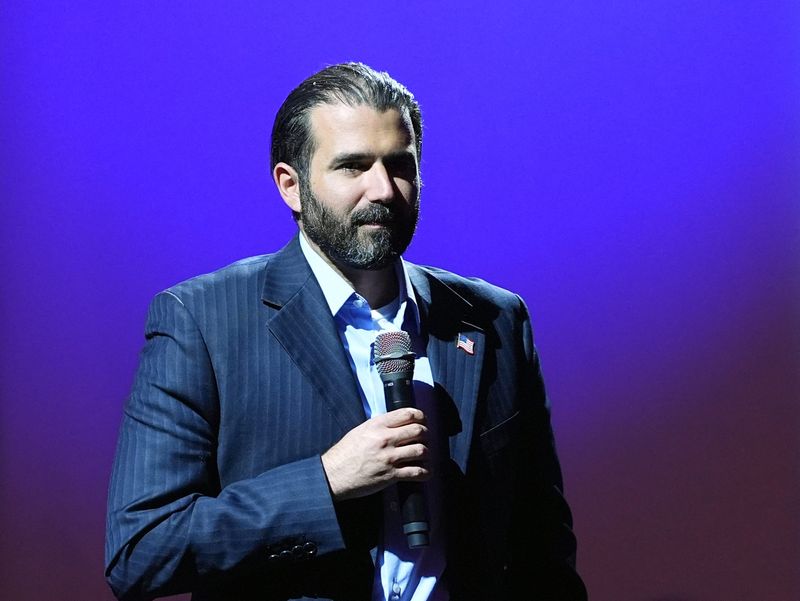
Josh Weil, who lost an April 1 congressional special election in the Daytona Beach area, is announcing he will run for the U.S. Senate seat in Florida on the 2026 ballot.
Weil, a former teacher who attracted endorsements from Bernie Sanders and rapper Killer Mike during that congressional run, says he thinks he can tap into anti-Donald Trump sentiment and raise $100 million to defeat incumbent Sen. Ashley Moody or any other comers.

“I think there’s a really big opportunity here in 2026,” Weil told The News-Journal in a June 17 interview. “We just saw this past weekend with the (No Kings) marches how many people are unhappy, are demanding change. … We’ve seen these actions all throughout our campaign harming people in regards to cuts to Social Security, Medicaid, Medicare, veterans benefits and now we’re seeing with the ICE raids and immigration, just a whole other level of discomfort with these things coming from the American government.”
Weil is launching his campaign as the highest-profile Democrat to have announced for the Senate seat, yet he also faces criticism from within his party’s own circles over how he spent some of the $15 million his campaign raised in the House race.
Who is Josh Weil and how did he rise to prominence?
Weil, 40, had been a public school teacher in the Orlando and Kissimmee area for 12 years until exiting to become a full-time candidate last December. He’s an East Meadow, New York, native who was raised by a single mother. He has degrees from Stony Brook University, Northbrook University and the University of Central Florida, where he earned a master’s degree.
Protecting public education remains one of his key concerns.
“The threat to public education is absolutely real and nowhere in the country more dangerous than in Florida,” Weil said. “We have the lowest per student funding of any state in the country, which means that the money that we receive from the federal Department of Education makes up a larger percentage of our budgets.”
Trump’s efforts to dismantle the federal Department of Education will have disastrous consequences for Floridians, he said.
“That will result in massive school closures, school consolidations and increases in class sizes,” Weil said.
Weil also ran for the U.S. Senate for several months in 2022 before dropping out when Congresswoman Val Demings emerged as the Democratic challenger to Marco Rubio.
The shuffle among Republicans appointed by President Donald Trump to administration jobs also opened the door for Weil’s last race, Florida’s 6th congressional seat, left vacant by Michael Waltz, who resigned to become Trump’s short-lived national security advisor.
Weil announced his run for Congress last December and offered himself as a progressive alternative to the other Democrat in the race, Ges Selmont, who argued the only kind of Democrat who could win the right-leaning 6th was a moderate. But Weil − with the help of an aggressive fundraising consultant, Jackson McMillan of Key Lime Strategies of St. Petersburg − won the Democratic primary with nearly 61%.
Waltz had won Florida’s 6th by 33 percentage points in November, defeating an opponent who had raised almost no money.
After Trump’s inauguration, Weil was able to tap into Democrats’ ire nationwide, arguing that the two open Florida congressional seats represented a possible way to take back the House from Republicans. Rather than competing against Democrats in all 435 districts for donor dollars − as the November 2026 candidates will do − Weil and Gay Valmont in Florida’s 1st District were the only two Democrats running in the spring special election, allowing them to raise considerably more than the typical Florida congressional campaign.
Weil said his own polling showed him ahead at times by 3%, but the money and attention he attracted ultimately motivated Republicans to turnout in higher-than-expected numbers, leading to the election of Trump-endorsed Randy Fine, a former Republican state lawmaker, by 14 points. Nonetheless, the Democratic National Committee hailed Weil’s effort as a “stunning overperformance.”
What does the 2026 Florida Senate race look like?
Aubrey Jewett, a University of Central Florida associate professor of politics and observer of statewide campaigns, said most of the attention on 2026 races is focused on what will be an open governor’s seat, with Congressman Byron Donalds having landed Trump’s endorsement and speculation still centering on the governor’s wife, Casey DeSantis on the Republican side. Newly minted Democrat David Jolly has announced a bid, as has no-party affiliation and former Democratic state Sen. Jason Pizzo.
But the Senate race hasn’t sparked as much talk.
Moody, the former Florida attorney general appointed by DeSantis to fill Rubio’s Senate seat, could draw a primary opponent, with former Congressman and Trump acolyte Matt Gaetz previously floating a potential run. But typically incumbent Republicans don’t face a challenge unless Trump demands it.
“Ashley Moody will presumably be the favorite, since she is the incumbent,” Jewett said. “Historically, you would have a number of Democrats interested because Florida was considered a competitive state.”
As recently as 2018, Florida had a Democratic senator, Bill Nelson. But the state has seen very few Democrats win statewide election and the gap between the GOP and Dems continues to grow. As of May 31, there were 1.3 million more registered Republicans than Democrats in Florida.
None of the Democrats who have filed to run for U.S. Senate have statewide name recognition. One potential candidate looming for Weil and the others is retired Lt. Col. Alexander Vindman, who told CBS News Miami in May that he has been approached and is considering a run. Vindman was the whistleblower who reported hearing Trump demand from Ukrainian President Volodomyr Zelenskyy a quid pro quo, an investigation of future political opponent Joe Biden in exchange for the release of U.S. military aid, which triggered Trump’s first impeachment in 2019.
How did Weil use $15 million, and was it effective?
Weil has faced criticism from Democrats, including Congresswoman Alexandria Ocasio-Cortez.
AOC complained on social media that Weil’s digital campaign was using her words without her permission. At the same time, Parkland shooting survivor and gun activist David Hogg, a former Democratic National Committee co-vice chair, said he sent a cease-and-desist letter to Weil’s fundraising consultant, McMillan, for the same activity.
The Weil campaign spent nearly $4.2 million on Key Lime Strategies between December and April, but Weil said the figure is misleading.
“What most people don’t realize is that Key Lime Strategies laid out the vast majority of our digital spending money for us and we reimbursed them on the back end,” Weil said. “So you know what you don’t see on there is $3 million in Meta ads.”
Campaign starts with a lawsuit threat
Florida congressional candidate Barbie Harden Hall posted on Facebook a lengthy critique of Weil’s 6th District campaign, questioning expenditures she said were ineffective and “irresponsibly milked” Democratic contributors across the country. She cited Federal Election Commission reports, media reports, and social-media posts.
She noted the arrest of a Weil campaign canvasser in Flagler County on felony charges after the Sheriff’s Office alleged she stole a bicycle from a Palm Coast home. Arlecia D. Brown, 35, of Orlando, pleaded no contest to burglary of an occupied dwelling, a second-degree felony, and grand theft, a third-degree felony, and is now serving a 10-year sentence in an Ocala state prison.
Fine − the Republican opponent − made hay of the situation and questioned whether the Weil campaign did background checks on its canvassers. “This is a massive political scandal,” Fine said.
Hall noted that the Weil campaign, which had blamed the third-party vendor, Trailblazing Canvassers, for hiring Brown, did not terminate the company, paying $1.4 million after the arrest and a total of $3.3 million.
Hall, a resident of Mount Dora in the 6th District, ran and lost in the neighboring 11th District in 2024 and is again pursuing that seat in 2026. She endorsed Weil but said she never received a mailer, a phone call from the campaign, or a canvassing visit, despite Weil investing heavily in those campaign approaches.
Hall also posted about how, as the Weil campaign proceeded, a romance appeared to be blooming between him and a campaign staffer, Shawna Busch, who earned $7,000 as a campaign staffer.
After the loss, on April 10, Weil paid Busch a $20,000 bonus. Hall noted no other campaign worker appeared to earn more than a $3,000 bonus.
Hall called the circumstances “problematic.”
“I do not believe that I am the only critical voice that will be coming out. I’m only trying to do so before people again give their hard-earned money towards a lost cause,” Hall wrote.
Weil said he was “disappointed” in Hall’s posts and called them “continued harassment” of Busch, whom he identified as his fiancée.
Asked about paying his fiancée a $20,000 bonus, Weil said there’s no “gotcha” material in his campaign finance report.
“Everything that we filed in our FEC report is completely within compliance. If it’s on the FEC report, that means it was done right and is in compliance with all federal regulations,” Weil said.
After her posts, Weil texted Hall claiming “all” of her statements about him and Busch are “completely untrue,” adding: “I am allowing you until our launch, this Wednesday at 8 a.m., to publish a full apology and retraction or I will be filing civil action against you and I can ensure that it will be highly publicized.”
This article originally appeared on The Daytona Beach News-Journal: Florida Democrat Josh Weil, who lost a House election in April, is running for U.S. Senate
Reporting by Mark Harper, Daytona Beach News-Journal / The Daytona Beach News-Journal
USA TODAY Network via Reuters Connect