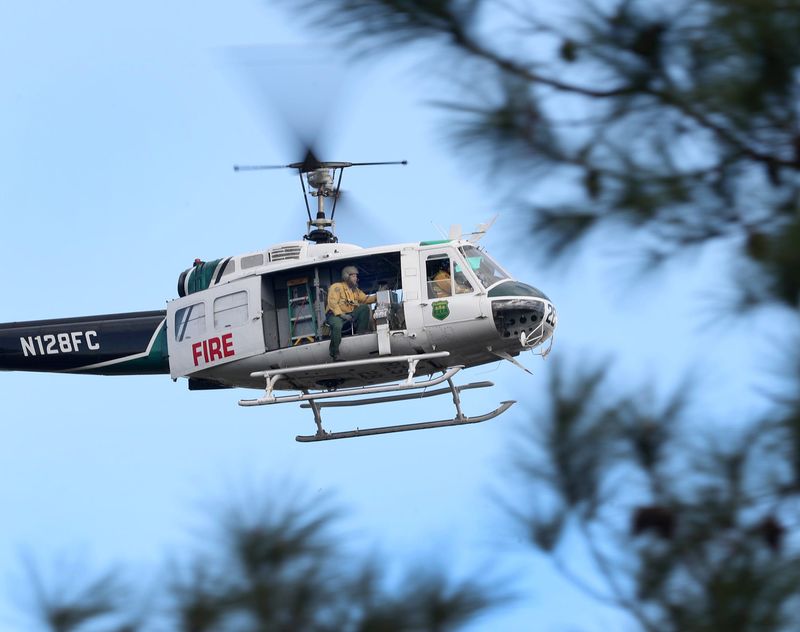
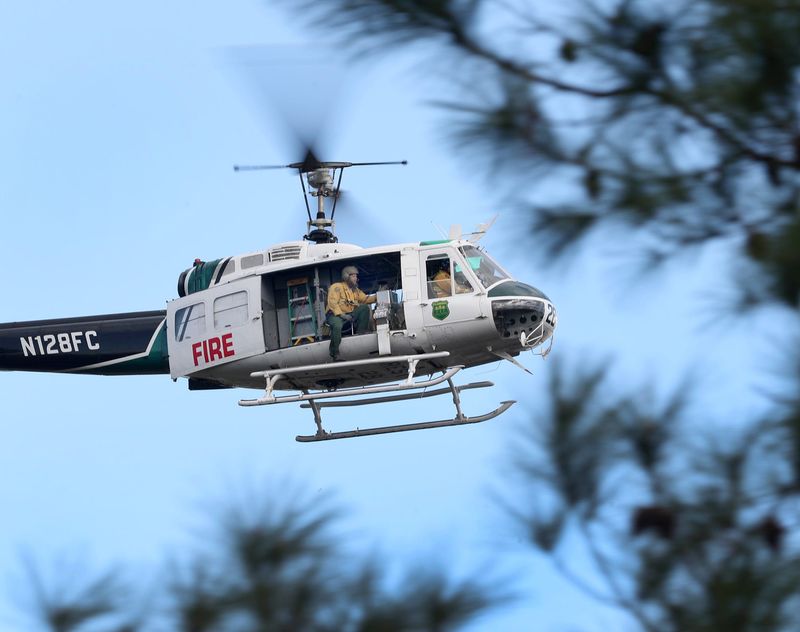
TIGER BAY STATE FOREST — Florida Forest Service Ranger Andrew Walter sat in the open door of the Huey helicopter shooting ping pong-size balls of flammable chemical also known as “dragon eggs,” to the ground below as the big chopper skimmed the tree tops of the forest.
About 20 to 30 seconds later several small columns of smoke and flames rose from the underbrush of the forest floor.

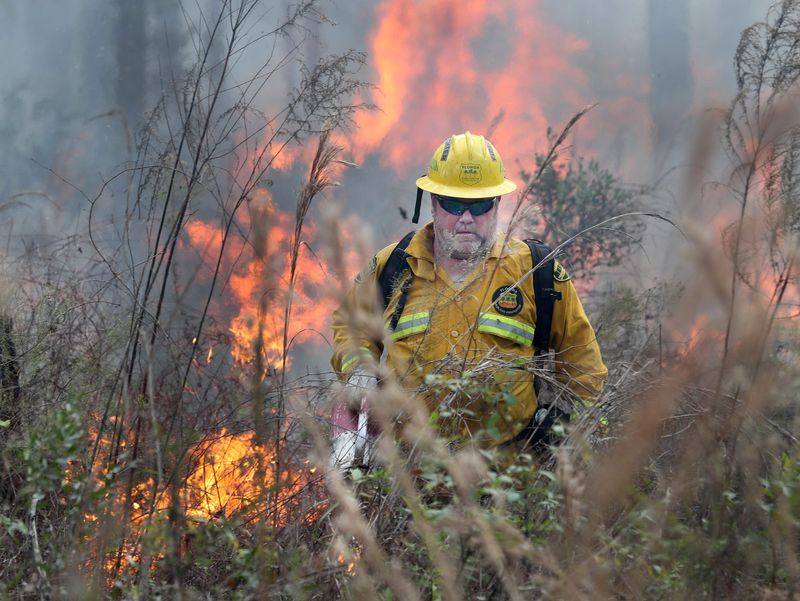
The Huey made several more sweeping passes over the forest along Clark Bay Road and International Speedway Boulevard. Minutes later, numerous small fires sprouted from the floor of the forest. They grew and merged into one large fire spewing orange and red flames as it devoured 1,833 acres of underbrush consisting of grass, palmetto and gallberry.
A huge column of thick black and brown smoke rose into the sky between Daytona Beach and DeLand as hot ashes rained down.
“The balls contain potassium permanganate. They are injected with glycol, which is antifreeze and when the chemicals mix they ignite,” said Camaron Greenlund, operations chief with the Florida Forest Service. “We use this when we have large-acreage prescribed burns.”
When the antifreeze and potassium permanganate mix, the ignition produces temperatures up to 2,500 degrees, Florida Forest Service rangers said.
This area being set on fire was of particular interest to the rangers and targeted for a controlled burn.
In 1998, it was totally consumed by the wildfires that raged through most of Florida, Greenlund said.
Those fires would torch more than 234,000 acres in Volusia and Flagler counties, almost half of the total acreage burned statewide that year, and destroy more than 67 homes in Flagler County and 13 homes, hunting camps and businesses in Volusia County. The fire also postponed NASCAR’s historic July 4 stock car race at Daytona International Speedway until October.
Prescribed burns help prevent wildfires
The prescribed burn last week was the first for the new year and the Florida Forest Service expects to be busy this year clearing underbrush from several areas in Volusia and Flagler counties and around the state. These authorized burns are carried out to remove hazardous vegetation to prevent catastrophic wildfires, said Julie Allen, spokeswoman for the Florida Forest Service Bunnell District.
The Bunnell District includes Volusia and Flagler counties, Allen said.
“The Florida Forest Service issues nearly 90,000 authorizations to burn annually,” she added.
For the year 2020-2021, the Florida Forest Service cleared 838 acres of brush by fire in Volusia and Flagler counties. In the last five years dating to 2016, almost 17,000 acres of underbrush have been burned in the two county area, Allen said.
The largest tracts of state land cleared with fire occurred in the 2018-2019 year when 7,287 acres were torched, Allen said.
Prescribed burns also manage habitat
Like the Florida Forest Service, Volusia County land managers also use prescribed burns to help protect communities and keep life and property safe from wildfires. However, the burns also help manage the habitat of the county’s 38,000 acres of conservation lands, said Cindy Venuti, manager of Volusia County’s conservation lands.
Prior to the influx of people moving to Florida, wildfires started by lightning strikes naturally cleared the underbrush and helped manage the vegetation in Volusia County’s in these areas, according to Venuti.
But now, due to population and the growth of surrounding communities, Mother Nature needs a little man-made spark and a watchful eye to get the job done.
“We cannot let the fires burn naturally anymore, so we mimic nature and purposely set these fires to maintain the habitat,” Venuti said. “There are so many different wildlife species that depend on this habitat for food source, cover, and all other wildlife needs.”
‘It’s got its science’ behind when, where and how to start Florida forest fires
Prescribed burns are anything but simple. Extensive planning goes into the event to ensure that the burn is carried out safely, Greenlund said.
Residents living near the burn areas are first notified, signs warning of fire and smoke are posted throughout the area and rangers keep a close eye on weather conditions. Factors like temperature, humidity, wind speed, drought index and atmospheric stability are closely monitored as they affect the dispersion of smoke from large fires, Greenlund said
“It’s got its science,” Greenlund said.
When a an aerial prescribed burn is called for, a line of fire has to be set first by rangers on foot so that when the “dragon eggs” spark a fire, the flames don’t jump beyond the prescribed area, Greenlund said.
“When we start these prescribed burns, we start with what we call a baseline,” Greenlund said. “What that is, is that we start a line of fire into the wind that provides an extra safety buffer once we put the helicopter in the air.”
The intense preparation was seen last week. Prior to the burn, at least 25 Florida Forest Service rangers and firefighters with Volusia County Fire Rescue, equipped with bulldozers and other firefighting equipment, gathered for a briefing before heading into the woods.
“This is the time of the year that we do prescribed burns because the trees go dormant,” Greenlund said. “We have a little bit more of a stable atmosphere once we get these cold fronts passing through. We have a better window to burn safely.”
The Huey helicopter landed after the briefing for refueling. After refueling, pilot Chris McNeil and Walter tested the chemical-loaded balls to make sure they would ignite. A machine that shoots out the ping pong-size balls was secured on the helicopter, and eight boxes, each containing 1,000 fire balls, were placed onboard the helicopter.
Walter manned the ball-spitting machine and Greenlund sat in the front seat, guiding McNeil over the 1,833-acre perimeter.
But before the helicopter arrived on scene, Senior Ranger John Craig had already hit the ground with drip torches, burning a baseline to contain the fire.
A line of fire followed Craig as he walked on the side of Clark Bay Road burning grass to create a buffer.
“We are backing off this flank so they can drop the drops,” Craig said, as he dripped flames from a torch loaded with 70% diesel and 30% gasoline. “We are getting all this road backed off so the fire doesn’t burn across the road.”
As the rangers opened a line along the side of Clark Bay Road, the helicopter started dropping the incendiary “dragon eggs” into the woods.
Successful burns common among 90,000 set annually
As the helicopter made its sweeping passes, on the ground, Florida Forest Ranger Donald King monitored wind speed and changes in humidity with a handheld weather meter and kept the helicopter crew updated on any atmospheric changes.
“(The meter) is saying (wind speed) about two miles an hour, relative humidity is 52% and temperature is 71,” King said looking at the weather meter while standing in a smoky section along Clark Bay Road. “Everything right now is within range of what we need to do the prescribed burn.”
About 30 minutes after the helicopter made its passes dropping the flammable balls, Florida Forest Service operations commanders drove around feeder roads assessing the progress of the fire and looking for “escapes” — fire jumping the perimeter. Luckily, none were found.
Fire escaping the perimeter is rare, Allen said, adding that “less than 1% of 90,000 burns” in a year have fire escapes.
“You are talking out of 90,000 authorizations far less than 1% of that actually get out of that prescription area,” Allen said. “Florida leads the nation in the number of successful prescribed burns that are conducted annually.”
The operation was a success, Florida Forest Service officials said, as bulldozers and heavy equipment patrolled the roadside on Clark Bay Road.
One concern was how the smoke was going to affect traffic and residents but the wind that day was in favor of the fire rangers.
“The wind is blowing just perfectly,” said Michael Roberts, the Florida Forest Service Area Supervisor for Volusia County. “There is no smoke over on ISB (International Speedway Boulevard). It worked out pretty well.”
This article originally appeared on The Daytona Beach News-Journal: ‘Dragon eggs’ and burning brush: On the front lines of a prescribed burn in a Florida forest
Reporting by Patricio G. Balona, The Daytona Beach News-Journal / The Daytona Beach News-Journal
USA TODAY Network via Reuters Connect