Florida is bordered by only two states — Georgia and Alabama — but a comfortable drive away for those in the Panhandle is Louisiana.
The strongest earthquake in the area for decades hit northwestern Louisiana less than a week ago, followed by several more. The most recent happened Monday, March 9.

Earthquakes do happen in or near Florida, but they’re rather rare since the closest fault line to the Sunshine State runs through the Caribbean Sea, just north of Puerto Rico and the Dominican Republic and south of Cuba toward Guatemala.
Here’s what to know.
Louisiana rattled by strongest earthquake in decades
On Thursday, March 5, residents of Coushatta in northwestern Louisiana were shook by a magnitude 4.9 earthquake.
➤ Louisiana rattled by strongest earthquake in decades
The 4.9 magnitude earthquake was the strongest in the region in decades, U.S. Geological Survey, data showed.
Since March 2, there have been eight earthquakes reported in the same general area, according to the U.S. Geological Survey, with the largest being the one on March 5.
There were four earthquakes on Monday, March 9, with the largest being a 4.4 magnitude west-northwest of Edgefield, Louisiana.
Have any earthquakes been reported in Florida?
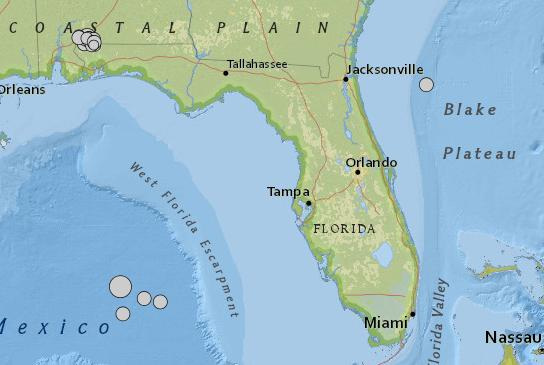
Yes, there have been earthquakes in Florida, with most clustered in the northwestern Panhandle. There have been more than 20 earthquakes reported in Florida since 1992, according to the U.S. Geological Survey.
Other quakes have occurred in the Gulf of America and in Atlantic waters off Florida’s coasts.
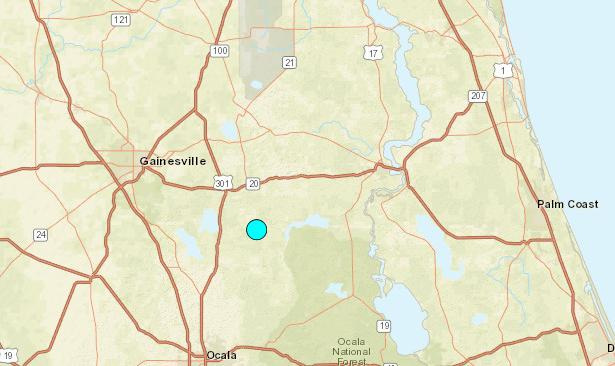
Several “earthquakes” in the Atlantic between Jacksonville and Palm Coast documented by USGC were listed as experimental explosions.
The most recent earthquake reported in Florida was a magnitude 1.8 Sept. 3, 2020, west-northwest of Jay in Santa Rosa County.
What’s the largest earthquake recorded in Florida?
According to the University of Florida, geologists agree the largest earthquake ever recorded in Florida happened on Jan. 12, 1879, about 11:45 p.m. It measured 4.4.
“A pair of 30-second tremors, possibly centered in the Palatka area, sent crockery tumbling off shelves and jolted startled residents awake in a large part of north Florida,” UF said.
“According to news accounts, the quake was felt in Cedar Key, Gainesville, Jacksonville, St. Augustine and Tallahassee, among other cities.”
Looking offshore, an even larger earthquake was felt in Florida after a 5.9 quake occurred under the Gulf of Mexico Sept. 10, 2006. It rocked Southwest Florida.
➤ Forget about hurricanes for a moment. Was there an earthquake off Florida?
More recently, a 4.0 magnitude earthquake was reported about 106 miles east of Cape Canaveral on Feb. 7, 2024.
How many earthquakes are there around the world?
The National Earthquake Information Center reports there are about 20,000 earthquakes around the globe each year, or approximately 55 every day.
As of 10 a.m. March 10, 46 earthquakes of 2.5 magnitude or greater had been reported around the world in the past 24 hours.
The largest within the the past 24 hours was a 6.0 quake west of Anacapri, Italy, followed closely by a 5.9 magnitude earthquake in Otobe, Japan.
The largest in the U.S. over the past 24 hours was a 3.3 magnitude in Bonanza, Oregon.
What do earthquake magnitudes mean?
Magnitude measures the strength of an earthquake.
Unlike hurricane categories, which max out at Category 5 no matter what maximum speeds are over 156 mph, there is no upper limit for earthquake magnitudes, according to Michigan Technological University.
Here is an explanation of earthquake magnitudes and the effects:
What is the largest earthquake ever recorded?
The largest earthquake ever instrumentally recorded — magnitude 9.5 — occurred off the coast of southern Chile on May 22, 1960.
The quake — along with several foreshocks and aftershocks — and the resulting tsunami brought death and destruction as far away as Hawaii, Japan, and the Philippines, according to NOAA.
The number of fatalities in Chile associated with both the earthquake andtsunami has been estimated to be between 490 and 5,700. The Chilean government estimated 2 million people were left homeless.
In Hawaii, the tsunami caused 61 deaths and 43 injuries, NOAA reported.
Two deaths and four injuries were reported along the U.S. west coast from 1- to 2-meter high waves.
The tsunami hit the coast of Japan almost a day after the earthquake, causing 139 deaths and destroying or washing away almost 3,000 houses.
At least 21 people died in the Philippines due to the tsunami.
The global impact of the tsunami led to the creation of the International Tsunami Warning System of the Pacific in 1965.
8 of largest earthquakes reported in or near Florida
Eight of largest earthquakes reported in or near Florida since 1992:
Why aren’t there more earthquakes in Florida?
Florida is among the most geologically stable areas in the United States.
“We have had earthquakes in Florida — and we could have one today — but it’s not as likely as other places,” said Doug Smith, professor of geology and longtime director of the University of Florida’s seismic network in 2000.
He explained earthquakes tend to occur in regions near the boundaries of underground plates or at weaknesses in the plates themselves.
The closest fault line to Florida runs through the Caribbean Sea, just north of Puerto Rico and the Dominican Republic and south of Cuba toward Guatemala.
Florida does not include any plate boundaries, and the plate the state occupies is very stable, he said, adding there are no recent volcanoes and no none active faults in the state.
What area of Florida is most prone to earthquakes?
A region of North Florida bounded roughly by Jackson County in the west, Nassau County in the east and Volusia and Levy counties in the south appears slightly more likely to experience earthquakes than other parts of the state, Smith said.
The reason is the type of rock. Northern portions of the state have granite, with basalt can be found beneath South Florida, Smith said.
How many major earthquakes happen each year?
According to records dating back to about 1900, about 16 major earthquakes happen every year, according to the U.S. Geological Survey.
That includes 15 earthquakes in the magnitude 7 range and one earthquake of magnitude 8.0 or greater.
Cheryl McCloud is a journalist for the USA TODAY Network-Florida’s service journalism Connect team. You can get all of Florida’s best content directly in your inbox each weekday day by signing up for the free newsletter, Florida TODAY, at https://floridatoday.com/newsletters.
This article originally appeared on Florida Today: Does Florida get earthquakes? What to know after Louisiana quakes
Reporting by Cheryl McCloud, USA TODAY NETWORK – Florida / Florida Today
USA TODAY Network via Reuters Connect