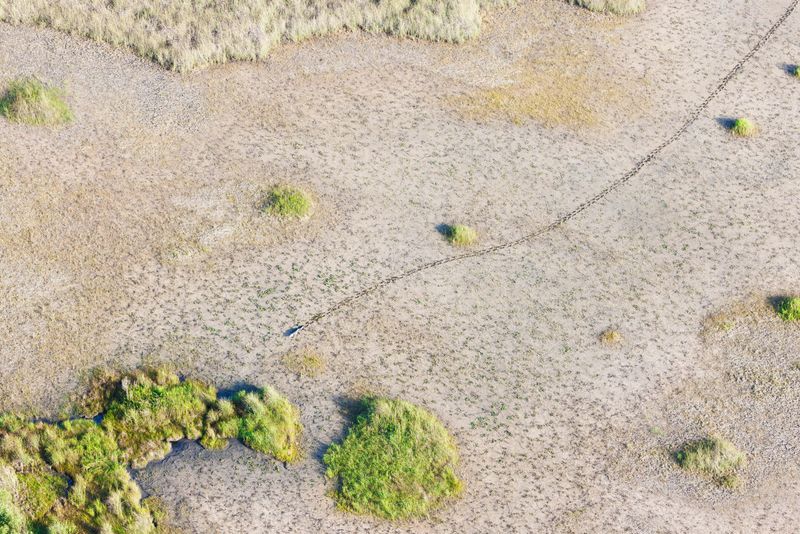
A lonely alligator on a desolate trek, its feet sinking into crusted mud where a shimmer of water should be, is emblematic of this year’s epic drought in the Central Everglades.
The mournful image taken during an aerial survey by South Florida Water Management District wildlife ecologist Mark Cook in early May is stark, a balding landscape where sparse whiskers of green struggle up from sun baked dirt and the gator is swallowed by brown instead of submerged in a cool pond.

Rainfall was less this past water year, a calendar that runs May 1 through April 30. About 45 inches fell in the southern reaches of the Sunshine State where there was 47 the year before and 59 the year before that.
But the prolonged extreme drought that sucked parts of South Florida dry of water and fish and the wading birds that prey on the fish, is not just a product of Mother Nature’s caprice. It is also the result of man’s meddling when dominion over the lush green toe of the state meant decades of slash and drain policies that perverted the fragile flora and fauna of Florida’s iconic River of Grass.
It’s also a potential for redemption with multi-billion dollar projects underway to restore the state’s natural plumbing that once overflowed regularly from Lake Okeechobee in a slow-motion gush to nourish the Everglades.
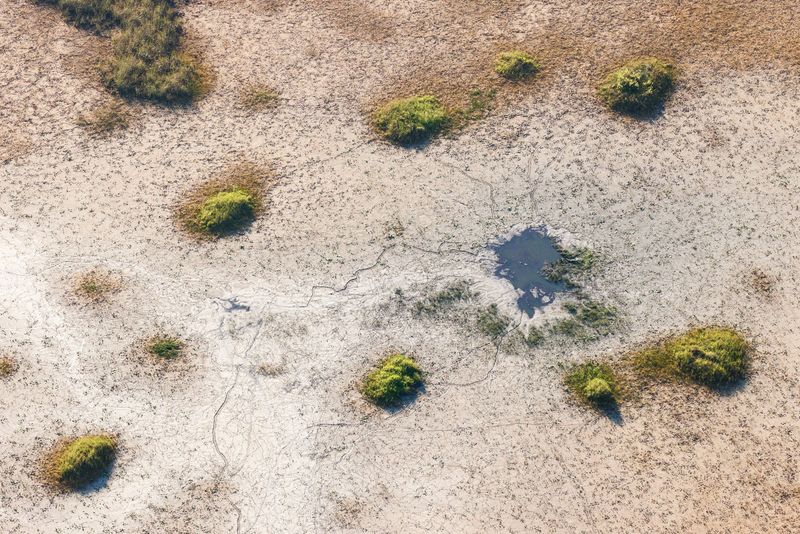
Cook said in an Instagram post highlighting the alligator photo that the environmentally-critical corduroy of elevations in the Everglades has dried down three times in the past five years. Far more frequently than the once every 20 to 30 years reflected in historical record.
“This repeated drying has been highly damaging to the ecology of this ridge and slough environment, as epitomized by these photos of a desperate alligator attempting to find water in this parched landscape,” he wrote.
Florida wading bird nesting is worst in 30 years
And it’s not just the random gator suffering. A dire presentation to the water management board on May 14 described a near apocalyptic scenario for wading birds in some areas of the Everglades and a worry that peat, which is the bedrock of Everglades ecology, is drying up and blowing away.
“There are no birds foraging, there are no birds nesting, there are no fish, there is no prey for the birds to eat,” said Cassondra Armstrong, a bureau chief at the water management district who focuses on ecological conditions. “It’s been pretty devastating for birds and wildlife in this area.”
Surveys have counted 3,500 wading bird nests, well below the 10-year average of more than 47,000. It’s the lowest amount of nesting the district has seen in 30 years.
“All wood stork nests, and most great egret nests, have failed,” Armstrong said. “In fact, there is very little activity anywhere in the Everglades.”
Loxahatchee Refuge offers small respite for South Florida’s wading birds
A notable exception is Water Conservation Area 1, which is the Arthur R. Marshall Loxahatchee National Wildlife Refuge west of Palm Beach County’s Boynton Beach. But even there, the birds are forced to forage in the agricultural fields and urban areas — not the best scenario for longevity, Armstrong said.
One of the most parched regions is a 915-square-mile expanse west of Broward and Miami-Dade counties and north of Everglades National Park. Its technical name is Water Conservation Area 3A, which does little to describe the grandeur of what is the largest remaining remnant of the original Everglades.
Armstrong showed another one of Cook’s aerial photos to board members May 14. It was of an isolated alligator hole—a large divot dug by gators to clear muck and vegetation from an area that creates a mini oasis. This hole was surrounded by a yawning sea of brown dotted with shrubby islands.
“It’s the only refuge,” she said about the gator hole. “It’s the remaining water in that slough.”
Steve Davis, chief science officer for The Everglades Foundation, said even in the face of the ongoing drought, there are areas benefiting from finished restoration projects.
Florida Bay, which needs freshwater flows to keep meadows of seagrass from being poisoned by high salinity levels, is better today than it’s been in lesser droughts. Everglades National Park is better than it was in a comparable drought in 2001. Shark River Slough, a vital conduit of freshwater through the park, is wet and trickling.
“In a sense we are seeing the benefits of restoration even in the midst of this very serious and prolonged drought,” Davis said. “When the faucet shuts of at the top, that puts the system in the condition it’s in.”
This past year, there wasn’t as much water to go around. Lake Okeechobee was at 11.4 feet above sea level as of May 19 when water managers have traditionally liked to keep it between 12.5 feet and 15.5 feet.
Water released into water conservation areas south of Lake Okeechobee was 40% what it was the previous year and 60% less than 2024.
Everglades National Park got 60% less water than last year and 70% less than in 2024.
“Where I usually have 2 to 3 feet of water, I’m walking on dust,” said Donna Kalil, who is a contracted Burmese python hunter for the water management district. “I haven’t seen many areas in the Everglades that have water. It’s pretty much dry everywhere.”
In April, Gov. Ron DeSantis and the U.S. Army Corps of Engineers announced that the construction of a 10,500 acre-reservoir planned in southwestern Palm Beach County will be completed by 2029, which is five years ahead of the original schedule.
The estimated $4 billion Everglades Agricultural Area Reservoir will hold water that can be sent south when needed. It comes with a manmade wetland, called a stormwater treatment area. The wetland cleans urban and agricultural pollutants from the water.
In a shorter timeline, the rainy season is upon South Florida. Since 1963, the median start date for the wet season is May 22, said John Mitnik, South Florida Water Management District Chief Engineer.
“We could have one or two events that completely provide the relief needed,” said Davis, noting that any rain now is too late to save this year’s wading bird nesting. “We are absolutely doing the right things, but it’s hard to manage your way out of drought.”
Kimberly Miller is a journalist for the USA TODAY NETWORK FLORIDA. She covers weather, the environment and critters as the Embracing Florida reporter. If you have news tips, please send them to kmiller@pbpost.com. You can get all of Florida’s best content directly in your inbox each weekday by signing up for the free newsletter, Florida TODAY, at palmbeachpost.com/newsletters.
This article originally appeared on Palm Beach Post: Desperate alligator seeking water becomes face of Florida drought
Reporting by Kimberly Miller, USA TODAY NETWORK – Florida / Palm Beach Post
USA TODAY Network via Reuters Connect