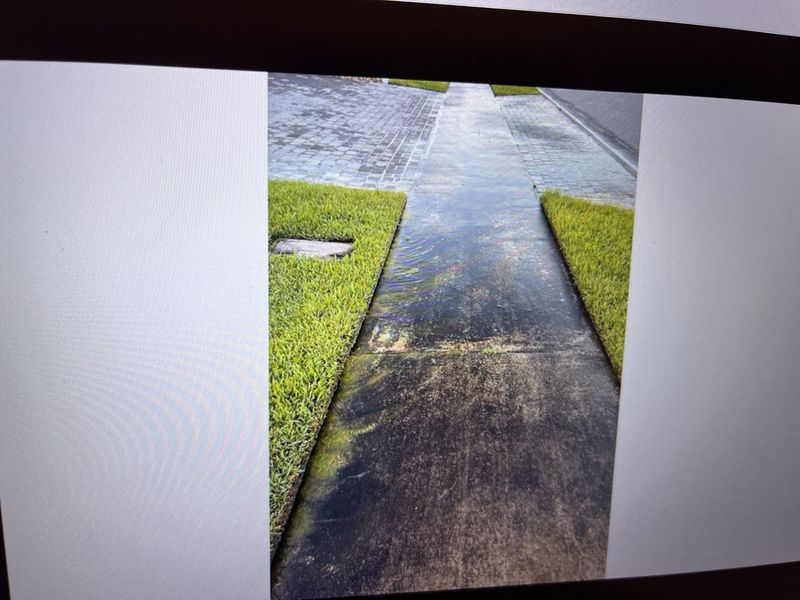
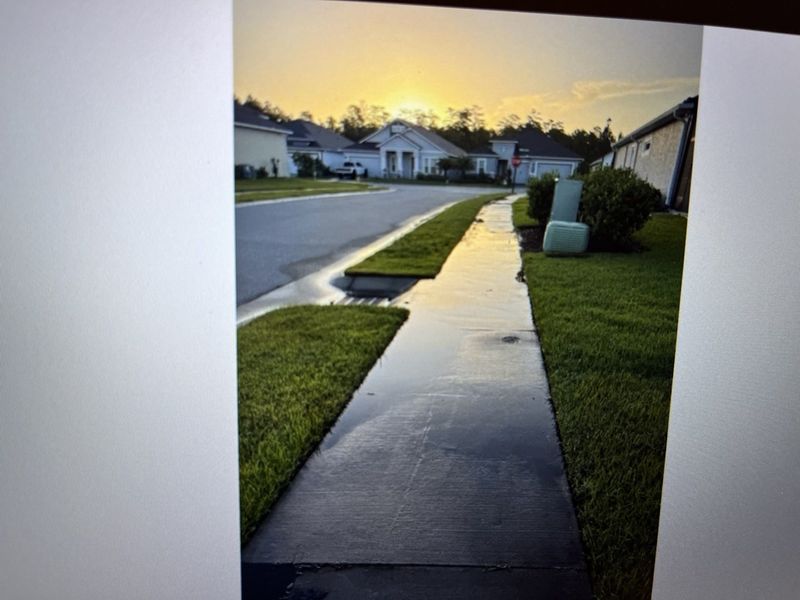
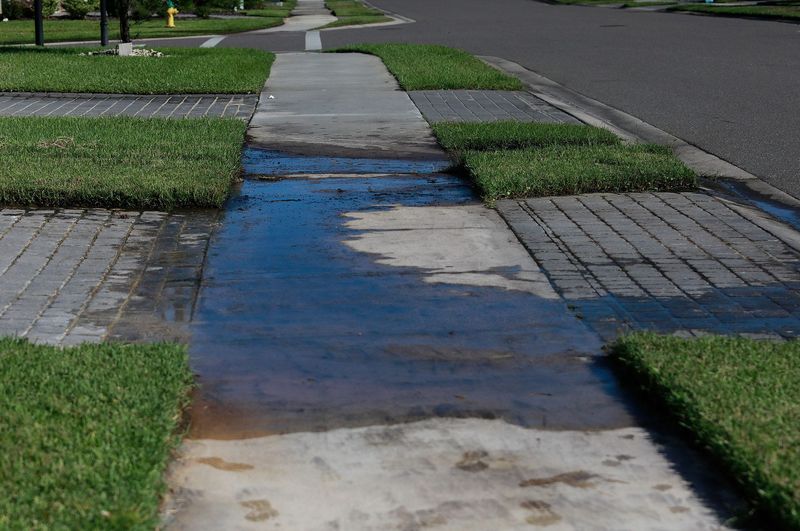
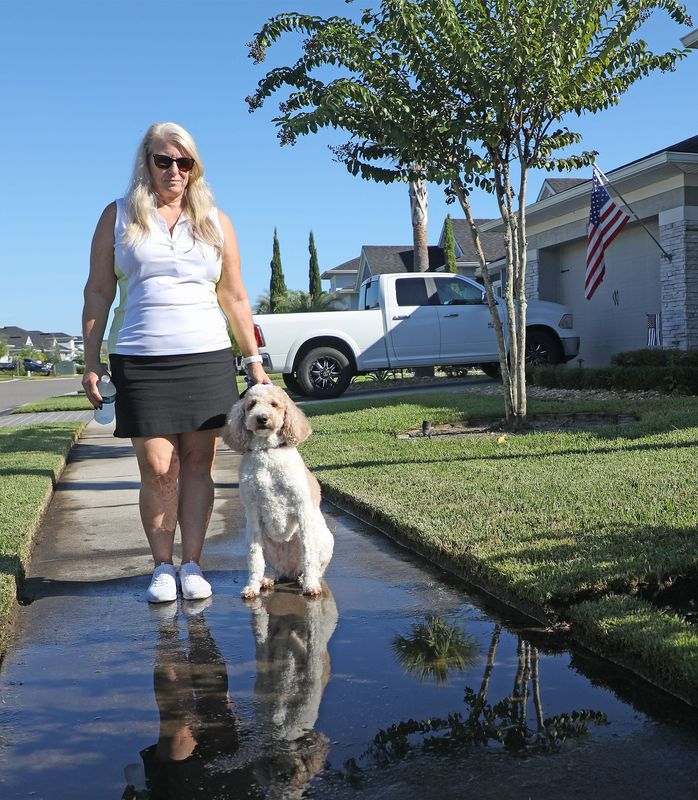
DAYTONA BEACH — Most people figure out that darkened stretches of sidewalks are usually coated with mud that drained out of grass, a slurry of weed killers and water, mold or algae.
They cautiously tiptoe across the stained walkway sections like they’re traversing a sheet of ice, or detour themselves onto the road to avoid the slippery areas.

More than 40 people in the Mosaic neighborhood who thought they could navigate the slick sidewalks in their community just west of LPGA Boulevard have found themselves suddenly slamming down onto the concrete. One woman broke her tailbone during her fall.
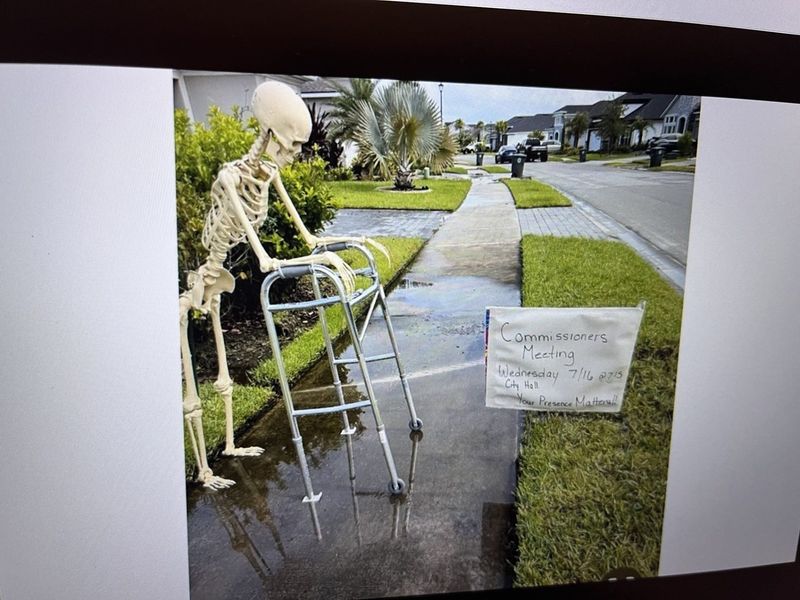
But it’s not just the slimy residue that’s got them angry. They’re convinced the sidewalks weren’t built properly, and they’re either too flat to drain toward the road, or angled toward their houses in a way that traps rain and sprinkler water on the sidewalks themselves.
Dozens of Mosaic residents want to know how the sidewalks ever passed city inspections since there are very specific rules about how many degrees a walkway should be pitched toward a road or yard. The answer in at least some cases might be that there never was an inspection, or the inspections were done haphazardly.
For months, city officials have met with representatives of the neighborhood’s developer, ICI Homes. The two sides have agreed now that extensive sidewalk and driveway reconstruction will be needed.
The city might be on the hook for $1 million for the upcoming work, but it’s still unclear exactly how much money will flow out of City Hall, and how much ICI will contribute.
“To the folks at Mosaic, I’m sorry that you had to experience that,” said Mayor Derrick Henry. “Somewhere along the way, somebody down here (in the Daytona city government) didn’t do their job. We kind of know who it was, but I’m very disappointed. We are going to do our part and do what we have to, to hold them accountable.”
How did the sidewalks pass city inspections?
Under Daytona Beach’s Land Development Code, the city manager holds the power to release or reduce a construction bond. The bond provides a financial guarantee from a surety company that a contractor fulfills their obligations for a construction project.
Current City Manager Deric Feacher, who has been on the job since June of 2021, relies exclusively on city staff members’ recommendations to reduce or release a bond, said Andy Holmes, assistant city manager for infrastructure.
Former Daytona Beach City Manager Jim Chisholm, who served from 2004 until 2021, decided unilaterally whether a bond would be reduced or released, Holmes said. Chisholm also decided whether a newly constructed street or sidewalk would be accepted, he said.
Chisholm oversaw Mosaic sidewalk construction from 2017 until 2021, and there are no city inspection records of that work during that period, Holmes said.
Chisholm could not be reached for comment.
The last four years of work in that neighborhood has been on Feacher’s watch, and Holmes did not indicate that there’s been a problem with city inspection records since mid-2021.
Because Chisholm apparently released bonds on at least some sections of the Mosaic sidewalks residents are complaining about, the city is responsible for the condition of those sidewalks. Whoever ICI hired to do that work is in the clear.
“It’s distasteful to me,” Holmes said. “The city didn’t build any of those sidewalks wrong. But legally, the city signed off on them.”
He said “the right thing to do” is for the city to fix the sidewalks since it’s the city’s responsibility.
The city still has current active performance bonds in place for the sidewalks the builder is responsible for.
“If they don’t fulfill their responsibility, the bond company will finish the work,” Holmes said.
More about ICI Homes, Mosaic
ICI Homes has been building houses in Florida and three other states for more than 45 years, constructing tens of thousands of homes. The company has built everything from affordable villas and townhomes to mansions throughout Florida, Georgia, Tennessee and North Carolina.
ICI has been ranked in the Top 100 Homebuilders in the country for more than a decade.
Headquartered in Daytona Beach, ICI Homes is helmed by CEO and founder Mori Hosseini. He has sat on many powerful boards, including those for International Speedway Corporation, the University of Florida, Embry-Riddle Aeronautical University, Halifax Health Medical Center, and the Board of Governors for the State University System of Florida.
Hosseini has buildings named after him on the ERAU and Daytona State College campuses. He’s a longtime donor to Republican politicians, and is known for his close relationship with Gov. Ron DeSantis.
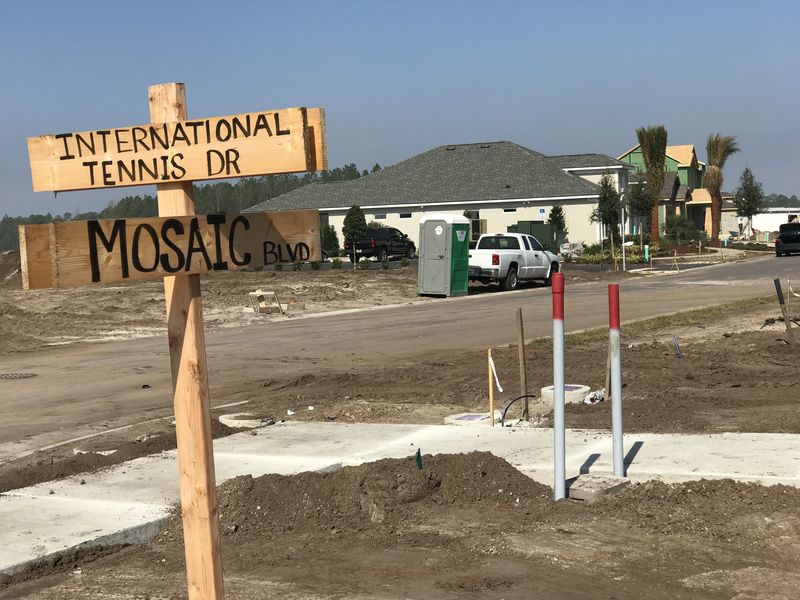
Mosaic is ICI’s only master-planned community in Daytona Beach. Development began in 2017, and the first families moved in the following year.
Since 2018, 523 homes have been completed across five phases, with three additional phases planned that will bring about 611 more homes to the Mosaic community.
“In all of our communities, ICI Homes collaborates with experienced subcontractors to ensure subdivision improvements are completed to the highest standards, consistently meeting or exceeding municipal requirements,” said Nika Hosseini, ICI Homes’ director of corporate strategy.
Something appears to have gone off track with some of the sidewalk construction in Mosaic, however.
“While projects are carefully planned and executed according to established standards, real world application can sometimes yield results that differ from expectations,” said Nika Hosseini, one of Mori Hosseini’s daughters.
She said ICI and the city of Daytona Beach are working together now to plan and implement necessary sidewalk reconstruction.
“We will continue to coordinate closely with city officials, and all work will proceed under the guidance and approval of the city, which serves as the final authority on sidewalk improvements,” she said.
Mosaic sidewalk repairs will take ‘monumental coordination effort’
City Commissioner Stacy Cantu, whose zone includes Mosaic, started hearing about the sidewalk problems last year. She has since jumped in and tried to help the residents.
Cantu has taken one resident who has documented the problems to speak with the city manager and city attorney.
“These residents need answers,” Cantu said. “They want something to be done.”
After multiple meetings and phone calls with ICI attorneys and city attorneys, there is a plan now for a joint repair project. Some of the work will be the city’s responsibility to complete, and some will be the developer’s responsibility, Holmes said.
“It’s not as simple as just going out there with yellow machines and digging up sidewalks,” he said. “You have to figure out who’s responsible for each section.”
The sidewalks that are part of the city’s responsibility have been evaluated, and a detailed scope of work for the contractor is being drafted. A cost estimate has been calculated, and the city is determining what source of funding will be used.
The aprons of homeowners’ driveways will also have to be rebuilt since they need to flow with the new angles of sidewalks. Many of those aprons are made up of pavers, so it won’t be as simple as ripping them out and pouring more concrete.
The city is not responsible for the aprons, Holmes said.
In a few months, city commissioners will vote on the proposed plan for the city’s portion of the work. Commissioners will also have to approve the company that does the reconstruction.
The city and ICI will coordinate so all of the required work happens in the correct sequence and timing.
“It sounds simple, but it’s a monumental coordination effort,” Holmes said. “We’ll coordinate with the developer because they have to do the driveway apron work at the same time we do sidewalks. You can’t leave a trip hazard. It’s two different contractors working at the same time.”
A timeline hasn’t been established yet for when work will begin and when it will wrap up. It’s likely to be done in phases over several months because the sidewalk problems are scattered throughout the subdivision, and if the whole neighborhood is torn up at the same time, driving and parking would become difficult.
Mosaic resident: ‘Who’s sleeping at the city?’
In a neighborhood where homes sell for $440,000 to $1 million, new residents don’t expect to have sidewalk problems. Brenda Fouser certainly didn’t when she and her husband moved into a brand new home in the neighborhood in July of 2021.
“The next year the water kept sitting on the sidewalk,” said Fouser, a retired critical care nurse.
She said the sidewalk in front of her home on Mosaic Boulevard is 1 inch lower than it should be. Another man in the neighborhood said the sidewalk in front of his house is more than 2 inches lower than it should be.
“Who signed off that this sidewalk passed inspection?” Fouser asked. “Had they been doing their job, the city would have caught this. Who’s sleeping at the city and not holding these builders accountable?”
Fouser and her husband have been very happy with their house, but not the drainage around it.
“Our side yards are marshes. The water just sits,” Fouser said.
She started complaining to city officials in 2022. That year she also started filling a binder with pictures and lists of people who have fallen on the Mosaic sidewalks.
“I don’t want a homeowner policy cancelled or insurance premiums raised because someone fell on a sidewalk,” she said.
She received very little response or action from the city until she contacted Cantu about eight months ago.
“I sent seven registered letters and did not receive one response,” Fouser said.
Mosaic sidewalks ‘definitely a danger’
One neighborhood man with an artificial hip wore hiking shoes on his walks thinking the extra tread would protect him on the sidewalks. It didn’t. He slid 3 feet and then plummeted onto the sidewalk.
Nancy Denza, another Mosaic resident, spoke before city commissioners in July to let them know that her husband fell last year on a slippery sidewalk across from their home.
Denza, who was a partner in an Orlando engineering firm, is afraid it’s a matter of time until someone gets seriously hurt on a neighborhood sidewalk, or gets hit by a car walking in the street for better footing.
“This infrastructure never should have been approved,” said Denza, who was also a vice president for a homebuilder.
Marianne Eagan reported to the city in October 2023 that the sidewalk that runs past her property floods and remains slippery even after pressure washing. She was told the problem would be fixed, but one year later she again complained to City Hall that nothing had been fixed.
Now, two years later, the problem lingers. Some residents have resorted to putting orange cones, yellow caution tape and warning signs in front of their houses to alert people to possible peril.
Mosaic resident Mark Perrez said the sidewalks are “definitely a danger.”
“I personally have fallen,” Perrez said. “I’ve injured my back cutting the grass. My kids have fallen several times.”
Another neighborhood resident who spoke at the July commission meeting, an architect, said “I’ve never seen such poor work in my life.”
You can reach Eileen at Eileen.Zaffiro@news-jrnl.com
This article originally appeared on The Daytona Beach News-Journal: Daytona could be liable for $1M in repairs after signing off on sidewalks years ago
Reporting by Eileen Zaffiro-Kean, Daytona Beach News-Journal / The Daytona Beach News-Journal
USA TODAY Network via Reuters Connect